Plastics & Polymers

Search documents
Loop Industries(LOOP) - 2026 Q3 - Earnings Call Transcript
2026-01-15 14:47
Financial Data and Key Metrics Changes - Cash operating expenses for the quarter were $2.2 million, reflecting a year-over-year decrease of $1.1 million [11] - Total liquidity available at the end of the third quarter was $7.7 million, which is expected to continue decreasing in the coming quarters [11][12] - The company has managed to reduce cash operating expenses significantly, with further opportunities for reduction already locked in [15] Business Line Data and Key Metrics Changes - The Infinite Loop India project is on budget and on schedule, with a supply contract executed with Nike as an anchor customer [3][4] - The facility in India is expected to have between five to six customers total, with ongoing negotiations for additional offtake agreements [27] - The textile-to-textile recycling segment is becoming a significant growth driver due to new European regulations mandating recycled content in clothing [4][8] Market Data and Key Metrics Changes - 66% of all PET and polyester manufactured globally comes from the polyester textile side, amounting to approximately 85 million tons per year [8] - The demand for textile-to-textile recycling is increasing as European regulations are set to be enforced starting in 2028 [7][8] Company Strategy and Development Direction - The company is focused on raising the remaining financing required for its equity contribution to the ELITE project and for operating expenses until the Indian facility starts up [12] - The partnership with Reed Société Générale Group is progressing, with site selection for a plant in Europe narrowing down to three potential sites [10][11] - The company is leveraging low-cost manufacturing in India to maintain competitive pricing and reduce capital expenditures [48][66] Management's Comments on Operating Environment and Future Outlook - Management expressed confidence in the financing and progress of both the Indian and European projects, anticipating meaningful revenue and profitability from engineering fees [16] - The company is well-positioned to capitalize on the growing demand for recycled materials due to regulatory changes in Europe [8][9] - Management highlighted the importance of their unique low-temperature depolymerization technology in overcoming recycling challenges [6][7] Other Important Information - The Indian facility is scheduled for construction completion by the end of 2027, aligning with the enforcement of new regulations [8][36] - The debt package for the Indian project is $130 million, with Loop required to provide an equity component of approximately $28 million [49][50] Q&A Session Summary Question: How much of the facility in India is under contract? - Management expects to have between five to six customers for the facility, currently having Nike and Tyrell Plus, with negotiations ongoing for additional customers [27] Question: Are pricing and margins similar for textile and packaging? - Management indicated that textile currently commands a higher premium due to regulatory pressures, but both segments are comparable in pricing [28][30] Question: What is the size of the German plant? - The German plant will have a capacity of 70,000 tons, similar to the Indian facility [45] Question: What is the size of the debt package for India? - The debt package for the Indian project is $130 million, with Loop providing an equity component of approximately $28 million [49][50] Question: What is the expected payback period for the Indian facility? - The payback period for the plant in India is expected to be less than three years [69]

液晶聚合物(LCP)薄膜行业趋势洞察:全球市场规模、分类和应用市场情况及预测
QYResearch· 2026-01-08 08:58
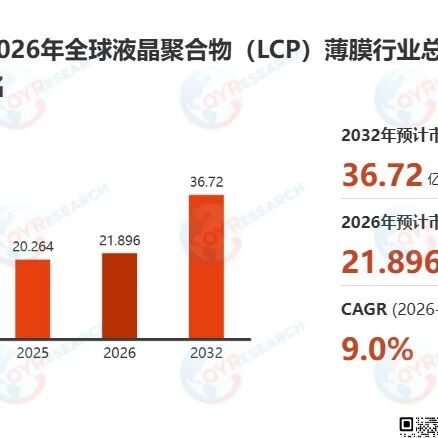
Core Viewpoint - The global liquid crystal polymer (LCP) film market is projected to reach USD 460 million by 2031, with a compound annual growth rate (CAGR) of 13.3% in the coming years [3]. Market Size, Classification, and Application - The LCP film market is expected to grow significantly, with the high melting point grade currently holding approximately 62.7% market share [7]. - Antennas are the primary demand source for LCP films, accounting for about 37.1% of the market [9]. Industry Development Trends - High-frequency and high-speed applications are becoming core growth points, with LCP films penetrating areas such as antennas, RF front ends, and semiconductor carriers due to their low dielectric constant and excellent dimensional stability [11]. - The trend towards thinner, more flexible, and higher precision products is evident, with LCP films evolving towards ultra-thin (≤12μm) and high flexibility to meet the needs of foldable phones and wearable devices [12]. - Manufacturing processes are shifting from "capable of production" to "high yield mass production," focusing on stability and yield rates [13]. - The localization and regionalization of supply chains are accelerating, with China and Southeast Asia increasing LCP film production lines to reduce reliance on traditional Japanese suppliers [14]. Market Drivers - Rapid advancements in high-frequency communication technologies are driving demand for LCP films, which are critical for 5G RF modules and satellite communications due to their low dielectric loss and high-frequency stability [16]. - The trend towards miniaturization and lightweight electronic devices is increasing the demand for flexible and high-strength materials like LCP films [17]. - The automotive and transportation electronics sectors are seeing a rise in demand for reliable materials, with LCP films being favored for their durability and stability in high-frequency applications [18]. - The need for high-reliability materials in high-end manufacturing and new energy sectors is pushing LCP films into applications in aerospace and industrial automation [19]. Market Challenges - Key technologies and raw materials for LCP films are concentrated among a few suppliers, creating barriers for new entrants [21]. - There are high requirements for performance consistency and batch stability, necessitating significant investment in process optimization and reliability verification [22]. - The cost structure of LCP films is high, with challenges in reducing costs while maintaining quality, leading to difficulties in penetrating lower-end applications [23]. - Rising competition from alternative materials in certain applications poses a threat to the expansion of LCP films [24].

Origin Materials(ORGN) - 2025 Q3 - Earnings Call Presentation
2025-11-13 22:00
Third Quarter 2025 Earnings Call Enabling the world's transition to sustainable materials USE OF PROJECTIONS. This presentation contains Origin's projected financial information. Such projected financial information is forward-looking and is for illustrative purposes only. It should not be relied upon as being indicative of future results. The assumptions and estimates underlying such projected financial information are inherently uncertain and are subject to many significant business, economic, competitive ...

Tredegar Q1 Earnings Down Y/Y as Aluminum Costs Weigh on Margins
ZACKS· 2025-05-14 18:45
Core Insights - Tredegar Corporation's shares have increased by 3.8% since the earnings report for Q1 2025, underperforming compared to the S&P 500's 4.5% growth during the same period [1] - The stock has shown a significant increase of 15.8% over the past month, outperforming the S&P 500's 8.8% growth [1] Financial Performance - For Q1 2025, Tredegar reported a net income from continuing operations of $0.02 per share, down from $0.08 per share in Q1 2024 [2] - Adjusted net income from ongoing operations decreased to $0.10 per share from $0.14 per share year-over-year [2] - Net sales reached $164.7 million, marking a 14.4% increase from $144 million in the same quarter last year [2] Segment Performance - **Aluminum Extrusions (Bonnell Aluminum)**: - Net sales increased by 17% year-over-year to $133.6 million, driven by a 12% rise in sales volume and higher metal costs [4] - EBITDA from ongoing operations fell by 27% to $9.2 million due to unfavorable sales mix, increased input costs, and higher labor and maintenance expenses [4] - Specialty products saw a volume growth of 52.8%, primarily from solar panel applications [4] - **PE Films**: - EBITDA improved by 8.9% to $7.5 million despite a 4% drop in sales volume [5] - Net sales increased by 3.2% to $25.5 million, supported by strong performance in surface protection films [5] Management Commentary - CEO John Steitz highlighted a recovery in Bonnell Aluminum, with a 36% year-over-year increase in net new orders, reaching the highest open orders in two years [6] - The new Section 232 tariffs on aluminum imports are expected to help regain market share lost to underpriced imports [6] - On PE Films, management anticipates normalization in demand in subsequent quarters, remaining cautious about global trade developments [7] Cost and Expense Analysis - The decline in Aluminum Extrusions' EBITDA was attributed to a lower spread between selling prices and metal costs, unfavorable manufacturing yields, and increased labor and maintenance expenses [8] - SG&A costs in this segment rose by 38.5%, primarily due to compensation, travel, and consulting fees [9] Guidance and Financial Position - For 2025, Tredegar forecasts capital expenditures of $17 million for Bonnell Aluminum and $3 million for PE Films [11] - Total debt decreased to $56.6 million as of March 31, 2025, from $61.9 million at the end of 2024, with a net leverage ratio of 1.1x [12] Other Developments - The company completed the sale of its Terphane business, resulting in a $9.4 million gain from discontinued operations [13] - Restructuring activities included the closure of the Richmond, VA, PE Films technical center [13]