
Urban Renewal

Search documents
官宣:狂砸2200亿!今年,广州旧改要变天!
Sou Hu Cai Jing· 2026-02-26 13:29
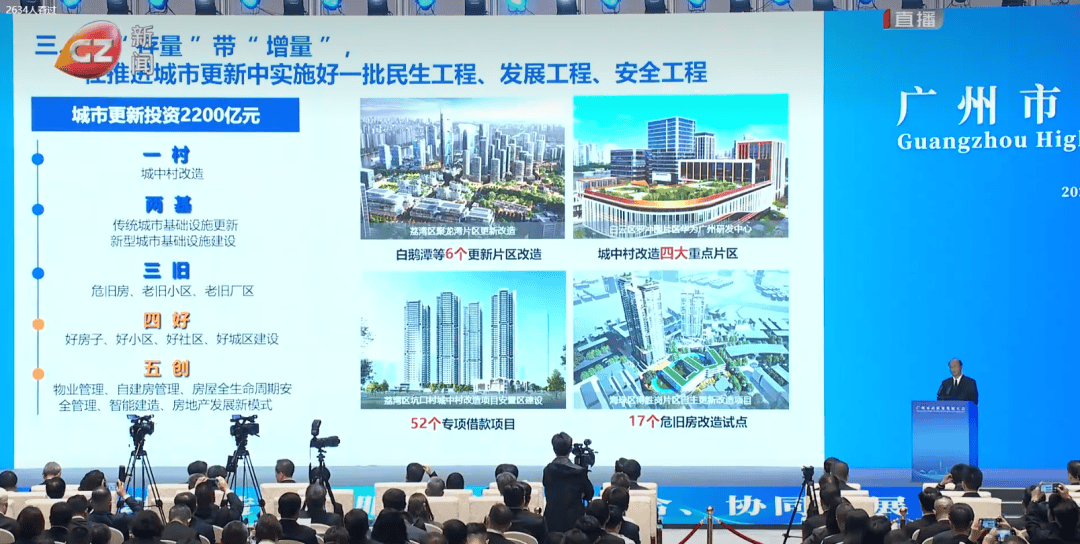
Group 1 - The core objective announced by Guangzhou is to invest 220 billion yuan by 2026 for urban renewal projects, an increase from the previous budget of 200 billion yuan [1] - The investment will focus on six urban renewal areas, four key urban village renovation areas, 52 special loan projects, and 17 pilot projects for the renovation of dilapidated houses [1][3] - The six urban renewal areas include Shamen, Baie Tan, and Guangzhou North Station, while the four key urban village renovation areas include Guangzhou Railway Station area, New Central Axis Haizhu area, Luochongwei area, and Huan Wushan Innovation Source area [3] Group 2 - The residents in these targeted areas are expected to benefit from the urban renewal initiatives, positioning them favorably for future real estate opportunities [3] - Baie Tan has emerged as a key area for real estate investment, attracting significant attention from potential homebuyers [5]

实施10大行动 更新10个片区
Xin Lang Cai Jing· 2026-02-24 22:23
Core Insights - The province will implement 10 major actions focused on urban renewal and infrastructure improvement, including the construction and renovation of over 4,000 kilometers of urban underground pipelines in 2026 [1][2]. Group 1: Urban Renewal Actions - The province will establish an urban renewal database, prioritizing cities for updates and aiming to secure funding from central government sources [1]. - A comprehensive city health check will be conducted for 16 cities, with plans to extend this to county-level cities, ensuring a thorough understanding of urban conditions [1]. - The province will focus on the renovation of existing buildings, including the transformation of old factories and underutilized commercial properties [1][2]. Group 2: Community and Infrastructure Development - There will be a strong push for the renovation of old urban residential communities, including the installation of elevators in suitable buildings [2]. - The initiative will include the establishment of complete community units within urban areas, with around 20 pilot projects in designated cities [2]. - Infrastructure improvements will focus on essential services such as gas, water supply, and sewage systems, alongside the enhancement of public service networks [2]. Group 3: Cultural and Environmental Preservation - A historical and cultural resource survey will be conducted to identify and protect significant cultural sites and buildings within the province [3]. - Efforts will be made to enhance urban ecological spaces, including the development of greenways and community parks [2][3].
天河员村开拆!记者实探最新进展,金融城西区交通瓶颈将解?
Nan Fang Du Shi Bao· 2026-02-14 11:08
Group 1 - The demolition work around the Yuan Village Zifu New Village area in Tianhe District, Guangzhou, officially commenced on February 13, marking a significant step in resolving the long-standing "dead-end road" issue in the Guangzhou International Financial City West District [2] - The West District of the Financial City serves as a crucial link connecting key areas such as Zhujiang New Town, Guangzhou International Financial City, and Pazhou, but has faced traffic bottlenecks due to the incomplete Flower City Avenue and persistent congestion on Yuan Village Second Cross Road [2] - The Tianhe District's major project work meeting in January revealed plans to accelerate the connectivity of the "six horizontal and seven vertical" skeleton road network, ensuring substantial progress on key projects like the eastern extension of Flower City Avenue and Yuan Village Second Cross Road within the year [2] Group 2 - The skeleton road network in the Financial City West District encompasses 10.94 hectares of various land uses and approximately 137,100 square meters of existing buildings, serving as the backbone of the transportation network and a vital artery for urban renewal efforts [4] - The area surrounding Yuan Village Zifu New Village includes a total of 63.5625 acres of land, featuring 30 shops, 3 express delivery transfer stations, and 1 agricultural market, which has been a popular food gathering place known for its late-night food stalls [4] - As of February 14, many vendors in the Chengjie Agricultural Market have vacated their stalls, with only a few remaining to clear out their inventory before the impending demolition [6][8]
北京一季度推动160个重大项目开工,总投资约5188亿元
Zhong Guo Xin Wen Wang· 2026-01-16 00:39
Core Viewpoint - Beijing aims to boost consumption, expand investment, strengthen industries, and stabilize expectations through six key initiatives, targeting a strong start in the first quarter of the year [1] Investment Expansion - Beijing plans to initiate 160 major projects in the first quarter with a total investment of approximately 518.8 billion yuan, focusing on four key areas [1] - In the modern industrial system construction sector, 36 projects, including the AI Innovation District and Cultural Intelligence District, are set to commence [1] - For modern infrastructure development, 55 projects, such as the overall enhancement of the road network in the northern area of Zhongguancun Science City, will begin [1] - In the area of public welfare, 45 projects, including the Beijing Sixth Experimental School, are planned [1] - The city will also focus on urban renewal, with 24 projects like the protective renovation of pilot courtyards in Dongcheng District [1] Confidence and Expectation Stabilization - Beijing will implement measures to stabilize expectations and boost confidence, with plans to introduce initiatives for economic stability by 2026 [1] - The city will release policies to support the construction of the Beijing-Tianjin-Hebei International Science and Technology Innovation Center, enhance contract R&D for innovative drugs, and promote high-quality development in the animation industry [1] - There are plans to quickly publish guidelines for funding applications in various fields, including high-precision industries, ultra-high-definition technology, AI applications, and new consumption models [1]
发力三大核心领域,2025年92个城市更新项目落地泉城
Qi Lu Wan Bao· 2026-01-15 08:23
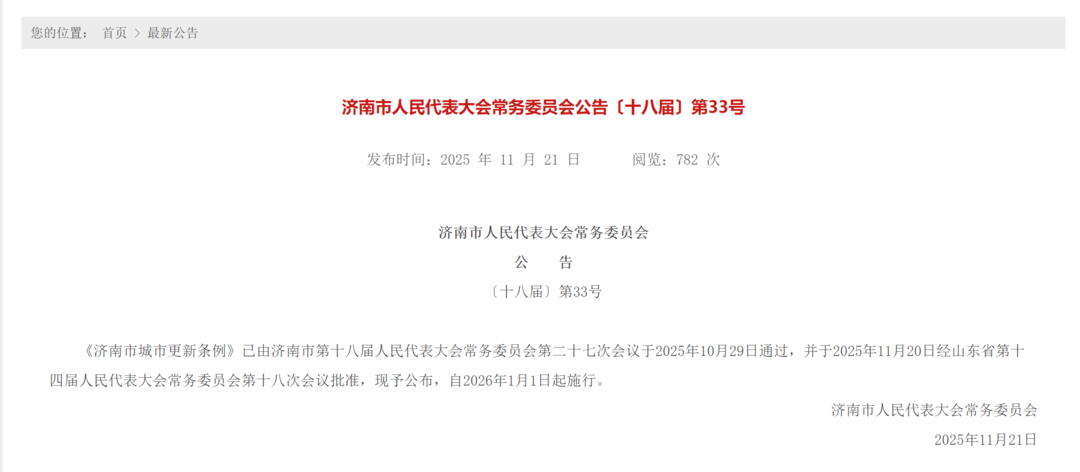
Group 1 - The core focus of Jinan's urban renewal strategy is to enhance urban capabilities and improve residents' well-being by 2025, with an emphasis on institutional development, project advancement, and financial support [1] - Jinan has been selected as a city for the 2025 Central Government's urban renewal action support and is included in the National Development Bank's urban renewal loan pilot program, with two projects recognized as national models [1] - The city has established a comprehensive regulatory framework for urban renewal, including the first local regulation in the province, the "Jinan Urban Renewal Ordinance," which will take effect on January 1, 2026 [3] Group 2 - In 2025, Jinan plans to accelerate urban renewal projects, launching 92 projects that will significantly improve living conditions for 48,000 households through the renovation of urban villages and old residential areas [7] - The city has completed significant infrastructure upgrades, including the renovation of 87.4 kilometers of heating pipelines and 99.7 kilometers of aging gas pipelines, enhancing urban safety [7] - Jinan is exploring diverse funding mechanisms for urban renewal, securing 1.51 billion yuan in bank credit for six pilot projects and actively seeking support through long-term special bonds [7]
都市评:三元里村旧改终迎破局,“三个率先”带来解题新思路
Nan Fang Du Shi Bao· 2025-08-25 14:43
Core Insights - The urban renewal project in Sanyuanli Village, Guangzhou, has officially commenced after 25 years of planning, marking a significant milestone in the city's development [2][5] - The project involves a total investment exceeding 20 billion yuan, covering an area of approximately 71.45 hectares, and aims to enhance living conditions and urban infrastructure [5][6] Group 1: Project Overview - The Sanyuanli urban renewal project began on August 23, with the construction of resettlement housing and the demolition of the old village [2] - The project is strategically located near key transport hubs, including the Guangzhou Railway Station, and aims to alleviate traffic congestion through infrastructure upgrades [5] - The initiative has received strong community support, achieving a 95% consent rate for the redevelopment plan [5] Group 2: Development Strategy - The project will utilize a model of "legal expropriation, net land transfer, and government leadership," ensuring stable funding and reducing risks associated with developers' financial chains [6] - The first phase includes the construction of 594 resettlement units, with demolition and construction occurring simultaneously to ensure transparency and community engagement [6] - The urban renewal is not just about physical reconstruction but also aims to reorganize and regenerate urban functions, reflecting a broader trend in urban development [6]

我省印发《关于支持实施城市更新行动若干政策措施》
Hai Nan Ri Bao· 2025-06-01 23:34
Core Viewpoint - The Hainan Provincial Government has issued a set of 20 policy measures across five categories to support urban renewal actions, aiming to create a comprehensive policy framework for urban renewal initiatives [2][3]. Group 1: Policy Framework - The policy measures enhance planning guidance, improve land supply security, innovate project supervision models, and strengthen multi-channel funding guarantees [2]. - Local governments are encouraged to develop urban renewal special plans based on the overall land use planning, ensuring orderly progress in urban renewal efforts [2]. Group 2: Land Use and Transition Policies - A transitional policy for the conversion of existing land use is introduced, allowing existing buildings to be repurposed for new industries and business models under certain conditions, with a five-year transition period [3]. - After the transition period, any necessary land use changes must be processed at market rates through agreements [3]. Group 3: Operational Models and Community Involvement - The policy explores integrated operational models for urban renewal, including unified planning, implementation, and operation across projects [3]. - It encourages the participation of private enterprises and social capital in urban renewal projects through various collaborative methods [3].