《可可托海的牧羊人》

Search documents
新时代党的治疆方略的成功实践白皮书丨新时代党的治疆方略的成功实践
Xin Hua She· 2025-09-20 04:17
Core Viewpoint - The white paper titled "Successful Practices of the Party's Governance Strategy in Xinjiang in the New Era" outlines the historical and contemporary governance strategies of the Chinese Communist Party (CCP) in Xinjiang, emphasizing social stability, national unity, and economic development as key objectives. Historical Governance Experience - The governance of Xinjiang has historically been placed within the broader context of national governance, emphasizing the importance of maintaining territorial integrity and social stability [10][11][12]. - The concept of a unified nation has been a guiding principle, with various historical regimes implementing governance structures that promote integration and development in Xinjiang [12][13]. - Development initiatives have been a consistent focus, with historical efforts in agriculture, infrastructure, and trade contributing to the region's growth [14][15]. CCP's Governance Journey - The CCP has actively engaged with the people of Xinjiang since its inception, focusing on liberation, social reform, and modernization [18][19]. - Significant milestones include the establishment of the Xinjiang Production and Construction Corps and the formation of the Xinjiang Uyghur Autonomous Region, marking pivotal moments in the region's governance [20][21]. New Era Governance Strategy - The governance strategy in the new era has been shaped by a comprehensive understanding of Xinjiang's strategic importance, with a focus on social stability and long-term peace [24][25]. - Key elements of the strategy include promoting national unity, enhancing cultural integration, and ensuring economic development that benefits all ethnic groups [27][29]. Social Stability and Long-term Peace - The strategy emphasizes the importance of combating separatism and terrorism, with significant achievements in maintaining social order and stability [32][33]. - Legal frameworks have been established to support anti-terrorism efforts, ensuring that governance is conducted within a legal context [34][30]. Construction of a Shared National Identity - Efforts to build a shared national identity among various ethnic groups have been prioritized, fostering a sense of community and mutual support [37][38]. - Cultural initiatives aim to enhance the appeal of mainstream values and promote a cohesive national narrative [39][40]. Democratic and Legal Development - The development of a democratic framework has been emphasized, with a focus on ensuring representation and participation from various ethnic groups in governance [42][43]. - The establishment of a comprehensive democratic system aims to enhance the legitimacy and effectiveness of governance in Xinjiang [43].
音乐人扎堆!2025年新疆演艺市场何以火热?
Zhong Guo Xin Wen Wang· 2025-08-27 10:34
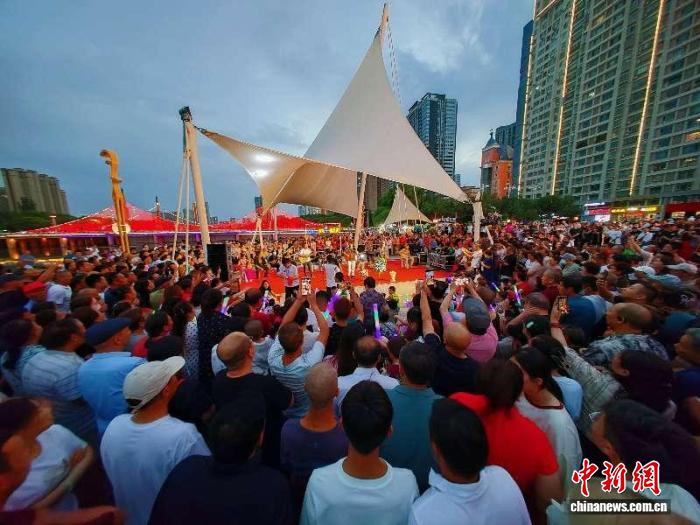
Core Insights - The Xinjiang performing arts market has been thriving since 2025, with numerous music events attracting audiences across the region [1][3] - The integration of culture and tourism has been a key driver for the growth of the performing arts sector in Xinjiang, supported by government initiatives and funding [4][9] Group 1: Market Growth - Xinjiang's performing arts market has seen a significant increase in activity, with major events like the 7th China Xinjiang International Dance Festival featuring 52 performances and attracting over 10 million viewers [3] - The average attendance rate for these events reached 92.4%, indicating strong public interest and engagement [3] - Notable artists such as Zhou Huajian and Zhang Jie have chosen Xinjiang as a stop for their tours, highlighting the region's growing appeal to musicians [3] Group 2: Policy and Investment - The Xinjiang Tourism Development Conference outlined a plan for 2025-2030, emphasizing the creation of signature performing arts productions and encouraging performances at tourist sites [4] - Since 2021, Xinjiang has invested 30 million yuan annually in cultural support, funding 534 various artistic projects to enhance the local arts scene [4] - The "Sound for Food" initiative during concerts has stimulated local economies by offering discounts at 124 businesses, linking cultural events to broader economic benefits [4] Group 3: Audience Engagement and Experience - The shift towards immersive performances has transformed tourist experiences, with events like "万方乐奏有于阗" in Hetian seeing visitor numbers increase nearly fivefold during peak seasons [6] - Digital platforms have expanded audience reach, with over 4 million online viewers for the 3rd Xinjiang Cultural Arts Festival and 430 million views across various online channels [6] - The introduction of VR and holographic projections in performances has enhanced audience engagement and experience [6] Group 4: Cultural Significance - Xinjiang's rich cultural heritage and unique musical landscape attract artists, with local music resonating deeply with both performers and audiences [7][8] - The blending of performing arts with tourism has created a virtuous cycle, promoting both sectors and enriching the cultural fabric of the region [9] - Government support for public performance venues and facilities has improved the overall environment for live music and cultural events [9]