「京娃」智能系统

Search documents
开学第一课换成了 AI,通识课今秋正式走进课堂
3 6 Ke· 2025-08-27 06:43
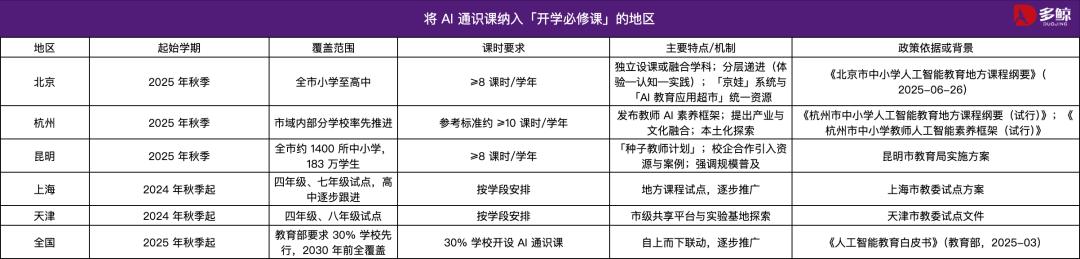
Core Insights - The introduction of artificial intelligence (AI) education in primary and secondary schools in Hangzhou marks a significant shift in China's educational landscape, with AI courses becoming a formal part of the curriculum starting from the 2025 autumn semester [1][5] - Major cities like Beijing, Hangzhou, and Kunming are leading the way in implementing AI education, with specific guidelines and requirements for course hours and content [2][3][4] Group 1: Implementation Details - Hangzhou will require at least ten class hours of AI education per academic year, starting from September 2023, as part of its local curriculum framework [1][3] - Beijing mandates a minimum of eight class hours for AI education across all grades, with a focus on integrating AI into existing subjects [3][6] - Kunming plans to implement AI courses in approximately 1,400 schools, covering over 180 million students, with a minimum of eight class hours per student [4][5] Group 2: Educational Frameworks - The AI education framework in Beijing includes a "京娃" intelligent system and an "AI education application supermarket" to provide standardized resources [3][7] - Hangzhou emphasizes local industry and culture integration into the AI curriculum, aiming to connect students with the digital economy [3][8] - Kunming's approach includes a "seed teacher program" to train key educators and enhance the practical applicability of AI courses [4][7] Group 3: Trends and Challenges - A common trend across regions is the establishment of clear course hour requirements, ensuring AI education has a defined presence in the curriculum [6][8] - The integration of ethical education into AI courses is becoming a standard, with various regions incorporating social responsibility into their curricula [8][9] - Challenges remain in teacher training and course quality, as many educators lack the necessary background in AI, which could hinder effective implementation [9][10] Group 4: Future Outlook - The Ministry of Education has set a target for 30% of schools to offer AI courses by 2025, with full coverage expected by 2030, indicating a critical period for the establishment of AI education [11] - The success of AI education will depend on continuous efforts in teacher training, curriculum development, and resource allocation to ensure it becomes a fundamental part of the educational system [11]