万家北交所慧选两年定期开放混合

Search documents
罕见!成长风格基金也分红了
Zhong Guo Zheng Quan Bao· 2025-11-13 00:29
Core Insights - The article highlights a notable trend of dividend announcements from actively managed equity funds, particularly growth-style funds, which is uncommon compared to traditional broad-based index and dividend-themed funds [1][2]. Group 1: Dividend Trends in Active Equity Funds - Several actively managed growth-style funds have announced dividends in Q4 2023, a rare occurrence, indicating a shift in strategy to provide returns to investors [1][2]. - For instance, E Fund announced a dividend of 0.9 yuan per 10 fund shares for its E Fund Kexun Mixed Fund, amounting to 226 million yuan, with a year-to-date return of over 100% [2]. - Other funds managed by well-known fund manager Chen Hao also declared dividends for the first time since 2021, with returns exceeding 50% this year [2]. Group 2: Reasons Behind Dividend Announcements - The dividends from actively managed funds primarily stem from capital gains rather than stock dividends, reflecting the strong performance of growth stocks in the A-share market [4]. - Analysts suggest that fund managers may use dividends to help investors realize gains and adjust their portfolio structures, especially in a market where growth stocks have performed well [4][5]. - Dividends can also serve as a mechanism to manage fund size and maintain optimal operational scales, particularly when funds experience rapid growth [5]. Group 3: Future Outlook and Industry Implications - The trend of dividend distribution is expected to expand among actively managed equity funds, driven by high returns and increasing investor demand for stable cash flows [6][7]. - The success of dividend strategies in index funds has influenced investor preferences, prompting actively managed funds to adopt similar practices to enhance investor experience and encourage long-term holding [7]. - Fund managers are encouraged to integrate dividend mechanisms into their product management frameworks to align with investor-centric principles [7].
变相灵活调仓 成长风格基金“红包雨”暗藏玄机
Zhong Guo Zheng Quan Bao· 2025-11-12 23:23
Core Viewpoint - The trend of dividend distribution among actively managed equity funds, particularly growth-style funds, has emerged in the fourth quarter of this year, with several funds announcing dividends for the first time in years, indicating a shift in the investment landscape and a response to investor demand for cash returns [1][2][6]. Summary by Sections Dividend Distribution Trends - Actively managed equity funds, such as E Fund's Stable Growth Mixed and E Fund's Kexiang Mixed, have announced dividends for the first time since 2021, reflecting a broader trend of dividend distribution in the market [2][4]. - The E Fund Kexiang Mixed fund will distribute a dividend of 0.9 yuan per 10 fund shares, amounting to 226 million yuan based on the benchmark shares [2]. Reasons for Dividend Distribution - The dividends from actively managed funds primarily stem from capital gains rather than stock dividends, as fund managers seek to lock in profits and provide cash returns to investors [1][4]. - The strong performance of growth-style funds in the A-share market has led to substantial accumulated returns, prompting fund managers to distribute dividends to help investors secure profits and mitigate potential future market volatility [4][6]. Impact on Fund Management - Dividend distribution allows fund managers to optimize their portfolio structure by selling off high-performing stocks to generate cash for dividends, thus adjusting their holdings based on market conditions [5][6]. - The trend of dividend distribution is expected to expand from index funds to actively managed equity funds, aligning with investor preferences for stable cash flows and enhancing the overall investment experience [6][7]. Future Outlook - The increasing focus on investor satisfaction and the regulatory push towards investor return-oriented strategies suggest that more actively managed equity funds will adopt dividend distribution as a standard practice [6][7]. - The competitive landscape may accelerate the trend of dividend distribution among actively managed funds, as they seek to meet growing investor demand for cash returns [6].
变相灵活调仓 帮助投资者落袋为安 成长风格基金“红包雨”暗藏玄机
Zhong Guo Zheng Quan Bao· 2025-11-12 21:58
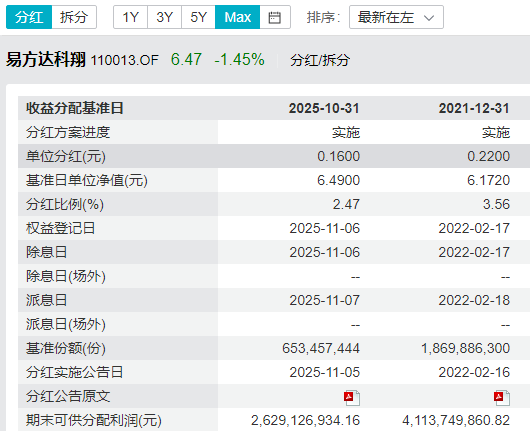
Core Viewpoint - The trend of dividend distribution is expanding from traditional index and dividend-themed funds to actively managed equity funds, driven by strong market performance and investor demand for stable cash flow [1][6]. Group 1: Dividend Distribution in Actively Managed Funds - Several actively managed equity funds, particularly growth-style products, have announced dividends for the first time in years, indicating a shift in distribution practices [1][2]. - E Fund's Ke Xun Mixed Fund announced a dividend of 0.9 yuan per 10 fund shares, amounting to 226 million yuan, marking its first dividend since 2021 [2]. - The E Fund's Ping An Growth Mixed Fund and Ke Xiang Mixed Fund also declared dividends, with amounts of 0.7 yuan and 1.60 yuan per 10 fund shares, respectively, reflecting strong performance in sectors like AI and energy storage [2][4]. Group 2: Reasons Behind Dividend Distribution - The dividends from actively managed funds primarily stem from capital gains rather than stock dividends, allowing fund managers to lock in profits and manage portfolio structure [1][4]. - Analysts suggest that distributing dividends helps investors secure returns and reduces exposure to net asset value fluctuations, especially in a volatile market [4][5]. - The trend of dividend distribution is seen as a response to increasing investor demand for tangible returns, with fund managers using dividends to optimize their holdings and maintain operational scale [5][6]. Group 3: Future Outlook - The trend of dividend distribution is expected to continue expanding among actively managed equity funds, aligning with regulatory shifts towards investor return orientation [6][7]. - As the A-share market recovers, actively managed funds are likely to accumulate sufficient reserves for dividends, catering to investors' preferences for stable cash flows [6]. - The competitive landscape may drive more actively managed funds to adopt dividend strategies, enhancing investor experience and encouraging long-term holding [6][7].
成长风格基金“红包雨”暗藏玄机
Zhong Guo Zheng Quan Bao· 2025-11-12 20:18
Core Viewpoint - The trend of dividend distribution is expanding from traditional index funds and dividend-themed funds to actively managed equity funds, driven by strong market performance and investor demand for stable cash flow [1][5][6]. Group 1: Dividend Distribution in Actively Managed Funds - Several actively managed equity funds, particularly growth-style products, have announced dividends for the first time in years, indicating a shift in distribution practices [1][2]. - E Fund's Kexun Mixed Fund announced a dividend of 0.9 yuan per 10 fund shares, amounting to 226 million yuan, marking its first dividend since 2021 [1][2]. - E Fund's Pingwen Growth Mixed Fund and Kexiang Mixed Fund also declared dividends of 0.7 yuan and 1.6 yuan per 10 fund shares, respectively, with total distributions of approximately 37.62 million yuan and 105 million yuan [2]. Group 2: Reasons for Dividend Distribution - The dividends from actively managed funds primarily stem from capital gains rather than stock dividends, allowing fund managers to lock in profits and manage portfolio structure [1][3]. - The strong performance of growth-style funds in the A-share market has led to substantial accumulated returns, prompting fund managers to distribute dividends to mitigate potential future market fluctuations [3][5]. - Dividends serve to optimize portfolio structure by allowing fund managers to sell off high-performing stocks and reinvest in more promising opportunities [4][5]. Group 3: Market Trends and Investor Sentiment - The increasing focus on investor satisfaction has made dividend distribution a common practice among public funds, with a growing preference for cash returns among investors [5][6]. - The trend of dividend distribution is expected to continue expanding, as actively managed funds align with investor demand for stable cash flows and seek to reduce irrational redemptions caused by short-term market volatility [5][6]. - Regulatory shifts are encouraging public funds to prioritize investor returns over mere asset growth, further supporting the trend of increased dividend distributions in actively managed equity funds [6].
罕见!成长风格基金,也分红了
Zhong Guo Zheng Quan Bao· 2025-11-12 14:49
Core Viewpoint - The trend of dividend distribution among actively managed equity funds, particularly growth-style funds, has become notable in the fourth quarter of this year, diverging from the traditional dividend sources of broad-based index and dividend-themed funds [1][6]. Dividend Distribution Trends - Several actively managed equity funds, especially those with a growth style, have announced dividends for the first time in years, indicating a shift in strategy to lock in profits for investors [2][6]. - For instance, E Fund announced a dividend of 0.9 yuan per 10 fund shares for its E Fund Kexun Mixed Fund, amounting to 226 million yuan, with a year-to-date return exceeding 100% [2][6]. - The Wanjiabj Exchange Wisdom Two-Year Regular Open Mixed Fund also declared its first dividend since inception, distributing 4 yuan per 10 fund shares, totaling 131 million yuan, marking it as the highest unit dividend among actively managed equity funds this year [4][5]. Reasons for Dividend Distribution - The dividends from actively managed equity funds primarily stem from capital gains rather than stock dividends, as fund managers seek to help investors realize profits amid strong market performance [6][7]. - Analysts suggest that the distribution of dividends can serve multiple purposes, including adjusting portfolio structures, reinvesting assets, and maintaining optimal operational scales [1][6][7]. Market Context and Future Outlook - The trend of dividend distribution is expected to expand further among actively managed equity funds, driven by the strong performance of the A-share market and increasing investor demand for stable cash flows [8][9]. - The growing preference for dividends among investors, cultivated by the dividend models of index funds, may encourage more actively managed funds to adopt similar strategies to meet investor needs and enhance long-term holding experiences [9].