
成长风格基金

Search documents
年内48只成长型基金分红累计金额超35亿元
Zheng Quan Ri Bao· 2025-11-19 16:16
Core Viewpoint - Growth-style funds, which have rarely distributed dividends in the past, have been increasingly active in dividend distribution this year, indicating a shift from focusing on scale to prioritizing returns [1][2]. Group 1: Dividend Distribution Trends - As of November 19, 48 growth-style funds have implemented dividends this year, with a total distribution amounting to 3.556 billion yuan, including 25 funds that have distributed dividends for the first time in three years [1]. - Notable fund managers, such as Chen Hao, have announced dividends for their funds in November, marking the first dividend distributions in three years for these products [1]. Group 2: Fund Management Strategy - The shift in dividend distribution reflects a broader trend among fund companies moving from a focus on scale to a focus on returns, as noted by industry experts [2]. - The source of dividends for growth-style funds primarily comes from capital gains realized through stock sales, contrasting with high-dividend strategy funds that rely on dividend income from constituent stocks [2]. Group 3: Performance and Market Conditions - Over 98% of growth-style funds have achieved positive net value growth this year, with an average growth rate of 32.62% [3]. - The strong performance of the stock market, particularly in technology stocks, has allowed fund managers to realize substantial gains, prompting them to distribute dividends as a means of securing profits and optimizing portfolio structure [3].
变相灵活调仓 帮助投资者落袋为安 成长风格基金“红包雨”暗藏玄机
Zhong Guo Zheng Quan Bao· 2025-11-12 21:58
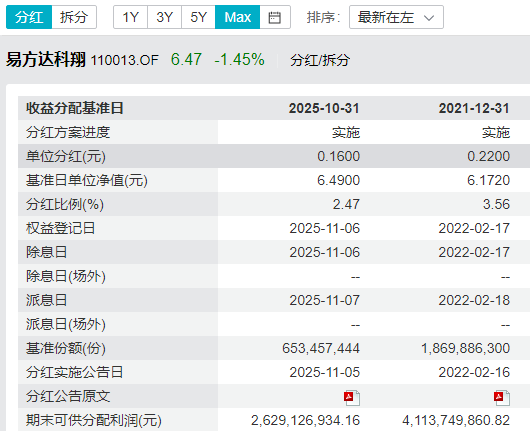
Core Viewpoint - The trend of dividend distribution is expanding from traditional index and dividend-themed funds to actively managed equity funds, driven by strong market performance and investor demand for stable cash flow [1][6]. Group 1: Dividend Distribution in Actively Managed Funds - Several actively managed equity funds, particularly growth-style products, have announced dividends for the first time in years, indicating a shift in distribution practices [1][2]. - E Fund's Ke Xun Mixed Fund announced a dividend of 0.9 yuan per 10 fund shares, amounting to 226 million yuan, marking its first dividend since 2021 [2]. - The E Fund's Ping An Growth Mixed Fund and Ke Xiang Mixed Fund also declared dividends, with amounts of 0.7 yuan and 1.60 yuan per 10 fund shares, respectively, reflecting strong performance in sectors like AI and energy storage [2][4]. Group 2: Reasons Behind Dividend Distribution - The dividends from actively managed funds primarily stem from capital gains rather than stock dividends, allowing fund managers to lock in profits and manage portfolio structure [1][4]. - Analysts suggest that distributing dividends helps investors secure returns and reduces exposure to net asset value fluctuations, especially in a volatile market [4][5]. - The trend of dividend distribution is seen as a response to increasing investor demand for tangible returns, with fund managers using dividends to optimize their holdings and maintain operational scale [5][6]. Group 3: Future Outlook - The trend of dividend distribution is expected to continue expanding among actively managed equity funds, aligning with regulatory shifts towards investor return orientation [6][7]. - As the A-share market recovers, actively managed funds are likely to accumulate sufficient reserves for dividends, catering to investors' preferences for stable cash flows [6]. - The competitive landscape may drive more actively managed funds to adopt dividend strategies, enhancing investor experience and encouraging long-term holding [6][7].
罕见!成长风格基金,也分红了
Zhong Guo Zheng Quan Bao· 2025-11-12 14:49
Core Viewpoint - The trend of dividend distribution among actively managed equity funds, particularly growth-style funds, has become notable in the fourth quarter of this year, diverging from the traditional dividend sources of broad-based index and dividend-themed funds [1][6]. Dividend Distribution Trends - Several actively managed equity funds, especially those with a growth style, have announced dividends for the first time in years, indicating a shift in strategy to lock in profits for investors [2][6]. - For instance, E Fund announced a dividend of 0.9 yuan per 10 fund shares for its E Fund Kexun Mixed Fund, amounting to 226 million yuan, with a year-to-date return exceeding 100% [2][6]. - The Wanjiabj Exchange Wisdom Two-Year Regular Open Mixed Fund also declared its first dividend since inception, distributing 4 yuan per 10 fund shares, totaling 131 million yuan, marking it as the highest unit dividend among actively managed equity funds this year [4][5]. Reasons for Dividend Distribution - The dividends from actively managed equity funds primarily stem from capital gains rather than stock dividends, as fund managers seek to help investors realize profits amid strong market performance [6][7]. - Analysts suggest that the distribution of dividends can serve multiple purposes, including adjusting portfolio structures, reinvesting assets, and maintaining optimal operational scales [1][6][7]. Market Context and Future Outlook - The trend of dividend distribution is expected to expand further among actively managed equity funds, driven by the strong performance of the A-share market and increasing investor demand for stable cash flows [8][9]. - The growing preference for dividends among investors, cultivated by the dividend models of index funds, may encourage more actively managed funds to adopt similar strategies to meet investor needs and enhance long-term holding experiences [9].

申万宏源证券晨会报告-20251112
Shenwan Hongyuan Securities· 2025-11-12 00:44
Core Insights - The report emphasizes the diverse strategies of secondary bond funds and the significant differences in their risk-return profiles, suggesting a focus on high-positioning and growth-oriented funds to capitalize on high-growth sectors [3][12] - It highlights the increasing investment in Hong Kong stocks by secondary bond funds, with the proportion reaching 11.21% of stock market value in Q3 2025, indicating a trend towards technology-driven assets [12] - The report outlines a three-dimensional selection system for high-elasticity products, focusing on high performance, good holding experience, and cost-effectiveness [12] Summary by Sections Secondary Bond Fund Strategies - The report identifies four main strategies for selecting secondary bond funds suitable for high volatility environments: high positioning, growth style, Hong Kong stock strategy, and tool-type products [3][12] - High-positioning funds typically have an average convertible bond position exceeding 30%, with 64 funds identified, ranging from conservative to aggressive styles [12] - Growth style funds are characterized by a weighted average PE ratio above 30, with evaluations based on holding experience and risk-return ratios [4][12] Hong Kong Stock Strategy - The report notes a continuous increase in the investment ratio of secondary bond funds in Hong Kong stocks, with specific funds maintaining stable positions [12] - It mentions that the investment limit for products that can invest in Hong Kong stocks is capped at 50% of their stock assets [12] Tool-Type Products - The report discusses the emergence of tool-type products within secondary bond funds, including strategies focused on innovation and micro-cap stocks [12] - It highlights specific funds that target dual innovation strategies and micro-cap stocks, indicating a growing trend in specialized investment approaches [12]