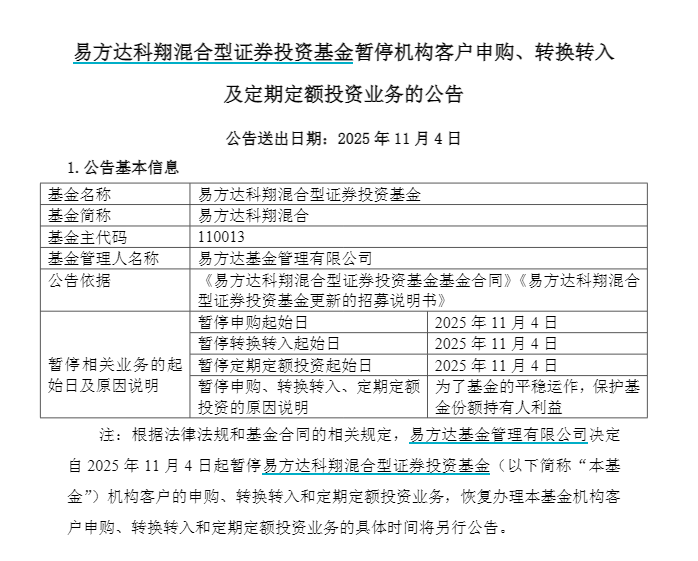
易方达科翔混合

Search documents
机构年底调仓:散户如何不被收割?
Sou Hu Cai Jing· 2025-12-04 18:40
Group 1 - The core observation is the simultaneous occurrence of a dividend wave and purchase limits among high-performing funds, indicating a strategic maneuver by institutions [1][2] - As of December 4, 2025, a total of 3,364 funds have distributed approximately 215.517 billion yuan in dividends, with the Huatai-PB CSI 300 ETF leading at 8.394 billion yuan [2] - The practice of large-scale dividends often coincides with market turning points, suggesting that institutions are cashing in profits to prepare for future investments [3] Group 2 - From a quantitative perspective, the analysis reveals distinct behaviors in stock movements, with one stock showing institutional accumulation while another reflects retail investor activity [6][8] - The year-end market behavior aligns with the "year-end effect," where fund managers begin positioning for the upcoming year, often starting their strategies earlier than retail investors realize [8] - The importance of understanding the underlying intentions behind dividends and purchase limits is emphasized, as they do not always correlate with positive or negative market signals [9][13] Group 3 - Recommendations for ordinary investors include recognizing the psychological impact of dividends for locking in annual returns and understanding the rationale behind purchase limits to mitigate performance risks [9][10] - The future of quantitative investing is anticipated to flourish with advancements in AI and big data, enabling individual investors to access analytical tools previously available only to institutions [12] - The focus should be on tracking capital movements and establishing a personal analytical framework to navigate the complexities of the market [13][14]

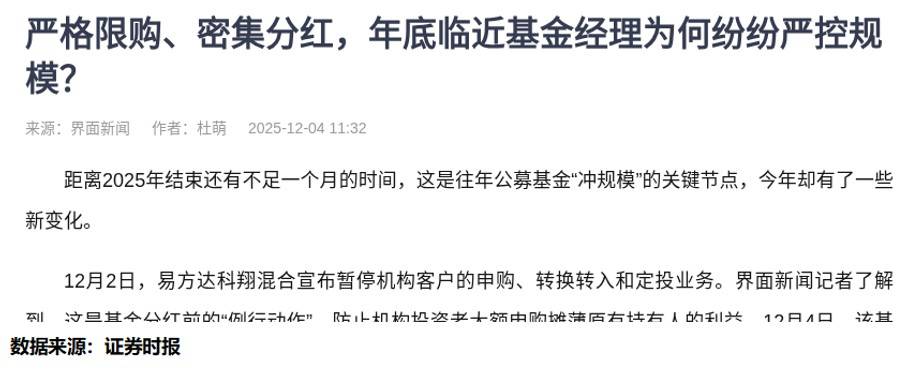
严格限购、密集分红,年底临近基金经理为何纷纷严控规模?
Sou Hu Cai Jing· 2025-12-04 03:17
Group 1 - The core point of the article highlights the recent changes in public fund operations, particularly the trend of limiting large subscriptions and implementing dividend distributions as a strategy to protect existing investors' interests [1][8] - On December 2, E Fund announced the suspension of subscription and conversion for institutional clients before its dividend distribution, which is a common practice to prevent dilution of existing shareholders' interests [1] - As of December 4, a total of 3,364 funds have implemented dividends this year, with a total distribution amounting to approximately 2,155.17 billion yuan [2] Group 2 - Twelve funds have distributed over 1 billion yuan in dividends this year, with seven being passive index equity funds, indicating a significant trend in the market [7] - Some high-performing funds have also limited daily subscription amounts, reflecting a shift from a focus on scale to prioritizing performance and investor interests [8] - Fund managers express concerns about rapid scale expansion due to large inflows, which complicates management and trading, emphasizing the importance of maintaining effective strategies over merely increasing fund size [8] Group 3 - The end of the year is seen as a critical period for asset rebalancing, with institutions potentially shifting towards high-dividend stocks to lock in annual returns [9] - Market analysts suggest that the current market conditions may favor sectors such as non-bank financials, metals, machinery, construction materials, banking, and tourism [8][10] - There is a focus on technology sectors, with expectations of adjustments and potential rebounds, particularly in areas supported by strong performance and favorable policies [10]

年内48只成长型基金分红累计金额超35亿元
Zheng Quan Ri Bao· 2025-11-19 16:16
Core Viewpoint - Growth-style funds, which have rarely distributed dividends in the past, have been increasingly active in dividend distribution this year, indicating a shift from focusing on scale to prioritizing returns [1][2]. Group 1: Dividend Distribution Trends - As of November 19, 48 growth-style funds have implemented dividends this year, with a total distribution amounting to 3.556 billion yuan, including 25 funds that have distributed dividends for the first time in three years [1]. - Notable fund managers, such as Chen Hao, have announced dividends for their funds in November, marking the first dividend distributions in three years for these products [1]. Group 2: Fund Management Strategy - The shift in dividend distribution reflects a broader trend among fund companies moving from a focus on scale to a focus on returns, as noted by industry experts [2]. - The source of dividends for growth-style funds primarily comes from capital gains realized through stock sales, contrasting with high-dividend strategy funds that rely on dividend income from constituent stocks [2]. Group 3: Performance and Market Conditions - Over 98% of growth-style funds have achieved positive net value growth this year, with an average growth rate of 32.62% [3]. - The strong performance of the stock market, particularly in technology stocks, has allowed fund managers to realize substantial gains, prompting them to distribute dividends as a means of securing profits and optimizing portfolio structure [3].
罕见!成长风格基金也分红了
Zhong Guo Zheng Quan Bao· 2025-11-13 00:29
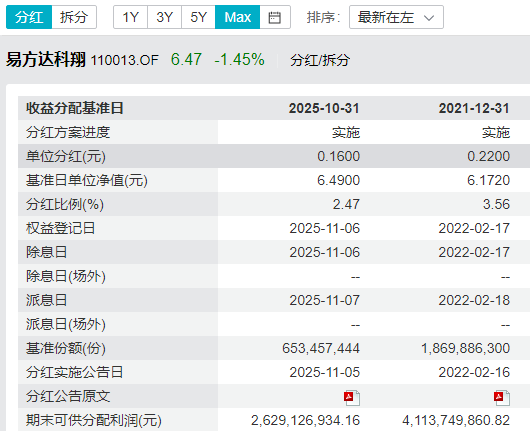
Core Insights - The article highlights a notable trend of dividend announcements from actively managed equity funds, particularly growth-style funds, which is uncommon compared to traditional broad-based index and dividend-themed funds [1][2]. Group 1: Dividend Trends in Active Equity Funds - Several actively managed growth-style funds have announced dividends in Q4 2023, a rare occurrence, indicating a shift in strategy to provide returns to investors [1][2]. - For instance, E Fund announced a dividend of 0.9 yuan per 10 fund shares for its E Fund Kexun Mixed Fund, amounting to 226 million yuan, with a year-to-date return of over 100% [2]. - Other funds managed by well-known fund manager Chen Hao also declared dividends for the first time since 2021, with returns exceeding 50% this year [2]. Group 2: Reasons Behind Dividend Announcements - The dividends from actively managed funds primarily stem from capital gains rather than stock dividends, reflecting the strong performance of growth stocks in the A-share market [4]. - Analysts suggest that fund managers may use dividends to help investors realize gains and adjust their portfolio structures, especially in a market where growth stocks have performed well [4][5]. - Dividends can also serve as a mechanism to manage fund size and maintain optimal operational scales, particularly when funds experience rapid growth [5]. Group 3: Future Outlook and Industry Implications - The trend of dividend distribution is expected to expand among actively managed equity funds, driven by high returns and increasing investor demand for stable cash flows [6][7]. - The success of dividend strategies in index funds has influenced investor preferences, prompting actively managed funds to adopt similar practices to enhance investor experience and encourage long-term holding [7]. - Fund managers are encouraged to integrate dividend mechanisms into their product management frameworks to align with investor-centric principles [7].
变相灵活调仓 成长风格基金“红包雨”暗藏玄机
Zhong Guo Zheng Quan Bao· 2025-11-12 23:23
Core Viewpoint - The trend of dividend distribution among actively managed equity funds, particularly growth-style funds, has emerged in the fourth quarter of this year, with several funds announcing dividends for the first time in years, indicating a shift in the investment landscape and a response to investor demand for cash returns [1][2][6]. Summary by Sections Dividend Distribution Trends - Actively managed equity funds, such as E Fund's Stable Growth Mixed and E Fund's Kexiang Mixed, have announced dividends for the first time since 2021, reflecting a broader trend of dividend distribution in the market [2][4]. - The E Fund Kexiang Mixed fund will distribute a dividend of 0.9 yuan per 10 fund shares, amounting to 226 million yuan based on the benchmark shares [2]. Reasons for Dividend Distribution - The dividends from actively managed funds primarily stem from capital gains rather than stock dividends, as fund managers seek to lock in profits and provide cash returns to investors [1][4]. - The strong performance of growth-style funds in the A-share market has led to substantial accumulated returns, prompting fund managers to distribute dividends to help investors secure profits and mitigate potential future market volatility [4][6]. Impact on Fund Management - Dividend distribution allows fund managers to optimize their portfolio structure by selling off high-performing stocks to generate cash for dividends, thus adjusting their holdings based on market conditions [5][6]. - The trend of dividend distribution is expected to expand from index funds to actively managed equity funds, aligning with investor preferences for stable cash flows and enhancing the overall investment experience [6][7]. Future Outlook - The increasing focus on investor satisfaction and the regulatory push towards investor return-oriented strategies suggest that more actively managed equity funds will adopt dividend distribution as a standard practice [6][7]. - The competitive landscape may accelerate the trend of dividend distribution among actively managed funds, as they seek to meet growing investor demand for cash returns [6].
变相灵活调仓 帮助投资者落袋为安 成长风格基金“红包雨”暗藏玄机
Zhong Guo Zheng Quan Bao· 2025-11-12 21:58
Core Viewpoint - The trend of dividend distribution is expanding from traditional index and dividend-themed funds to actively managed equity funds, driven by strong market performance and investor demand for stable cash flow [1][6]. Group 1: Dividend Distribution in Actively Managed Funds - Several actively managed equity funds, particularly growth-style products, have announced dividends for the first time in years, indicating a shift in distribution practices [1][2]. - E Fund's Ke Xun Mixed Fund announced a dividend of 0.9 yuan per 10 fund shares, amounting to 226 million yuan, marking its first dividend since 2021 [2]. - The E Fund's Ping An Growth Mixed Fund and Ke Xiang Mixed Fund also declared dividends, with amounts of 0.7 yuan and 1.60 yuan per 10 fund shares, respectively, reflecting strong performance in sectors like AI and energy storage [2][4]. Group 2: Reasons Behind Dividend Distribution - The dividends from actively managed funds primarily stem from capital gains rather than stock dividends, allowing fund managers to lock in profits and manage portfolio structure [1][4]. - Analysts suggest that distributing dividends helps investors secure returns and reduces exposure to net asset value fluctuations, especially in a volatile market [4][5]. - The trend of dividend distribution is seen as a response to increasing investor demand for tangible returns, with fund managers using dividends to optimize their holdings and maintain operational scale [5][6]. Group 3: Future Outlook - The trend of dividend distribution is expected to continue expanding among actively managed equity funds, aligning with regulatory shifts towards investor return orientation [6][7]. - As the A-share market recovers, actively managed funds are likely to accumulate sufficient reserves for dividends, catering to investors' preferences for stable cash flows [6]. - The competitive landscape may drive more actively managed funds to adopt dividend strategies, enhancing investor experience and encouraging long-term holding [6][7].
成长风格基金“红包雨”暗藏玄机
Zhong Guo Zheng Quan Bao· 2025-11-12 20:18
Core Viewpoint - The trend of dividend distribution is expanding from traditional index funds and dividend-themed funds to actively managed equity funds, driven by strong market performance and investor demand for stable cash flow [1][5][6]. Group 1: Dividend Distribution in Actively Managed Funds - Several actively managed equity funds, particularly growth-style products, have announced dividends for the first time in years, indicating a shift in distribution practices [1][2]. - E Fund's Kexun Mixed Fund announced a dividend of 0.9 yuan per 10 fund shares, amounting to 226 million yuan, marking its first dividend since 2021 [1][2]. - E Fund's Pingwen Growth Mixed Fund and Kexiang Mixed Fund also declared dividends of 0.7 yuan and 1.6 yuan per 10 fund shares, respectively, with total distributions of approximately 37.62 million yuan and 105 million yuan [2]. Group 2: Reasons for Dividend Distribution - The dividends from actively managed funds primarily stem from capital gains rather than stock dividends, allowing fund managers to lock in profits and manage portfolio structure [1][3]. - The strong performance of growth-style funds in the A-share market has led to substantial accumulated returns, prompting fund managers to distribute dividends to mitigate potential future market fluctuations [3][5]. - Dividends serve to optimize portfolio structure by allowing fund managers to sell off high-performing stocks and reinvest in more promising opportunities [4][5]. Group 3: Market Trends and Investor Sentiment - The increasing focus on investor satisfaction has made dividend distribution a common practice among public funds, with a growing preference for cash returns among investors [5][6]. - The trend of dividend distribution is expected to continue expanding, as actively managed funds align with investor demand for stable cash flows and seek to reduce irrational redemptions caused by short-term market volatility [5][6]. - Regulatory shifts are encouraging public funds to prioritize investor returns over mere asset growth, further supporting the trend of increased dividend distributions in actively managed equity funds [6].
罕见!成长风格基金,也分红了
Zhong Guo Zheng Quan Bao· 2025-11-12 14:49
Core Viewpoint - The trend of dividend distribution among actively managed equity funds, particularly growth-style funds, has become notable in the fourth quarter of this year, diverging from the traditional dividend sources of broad-based index and dividend-themed funds [1][6]. Dividend Distribution Trends - Several actively managed equity funds, especially those with a growth style, have announced dividends for the first time in years, indicating a shift in strategy to lock in profits for investors [2][6]. - For instance, E Fund announced a dividend of 0.9 yuan per 10 fund shares for its E Fund Kexun Mixed Fund, amounting to 226 million yuan, with a year-to-date return exceeding 100% [2][6]. - The Wanjiabj Exchange Wisdom Two-Year Regular Open Mixed Fund also declared its first dividend since inception, distributing 4 yuan per 10 fund shares, totaling 131 million yuan, marking it as the highest unit dividend among actively managed equity funds this year [4][5]. Reasons for Dividend Distribution - The dividends from actively managed equity funds primarily stem from capital gains rather than stock dividends, as fund managers seek to help investors realize profits amid strong market performance [6][7]. - Analysts suggest that the distribution of dividends can serve multiple purposes, including adjusting portfolio structures, reinvesting assets, and maintaining optimal operational scales [1][6][7]. Market Context and Future Outlook - The trend of dividend distribution is expected to expand further among actively managed equity funds, driven by the strong performance of the A-share market and increasing investor demand for stable cash flows [8][9]. - The growing preference for dividends among investors, cultivated by the dividend models of index funds, may encourage more actively managed funds to adopt similar strategies to meet investor needs and enhance long-term holding experiences [9].
太突然!刚刚,又爆了!
中国基金报· 2025-11-04 07:21
Core Insights - The article highlights the recent surge in the issuance of new funds in the Chinese market, particularly two "daylight funds" that were fully subscribed in one day, indicating strong investor interest amid the A-share market's fluctuations around the 4000-point mark [2][4][6]. Fund Issuance Trends - On November 4, 2023, the Fuquan Xinghe Fund managed by Fan Yan raised over 30 billion yuan, reaching its fundraising cap and leading to an early closure of subscriptions [4][6]. - Similarly, the Penghua Qihang Quantitative Stock Fund managed by Su Junjie also surpassed the 30 billion yuan cap on the same day, prompting an early end to its fundraising [6]. - The issuance of equity and mixed funds has seen a significant increase, with stock funds and mixed funds reaching 3600.65 billion units and 1230.83 billion units respectively by November 3, 2023, marking increases of 43.86% and 76.04% compared to the previous year [9]. Market Dynamics - The article notes a trend of "daylight funds" emerging frequently, with several funds achieving rapid fundraising success in recent months, such as the Huatai-PB Yingtai Fund raising approximately 55 billion yuan in one day [8]. - In October 2023, the average issuance of mixed funds reached 7.57 million units, the highest since November 2022 [9]. Fund Management Strategies - A number of high-performing funds have announced a suspension of new subscriptions to manage inflows and protect existing investors' interests. For instance, the Yifangda Pingwen Growth Fund and Yifangda Kexiang Fund suspended subscriptions starting November 4, 2023 [11][14]. - The industry is witnessing a shift where fund companies are prioritizing performance over scale, as evidenced by the decision to limit new investments in successful funds to maintain operational stability and mitigate risks [15].

太突然!刚刚,又爆了!
Zhong Guo Ji Jin Bao· 2025-11-04 07:20
Core Insights - The issuance of new funds has surged, with two "sunshine funds" launched on the same day, reflecting strong investor demand amid the A-share market's rise towards 4000 points [1][2] Fund Issuance Trends - On November 4, both the Fuquan Xinghe Fund and the Penghua Qihang Quantitative Stock Fund raised over 30 billion yuan each, reaching their fundraising limits and prompting early closure and proportional allocation [2] - As of November 3, the total issuance of stock and mixed funds for the year reached 3,600.65 billion units and 1,230.83 billion units, representing year-on-year increases of 43.86% and 76.04% respectively [3] Market Dynamics - The trend of "sunshine funds" has been prevalent, with several funds achieving significant fundraising in a single day, indicating a robust market environment [2] - In October, the average issuance of mixed funds reached 75.7 million units, the highest since November 2022 [3] Fund Management Strategies - Several high-performing funds have announced a halt to new subscriptions to protect existing investors' interests and manage fund size effectively [4][7] - A total of 215 equity funds have announced suspensions of large subscriptions or new subscriptions this year, primarily those with strong performance [8] Industry Implications - The recent trend of limiting subscriptions reflects a shift in the industry towards prioritizing performance over scale, aiming for sustainable growth and stability [8]