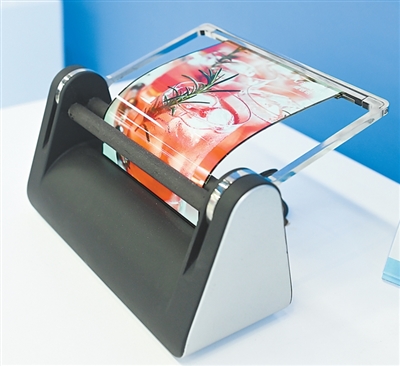
三折叠笔记本

Search documents
柔性屏,打开“显示”新视窗
Ren Min Ri Bao· 2025-12-05 00:07
Core Insights - The display technology is rapidly transitioning from "rigid" to "flexible," with flexible displays increasingly applied in consumer electronics, commercial spaces, and smart interactions [1] - Recent advancements include the development of high-performance stretchable polymer light-emitting diodes (PLED) by the Chinese Academy of Sciences and a prototype stretchable display by LG, achieving approximately 53% stretchability [1] - Flexible displays are reshaping human-computer interaction and creating a new generation of industrial clusters with applications ranging from foldable phones to curved screens [1] Group 1: Flexible Display Technology - Flexible displays are not merely bent versions of traditional glass screens; they require a multi-layered structure that includes flexible substrates, electronic components, packaging films, and cover plates [2] - The flexible substrate materials, such as polyimide and polyester, are essential for withstanding high temperatures and numerous folds without deformation [2] - Core electronic components like thin-film transistors (TFT) and organic light-emitting diodes (OLED) rely on high-performance materials to ensure rapid current flow and self-emission capabilities [3] Group 2: Packaging and Protection - Packaging technology is crucial for protecting flexible displays from environmental factors like oxygen and moisture, with ideal materials being lightweight, flexible, and offering excellent moisture and oxidation resistance [4] - Researchers are developing multi-layer composite packaging and exploring self-healing coatings to enhance the longevity of flexible displays while maintaining their flexibility [4] Group 3: Market Expansion and Applications - The global market for flexible displays is expanding, with projections indicating that shipments of flexible AMOLED panels will reach 631 million units by 2024, accounting for 42% of the smartphone screen market [5] - By 2031, the flexible display market is expected to exceed $173 billion, with a compound annual growth rate of 34.3% [5] - Applications of flexible displays are broadening across various sectors, including smart terminals, wearables, automotive, healthcare, and public services [5] Group 4: Innovations in Wearables and Automotive - In the smart terminal sector, flexible displays are enhancing product forms, with Huawei set to release a foldable laptop with an 18-inch screen in 2025 [5] - Flexible displays are transforming automotive interfaces, with companies like Mercedes and BMW integrating flexible OLED screens into their vehicles for improved interaction [6] Group 5: Healthcare and Public Services - In healthcare, flexible displays are being integrated into wearable medical devices for real-time monitoring of health parameters [7] - Public services are adopting large flexible OLED screens for advertising and information dissemination, with applications in venues like the Paris Olympics [7] Group 6: Future of Intrinsic Flexibility - Current flexible displays rely on external structures for deformation, facing challenges such as fragility and resolution loss [8] - The development of intrinsic flexible materials aims to address these issues by enabling the display itself to withstand deformation through molecular structure and micro-design [9] - Intrinsic flexibility could lead to new applications, integrating sensors and AI for real-time data analysis and adaptive interaction [9][10]
柔性屏,打开“显示”新视窗(国际科技前沿)
Ren Min Ri Bao· 2025-11-30 22:01
Core Insights - The article discusses the rapid advancement of flexible display technology, highlighting its transition from rigid to flexible forms, which is increasingly applied in various sectors such as consumer electronics, commercial spaces, and smart interactions [5][8]. Group 1: Flexible Display Technology Development - Flexible displays are characterized by their ability to bend and stretch, leading to innovative applications in products like foldable phones and curved screens [5][8]. - Recent breakthroughs include the development of high-performance stretchable polymer light-emitting diodes (PLEDs) by the Chinese Academy of Sciences, which significantly enhance optical performance and mechanical stability [5][11]. - LG Display has showcased a prototype of a stretchable display capable of approximately 53% deformation, indicating significant progress in the field [5][8]. Group 2: Manufacturing Process of Flexible Displays - The creation of flexible displays involves a complex multi-layer structure, requiring innovations in flexible substrate materials, core electronic components, structural design, and packaging technology [6][7]. - Flexible substrates must be thin, soft, and resistant to high temperatures and corrosive environments, with common materials including polyimide and polyester [6]. - Core electronic components like thin-film transistors (TFT) and organic light-emitting diodes (OLED) rely on high-performance materials to ensure rapid current flow and energy efficiency [7]. Group 3: Market Expansion and Applications - The global market for flexible displays is projected to grow significantly, with an estimated shipment of 631 million flexible AMOLED panels in 2024, accounting for 42% of the smartphone screen market [8]. - By 2031, the flexible display market is expected to exceed $173 billion, with a compound annual growth rate (CAGR) of 34.3% [8]. - Applications are expanding across various sectors, including smart terminals, wearables, automotive, healthcare, and public services, enhancing user experience and functionality [9][10]. Group 4: Future Innovations and Challenges - The concept of intrinsic flexibility is emerging, which refers to the inherent ability of materials to withstand deformation without relying on external structures [11][12]. - Research teams are exploring new material systems to improve the mechanical strength and durability of flexible displays, with ongoing challenges in achieving large-scale applications [11][12]. - The integration of sensors and AI algorithms in intrinsic flexible displays could lead to personalized and intelligent user experiences, transforming the interaction between devices and users [12].