三星Galaxy A系列

Search documents
国产手机“亮家底”,沙特王室成员探访深圳智能手机制造产线
Nan Fang Du Shi Bao· 2025-11-20 00:51
Core Insights - The visit of Saudi royal family members, including Princess Abeer Al Saud, to Honor's smart manufacturing factory in Shenzhen represents a new outbound strategy for Chinese manufacturers, aiming to showcase high manufacturing standards and counter the perception of Chinese products as low-end [1][2] - The Middle East is emerging as a competitive battleground for Chinese smartphone manufacturers, with a projected smartphone shipment volume of 13.2 million units by Q2 2025, reflecting a 15% year-on-year growth [1][2] - Honor has achieved a 95% year-on-year increase in shipment volume, capturing a 10% market share in the Middle East, while the overall competition among leading manufacturers remains intense [1][3] Group 1 - The visit to the Shenzhen factory highlights a shift in strategy, focusing on high-end and technologically advanced products rather than entry-level models [1][2] - The factory is recognized as a national-level smart manufacturing demonstration site, with over 85% of its processes automated, showcasing China's manufacturing efficiency and standards [2][3] - The emphasis on AI-driven products and retail expansion aligns with the high internet penetration and affluent consumer base in the Gulf countries, indicating a move away from purely price-based competition [2][3] Group 2 - Honor's latest offerings, including the foldable flagship Magic V5 and AI features, cater to the growing demand for AI-enabled devices in the context of Saudi Arabia's Vision 2030 and the upcoming China-Saudi cultural year [3] - Despite rapid growth, Chinese brands still face a significant gap compared to Samsung's 34% market share, which is supported by its Galaxy A series and financial strategies [3] - The ability of Chinese manufacturers to leverage technology and manufacturing capabilities to penetrate the high-end market will be a key focus in the latter half of the year [3]
业绩连续承压,传音发布全球最薄三折叠手机
Guan Cha Zhe Wang· 2025-07-18 11:32
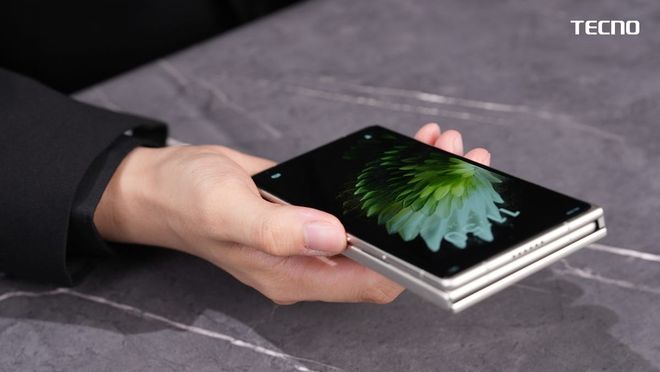
Core Viewpoint - Transsion is set to launch its first tri-fold smartphone, the Phantom Ultimate G Fold Concept, following similar products from Huawei and Samsung, indicating a competitive push in the foldable smartphone market [1][7]. Group 1: Product Features - The Phantom Ultimate G Fold Concept features a G-shaped folding design with an internal dual-hinge structure, offering a 9.94-inch display when unfolded and a battery capacity exceeding 5000mAh [1][7]. - In its folded state, the device measures only 11.49mm thick, and 3.49mm when unfolded, making it thinner than competitors like Huawei Mate XT Ultimate and Samsung Galaxy Z Fold 7 [3][5]. - The device utilizes a custom dual-hinge system, which includes a droplet-shaped hinge for folding and a larger main hinge that allows for partial folding, enabling functionalities like video calls [5][7]. Group 2: Market Context - The global smartphone market experienced a 1% year-on-year decline in Q2 2025, marking the first drop in six consecutive quarters, attributed to cautious consumer sentiment amid economic uncertainty [7]. - Samsung maintained its market leadership with a 19% share, followed by Apple at 16%, Xiaomi at 15%, and Transsion at 9%, which saw a 2% decline in market share [7][9]. - Transsion's performance has been under pressure, with a significant revenue drop of 25.45% year-on-year in Q1 2025, and a net profit decline of 69.87%, attributed to market competition and supply chain costs [8][9]. Group 3: Financial Performance - In 2024, Transsion reported a revenue of 68.715 billion yuan, a 10.31% increase, but this was a significant slowdown from the previous year's 33.69% growth, marking the second-lowest growth rate since its listing [8]. - The net profit for 2024 was 5.549 billion yuan, a slight increase of 0.22%, while the non-recurring net profit fell by 11.54% [8].