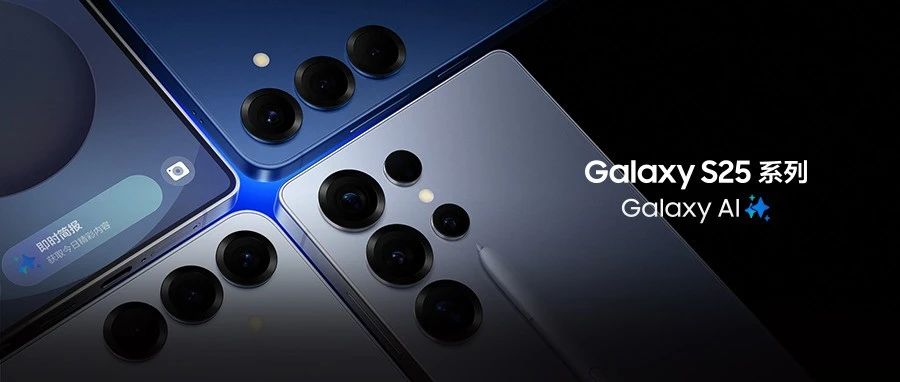
三星S25系列

Search documents
国产手机“亮家底”,沙特王室成员探访深圳智能手机制造产线
Nan Fang Du Shi Bao· 2025-11-20 00:51
Core Insights - The visit of Saudi royal family members, including Princess Abeer Al Saud, to Honor's smart manufacturing factory in Shenzhen represents a new outbound strategy for Chinese manufacturers, aiming to showcase high manufacturing standards and counter the perception of Chinese products as low-end [1][2] - The Middle East is emerging as a competitive battleground for Chinese smartphone manufacturers, with a projected smartphone shipment volume of 13.2 million units by Q2 2025, reflecting a 15% year-on-year growth [1][2] - Honor has achieved a 95% year-on-year increase in shipment volume, capturing a 10% market share in the Middle East, while the overall competition among leading manufacturers remains intense [1][3] Group 1 - The visit to the Shenzhen factory highlights a shift in strategy, focusing on high-end and technologically advanced products rather than entry-level models [1][2] - The factory is recognized as a national-level smart manufacturing demonstration site, with over 85% of its processes automated, showcasing China's manufacturing efficiency and standards [2][3] - The emphasis on AI-driven products and retail expansion aligns with the high internet penetration and affluent consumer base in the Gulf countries, indicating a move away from purely price-based competition [2][3] Group 2 - Honor's latest offerings, including the foldable flagship Magic V5 and AI features, cater to the growing demand for AI-enabled devices in the context of Saudi Arabia's Vision 2030 and the upcoming China-Saudi cultural year [3] - Despite rapid growth, Chinese brands still face a significant gap compared to Samsung's 34% market share, which is supported by its Galaxy A series and financial strategies [3] - The ability of Chinese manufacturers to leverage technology and manufacturing capabilities to penetrate the high-end market will be a key focus in the latter half of the year [3]
AI驱动行业创新!消费电子ETF(159732)上涨0.92%,均胜电子涨停
Mei Ri Jing Ji Xin Wen· 2025-09-16 05:03
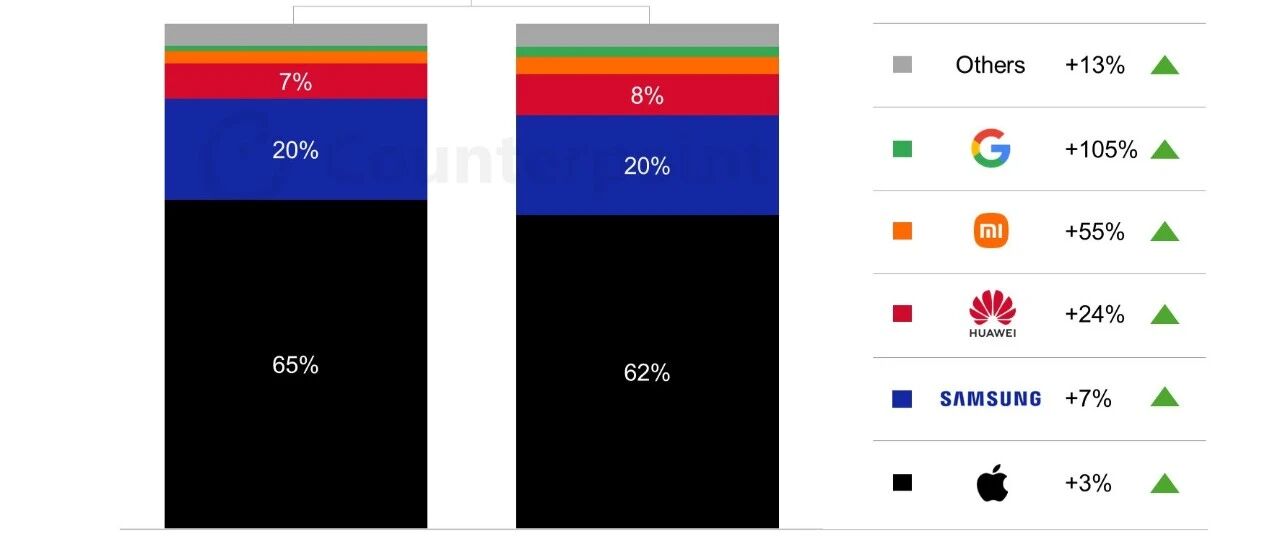
Core Viewpoint - The A-share market experienced a collective decline on September 16, with the Shanghai Composite Index down by 0.15%, while sectors such as computer hardware, leisure products, and automotive parts showed gains. The consumer electronics sector demonstrated strength, with significant increases in specific stocks and a positive outlook for high-end smartphone sales in 2025 [1]. Industry Summary - The consumer electronics ETF (159732) rose by 0.92%, with notable stock performances: Jingsheng Electronics up by 10.00%, Shenghong Technology up by 5.78%, Changying Precision up by 5.77%, Kobot up by 5.20%, and Transsion Holdings up by 3.95% [1]. - Global high-end smartphone sales are projected to grow by 8% year-on-year in the first half of 2025, reaching a historical high. Apple maintains a leading market share of 62%, with a 3% year-on-year increase. Xiaomi is performing well in the Chinese market due to its high-end strategy and synergy with electric vehicles and IoT ecosystems. Google has re-entered the top five in the high-end market, and Samsung's S25 series is outperforming its predecessor with positive expectations for foldable screen new products [1]. - According to GuoDa Securities, the accelerated adoption of AI PCs, AI smartphones, smart acoustics, and smart wearables, along with ongoing improvements in spatial computing device experiences, are driving continuous innovation in the consumer electronics industry [1]. Company Summary - The consumer electronics ETF (159732) tracks the Guozheng Consumer Electronics Index, primarily investing in 50 A-share listed companies involved in the consumer electronics industry. The industry is mainly concentrated in electronic manufacturing and optical optoelectronics, which are high-profile sectors attracting market attention [1].




2025年上半年全球高端智能手机销量创历史新高
Counterpoint Research· 2025-09-11 01:03
Core Insights - The global high-end smartphone market saw an 8% year-on-year growth in the first half of 2025, marking the highest record for this period [4][5] - The high-end segment contributed over 60% of global smartphone revenue, highlighting its strategic importance [5] - Apple remains the largest brand in the high-end market with a 62% share, although its market share has slightly declined due to faster growth from other OEMs [5][9] Market Trends - The trend of "premiumization" is becoming increasingly evident across various regions, driven by enhanced consumer engagement and affordability [5] - The top ten high-end markets accounted for nearly 80% of sales, with India being the fastest-growing market at 37% year-on-year [9][10] - Foldable smartphones are emerging as a niche but growing category, with Apple expected to enter this market in 2026 [10] Brand Performance - Xiaomi has significantly improved its position in the high-end segment, with a 55% year-on-year increase, primarily driven by its performance in China [9][10] - Google has re-entered the top five high-end smartphone brands after five years, with its Pixel 9 series seeing a doubling in sales [9][10] - Samsung achieved a 7% year-on-year growth, supported by the performance of its S25 series [9][10] Technological Innovations - Devices with generative AI capabilities accounted for over 80% of high-end smartphone sales in the first half of 2025, indicating a shift in consumer preference towards AI ecosystems [10]

Canalys:2025年全球智能手机出货量预计为12.2亿台 同比上升0.1%
智通财经网· 2025-06-09 06:42
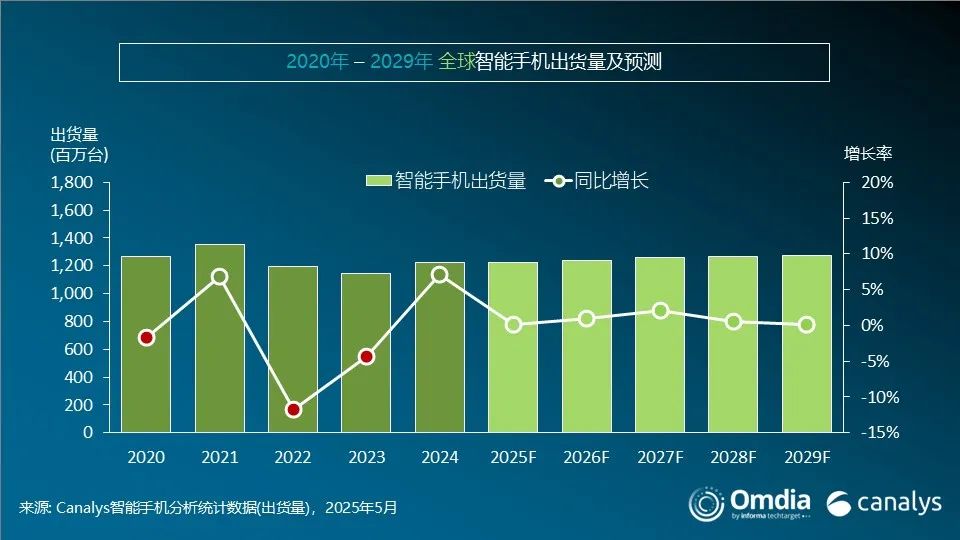
Global Smartphone Market Overview - The global smartphone market is expected to see a year-on-year growth of 0.2% in Q1 2025, indicating a recovery phase [1] - The total global smartphone shipments are projected to reach 1.22 billion units in 2025, reflecting a slight increase of 0.1% compared to the previous year [1] - The market is anticipated to grow at a modest compound annual growth rate (CAGR) of 1% from 2025 to 2029, facing challenges from low-end replacement demand and geopolitical uncertainties [1] High-End Smartphone Market Insights - The high-end smartphone segment (priced above $600) experienced a year-on-year shipment increase of 12% in Q1 2025, driven by manufacturers' commitment to premium offerings and advancements in AI technology [4] - Apple leads the high-end market with a 59% share, showing a 10% growth year-on-year [5] - Huawei's high-end segment grew by 69%, capturing a 9% market share, while Google and Xiaomi also reported significant growths of 21% and 81% respectively [4][5] Regional Market Performance - In the Asia-Pacific region (excluding Greater China), Apple holds a 61% market share in the high-end segment, with a 12% year-on-year growth [7] - In North America and Latin America, Apple dominates with a 71% market share, reflecting an 18% increase [7] - In Europe, the Middle East, and Africa, Apple maintains a 55% share with a 15% growth, while Samsung follows with a 37% share and a 13% increase [9] AI Smartphone Projections - The penetration rate of AI smartphones is expected to reach 34% by 2025, supported by advancements in chip capabilities and model efficiency [9] - Apple leads the global AI smartphone market with a shipment of 43.6 million units, accounting for 58% of the market [12] - In mainland China, Apple also leads with a 40% market share in AI smartphones, followed by Xiaomi with 26% [16] Foldable Smartphone Forecast - The foldable smartphone market is projected to achieve only a 0.1% year-on-year growth in 2025, with major manufacturers attempting to stimulate demand through price reductions and SKU expansions [24] - 2026 is anticipated to be a pivotal year for the foldable market, potentially revitalized by Apple's rumored foldable product [24] 5G Smartphone Outlook - The penetration of 5G smartphones is expected to continue growing, with projections indicating that by 2029, 88% of smartphone shipments will be 5G-enabled [26]
谁能拒绝一个「会进化」的手机?
36氪· 2025-03-26 13:51
Core Viewpoint - The Samsung S25 series is set to initiate a significant shift towards AI integration in smartphones, enhancing user interaction and experience in daily life [3][23]. Group 1: AI Integration and Features - The S25 series builds on Samsung's previous advancements in AI, particularly with the introduction of Galaxy AI, which enhances user interaction through multi-modal capabilities [5][8]. - Bixby now features multi-modal perception, allowing it to understand images, documents, and voice commands, providing a more comprehensive interaction experience [8][9]. - The S25 series includes a customized Snapdragon 8 Gen 2 mobile platform, strengthening its AI capabilities [6]. Group 2: User Experience Enhancements - Bixby's cross-application execution capability simplifies user tasks by allowing seamless interaction between different apps, such as setting alarms based on weather data [11]. - The intelligent drag-and-drop feature enables users to easily share information across applications, enhancing efficiency [13]. - Real-time window functionality allows users to control key applications directly from the lock screen, improving accessibility [17]. Group 3: Advancements in Mobile Imaging - The S25 series introduces an enhanced AI super-visual engine for intelligent optimization of photography, enabling users to capture professional-quality images [20]. - The device supports 10-bit HDR video recording, significantly improving color richness compared to previous models [22]. - AI features like audio eraser enhance video quality by removing background noise, catering to content creators [22]. Group 4: Market Context and Future Outlook - The AI smartphone market is expected to grow significantly, with predictions of a 73.1% increase in GenAI smartphones by 2025, reaching 405 million units [28]. - Samsung's early entry into the AI smartphone market with Galaxy AI has positioned it favorably against competitors like Apple and Huawei [28][29]. - The S25 series exemplifies a shift from traditional smartphones to AI-driven devices, promising a transformative user experience [29].