东吴行业轮动A

Search documents
刚刚过去的蛇年,你的基金赚钱了吗?
Sou Hu Cai Jing· 2026-02-25 09:15
Core Insights - The A-share market experienced a significant structural bull market during the Snake Year (January 29, 2025 - February 16, 2026), with the Shanghai Composite Index returning to 4000 points after ten years, while global capital markets showed a trend of strong stocks and stable bonds, alongside a historic surge in precious metals [2][3]. Market Performance - The A-share market saw substantial gains, with the Shanghai Composite Index rising by 25.58%, the Shenzhen Component Index by 38.84%, and the ChiNext Index by 58.73%. The Hong Kong market also performed well, with the Hang Seng Index increasing by 32.04%. Precious metals saw remarkable increases, with the Wande Silver Industry Index and Wande Gold Industry Index rising by 295.37% and 127.66%, respectively [3][4]. Fund Performance - The Snake Year was a "harvest year" for the public fund industry, with an average return of 24.13% across 12,027 funds, where 97.41% of funds achieved positive returns. Commodity funds led with an average return of 60.78%, while active equity funds averaged 39.82% with nearly 99% achieving positive returns. Index funds also performed well with an average return of 37.97%, and bond funds provided stable returns averaging 3.85% [4][5]. Top Performing Funds - A total of 170 funds achieved returns exceeding 100%, with six funds surpassing 150%. The top three funds were all focused on technology themes, with returns of 221.41% for Yongying Technology Select A, 171.25% for Huashang Balanced Growth A, and 163.23% for AVIC Opportunity Navigator A. Additionally, several funds related to non-ferrous metals also performed strongly, with returns exceeding 120% [5][6]. Underperforming Funds - Despite the overall strong market performance, 311 funds recorded negative returns, with 15 funds experiencing declines of over 10%. The worst performer was Tongtai Huize A, with a return of -21.17%, attributed to a change in fund management and a shift in investment focus [7][9].


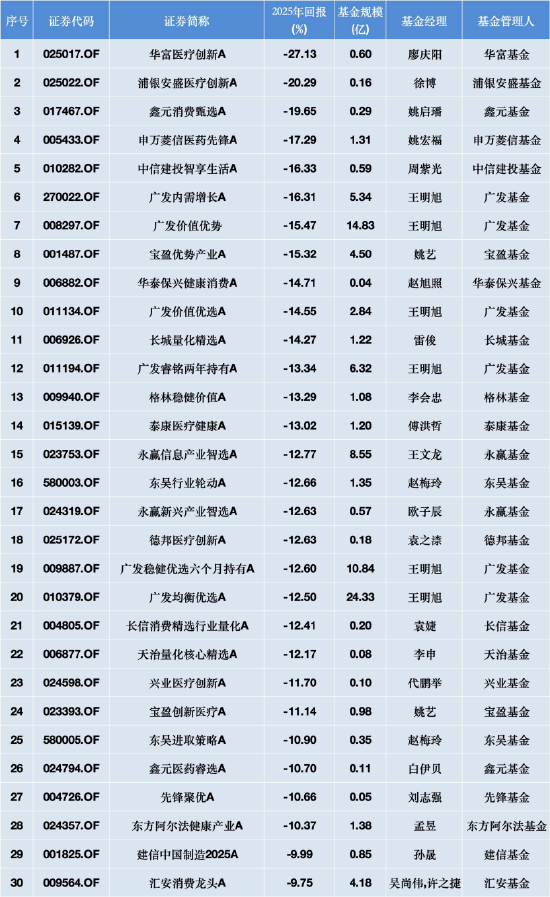
东吴基金赵梅玲在管2产品齐入年度跌幅榜TOP30,东吴进取策略A、东吴行业轮动A近三年跑输基准超40%
Xin Lang Cai Jing· 2026-01-07 08:10
Core Insights - The A-share market has shown an upward trend since 2025, leading to a general recovery in the performance of actively managed equity funds, with the total industry scale approaching a new high of 36 trillion [1][13] - Among 4,711 actively managed equity funds with performance records, 4,494 reported positive returns over the past year, while 217 had negative returns [1][13] - The top 30 funds with the largest declines all had annual returns below -9.75%, with several funds losing over 15%, including Huafu Medical Innovation A at -27.13% [1][14] Fund Performance - The worst-performing funds include: - Huafu Medical Innovation A: -27.13% return, size 0.60 billion [2][14] -浦银安盛医疗创新A: -20.29% return, size 0.16 billion [2][14] - 鑫元消费甄选A: -19.65% return, size 0.29 billion [2][14] - The performance of the top 30 funds with the largest declines indicates significant underperformance, with many funds experiencing substantial losses [1][15] Historical Performance Analysis - Dongwu Industry Rotation A and Dongwu Progress Strategy A, managed by Zhao Meiling, have shown poor performance, with returns of -12.66% and -10.90% respectively [3][15] - Both funds have long histories, with Dongwu Industry Rotation A established in April 2008 and Dongwu Progress Strategy A in May 2009, yet they have consistently underperformed in recent years [4][16] - The three-year returns for these funds are -22.25% and -24.34%, significantly lagging behind their benchmarks [4][16] Portfolio Composition - The two funds exhibit high similarity in their holdings, with overlapping top ten stocks that have generally performed poorly recently [5][17] - Key holdings for Dongwu Industry Rotation A include: - 分众传媒: 8.52% - 恒瑞医药: 6.94% - 圆通速递: 6.71% [19] - Recent performance of these stocks has been detrimental to the funds' net values, with significant declines observed [19] Industry Trends - Zhao Meiling's funds have a long-term focus on consumer, pharmaceutical, and high-end manufacturing sectors, which have shown mixed performance in recent structural market conditions [12][24] - The overall market for actively managed equity funds in 2025 has been positive, but significant internal differentiation exists, with some thematic products and smaller funds struggling amid market volatility [12][24]