
个人消费贷不良资产包

Search documents
并购之王3亿抄底74亿不良资产
2 1 Shi Ji Jing Ji Bao Dao· 2026-01-24 15:21
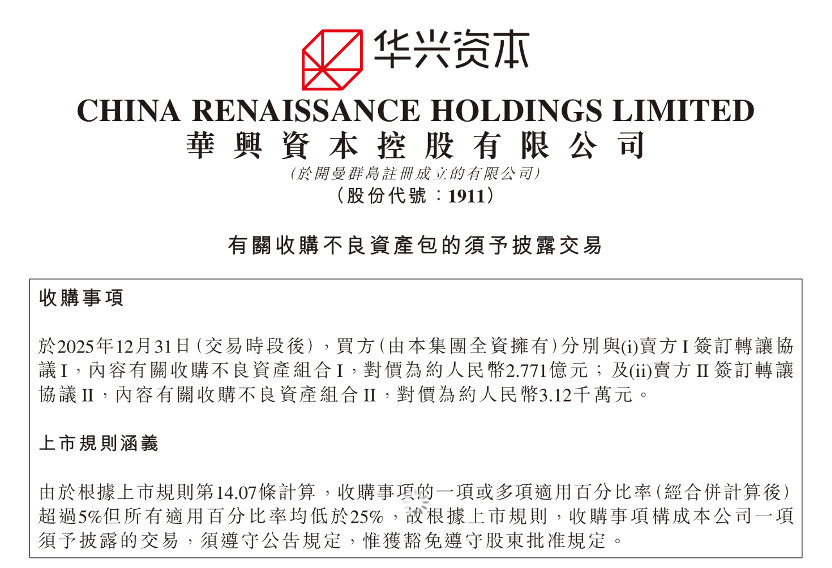
Core Viewpoint - Huaxing Capital, known for major mergers and acquisitions, is entering the distressed asset disposal market by acquiring a personal consumer loan bad debt package worth 7.429 billion yuan for 308 million yuan, marking a significant shift in its business strategy [1][2][3][5]. Group 1: Acquisition Details - The acquisition involves two bad debt packages from Qifu Technology, with a total principal amount of 7.429 billion yuan, purchased at an average discount rate of approximately 4.15% [5]. - The first package has an outstanding principal of 6.677 billion yuan with an average overdue period of 854 days, while the second package has an outstanding principal of 752 million yuan with an average overdue period of 439 days [7]. - Payment for the acquisition will be made in two installments: 74% within 25 business days after signing the transfer agreement, and the remaining 26% within 15 business days after the first payment [7]. Group 2: Market Context - The personal consumer loan bad debt market has seen a significant decline in prices, with the average discount rate dropping to 3.8% in Q1 2025, indicating a challenging environment for asset recovery [8]. - The market has witnessed extreme cases where consumer finance companies listed bad debt packages at significantly low starting prices, reflecting the tough conditions in the sector [8]. Group 3: Strategic Shift - Huaxing Capital is transitioning from a traditional investment bank to a technology-driven financial services firm, responding to declining revenues and seeking new growth avenues [10][11]. - The company reported a revenue drop from 1.58 billion yuan in 2022 to 780 million yuan in 2024, with a cumulative loss exceeding 1 billion yuan over three years [10]. - The entry into the distressed asset market is seen as a strategic move to establish capabilities in asset management and capitalize on potential returns as the market recovers [11]. Group 4: Industry Dynamics - The distressed asset disposal market is becoming increasingly competitive, with major players, including internet giants, actively participating and employing various operational models [13][14]. - The current market conditions, characterized by a high volume of non-performing loans, provide a substantial opportunity for new entrants like Huaxing Capital [13]. - The collaboration between strong financial backers and specialized asset management companies is enhancing asset recovery efficiency, addressing challenges faced by larger institutions [14].


并购之王3亿抄底74亿不良资产
21世纪经济报道· 2026-01-24 15:02
Core Viewpoint - Huaxing Capital, known for major mergers and acquisitions, has entered the distressed asset disposal market by acquiring a personal consumer loan bad debt package worth 7.429 billion yuan for only 308 million yuan, marking a significant shift in its business strategy [1][3][9]. Group 1: Acquisition Details - The two bad debt packages acquired from Qifu Technology have a total principal amount of 74.29 billion yuan, with an average discount rate of approximately 4.15% [3][6]. - The first package has an unpaid principal of 6.677 billion yuan with an average overdue period of 854 days, while the second package has an unpaid principal of 752 million yuan and an average overdue period of 439 days, with a higher proportion of debts overdue for one to two years [5][6]. Group 2: Market Context - The personal consumer loan bad debt market has seen a significant decline in prices, with the average discount rate for such assets dropping to 3.8% in Q1 2025, indicating a challenging environment for asset recovery [6][7]. - The market for distressed assets is becoming increasingly competitive, with major players like JD.com and Alibaba already establishing platforms for asset disposal, indicating a shift in the landscape [12][13]. Group 3: Strategic Shift - Huaxing Capital's move into the distressed asset sector is part of a broader transformation strategy aimed at addressing declining revenues from traditional investment banking activities, which fell from 1.58 billion yuan in 2022 to 780 million yuan in 2024 [8][9]. - The company aims to leverage this new venture not only for financial returns but also to build capabilities in asset management, positioning itself for future growth in a recovering market [9][10]. Group 4: Challenges Ahead - Transitioning from a service-based model to holding assets involves significant risks, including the need for substantial capital and the long recovery periods typical of distressed asset management, which can take 4-6 years to break even [10][12]. - The success of Huaxing Capital in this new domain will depend on its ability to quickly develop the necessary expertise and operational frameworks to effectively manage and recover these assets [13].

并购之王的新战场:华兴资本3亿抄底74亿不良资产背后
2 1 Shi Ji Jing Ji Bao Dao· 2026-01-23 13:27
Core Insights - Huaxing Capital, known for major mergers, is entering the distressed asset disposal market by acquiring a personal consumer loan bad debt package worth 7.429 billion yuan for 308 million yuan, reflecting a discount rate of approximately 4.15% [1][3][5] Company Overview - Huaxing Capital has transitioned from a traditional investment bank to a player in the distressed asset market, marking a significant shift in its business model [2][8] - The company has faced declining revenues, with total income dropping from 1.58 billion yuan in 2022 to 780 million yuan in 2024, resulting in cumulative losses exceeding 1 billion yuan [7] Market Context - The personal loan bad debt market has seen a significant decline in asset prices, with average discount rates dropping to historical lows of 3.8% in early 2025, indicating a challenging environment for asset recovery [6][10] - The market for distressed assets is becoming increasingly competitive, with major players like JD.com and Alibaba also entering the space, utilizing their platforms for asset disposal [10][11] Strategic Implications - Huaxing Capital's entry into the distressed asset sector is seen as a strategic move to diversify its revenue streams amid declining traditional business performance [7][12] - The acquisition is expected to provide potential high returns as the market recovers, with the company expressing confidence in the eventual recovery of a significant portion of the debts [8][12] Operational Challenges - The transition to holding distressed assets involves significant risks, including the need for substantial capital and the long recovery periods typically associated with such investments [8][12] - The company must overcome challenges related to asset recovery efficiency and the high costs associated with distressed asset management [12]
深度丨并购之王的新战场:华兴资本3亿抄底74亿不良资产背后
2 1 Shi Ji Jing Ji Bao Dao· 2026-01-23 13:23
Core Viewpoint - Huaxing Capital, known for major mergers, is entering the distressed asset disposal market by acquiring a personal consumer loan bad debt package worth 7.429 billion yuan for 308 million yuan, marking a significant shift in its business strategy [1][5]. Company Summary - Huaxing Capital has been recognized for orchestrating significant mergers in the past, such as Didi and Kuaidi, and Meituan and Dianping, earning the title "King of Mergers" [4]. - The company has faced challenges in its traditional business, with total revenue declining from 1.58 billion yuan in 2022 to 780 million yuan in 2024, resulting in cumulative losses exceeding 1 billion yuan [4]. - In 2024, under new leadership, Huaxing Capital announced a strategic transformation towards "tech finance," aiming to reshape its governance and business model [5]. Industry Summary - The distressed asset market is seeing increased participation from various large industrial players, with a common model involving strong investment firms providing capital while local asset management companies handle operations [1][8]. - The average discount rate for personal consumer loan bad debts has dropped to a historical low of 3.8% in Q1 2025, indicating a challenging market environment [3]. - The total non-performing loan balance of commercial banks reached 3.5 trillion yuan by Q3 2025, suggesting a substantial market for asset disposal [7]. - The entry of new players into the distressed asset sector is expected to enhance competition and efficiency, although challenges such as long recovery periods and high disposal costs remain significant [8].