
个人消费贷款不良资产包

Search documents
消金行业加速“排雷” 地方AMC系处置主力
2 1 Shi Ji Jing Ji Bao Dao· 2025-10-21 14:15
Core Viewpoint - The consumer finance industry is experiencing a surge in the transfer market for non-performing assets, with major institutions like Hangzhou Bank Consumer Finance and Ant Consumer Finance listing over 3.1 billion yuan in personal loan non-performing asset packages, indicating a pressing need for asset structure optimization [1][2][5]. Summary by Sections Non-Performing Asset Transfers - Hangzhou Bank Consumer Finance announced the transfer of a personal consumer finance non-performing loan package totaling 1.974 billion yuan, with a starting price of only 70 million yuan, reflecting a significant discount of 96.45% [2][4]. - Ant Consumer Finance also launched a non-performing loan transfer project involving 1.179 billion yuan, with a starting price of 125 million yuan and a discount rate of approximately 90% [2][4]. - Other consumer finance companies, such as Bank of China Consumer Finance, have also joined the trend, with a total of nearly 850 million yuan in non-performing loans listed [3][4]. Market Trends and Characteristics - As of October 21, the total scale of personal consumer loan non-performing asset packages listed by consumer finance companies has exceeded 4.5 billion yuan, with an average discount rate of 6.17% [5][6]. - The common characteristics of these asset packages include a high number of accounts, small amounts, and a significant proportion of non-litigation assets, indicating potential for recovery through effective collection methods [5][9]. Reasons for Accelerated Asset Transfers - The primary reasons for the accelerated pace of asset transfers include the need to optimize asset-liability structures, alleviate post-loan pressure, and respond to market demand [9][10]. - Companies aim to reduce the impact of non-performing assets on their financial performance and focus on core business areas such as product innovation and risk control [9][10]. Challenges in Asset Recovery - The low pricing of non-performing assets is attributed to the increasing difficulty of recovery, particularly due to the small amounts and high number of accounts involved, which raises operational costs [10][11]. - The market is becoming more cautious in evaluating personal loan non-performing assets, as recovery may take 2-3 years, during which time the acquiring party must cover various costs [12][14]. Role of Local Asset Management Companies (AMCs) - Local AMCs have emerged as the main players in acquiring these low-priced non-performing asset packages, despite the challenges involved [13][14]. - The profitability of acquiring such assets depends on the ability to manage costs effectively and implement efficient recovery strategies [14][15]. Future Outlook - The market for personal non-performing asset disposal is expected to continue expanding, with opportunities for institutions that have the necessary resources and capabilities to engage in long-term investments [15].

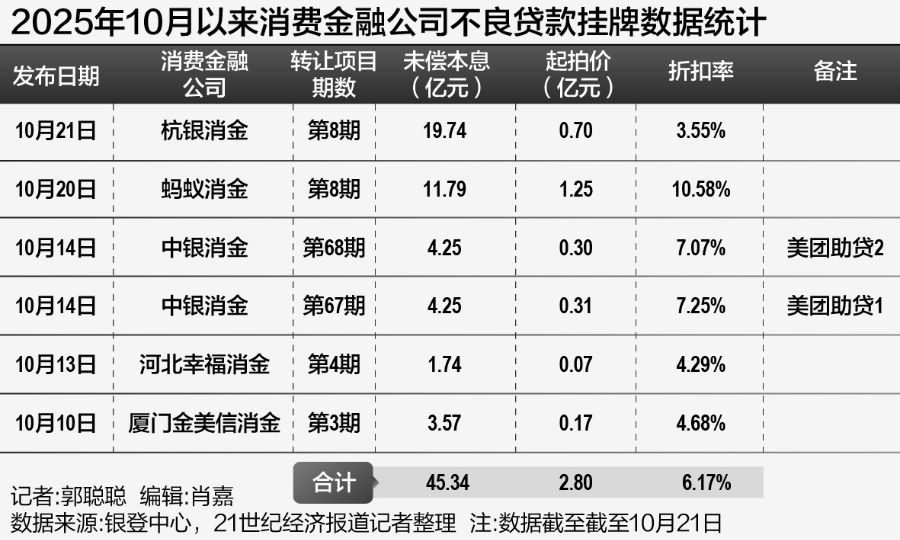
月内规模已超45亿元,有消金机构0.3折拍卖19.74亿元不良信贷包
2 1 Shi Ji Jing Ji Bao Dao· 2025-10-21 13:52
Core Viewpoint - The consumer finance industry is experiencing a surge in the transfer of non-performing assets, indicating a pressing need for financial institutions to optimize their asset structures [1][10]. Group 1: Non-Performing Asset Transfers - In October, major consumer finance institutions like Hangzhou Bank Consumer Finance and Ant Consumer Finance have listed non-performing loan packages totaling over 3.1 billion yuan, reflecting the urgency to improve asset quality [1][3]. - Hangzhou Bank Consumer Finance announced a non-performing loan package with an outstanding principal and interest of 1.974 billion yuan, with a starting price of only 70 million yuan, resulting in a significant discount of 96.5% [3][5]. - Ant Consumer Finance also launched a non-performing loan package with an outstanding amount of 1.179 billion yuan, with a starting price of 125 million yuan, reflecting a discount rate of approximately 90% [3][5]. Group 2: Market Dynamics and Trends - The total amount of non-performing loan packages listed by consumer finance companies in October has exceeded 4.5 billion yuan, with an average discount rate of 6.17% [5][10]. - The characteristics of these asset packages include a high number of borrowers, small loan amounts, and a significant proportion of non-litigation assets, indicating potential for recovery [5][10]. - The pace of asset transfers has been high this year, with 19 out of 27 consumer finance companies listing non-performing loans, totaling 166 packages as of October 21 [7][9]. Group 3: Reasons for Accelerated Asset Transfers - Companies are motivated to transfer non-performing assets to optimize their asset-liability structures, reduce the impact of bad loans on performance, and free up resources for new business initiatives [10]. - The need to alleviate post-loan pressure is another factor, as managing non-performing loans requires significant human and material resources [10]. - Market demand for non-performing loans has also increased, with the launch of policies in 2021 facilitating the bulk transfer of personal bad loans, leading to a more active market [10]. Group 4: Challenges in Asset Recovery - The trend of "small amounts and many cases" in non-performing loans raises the cost of recovery, as significant resources are needed for collection efforts [11][12]. - The market is becoming increasingly cautious in evaluating personal loan non-performing assets, as the recovery process can take 2-3 years, with high associated costs [13]. - Local Asset Management Companies (AMCs) have emerged as the main players in acquiring these low-priced non-performing assets, despite the challenges of managing and recovering these loans [14][15].

超百亿资产包接连上架 四季度银行业不良处置按下加速键
Zheng Quan Shi Bao· 2025-10-14 17:36
Core Viewpoint - The recent announcements from Bohai Bank and Guangzhou Rural Commercial Bank regarding the transfer of significant asset packages reflect a broader trend in the banking industry to optimize asset structures and reduce capital occupation as the year-end approaches [1][4]. Group 1: Asset Transfer Details - Bohai Bank plans to transfer approximately 69.833 billion yuan in debt assets, which includes principal of about 49.937 billion yuan, interest of approximately 10.436 billion yuan, penalty interest of around 9.334 billion yuan, and judicial fees of about 0.126 billion yuan [2][3]. - The book value of the assets to be transferred is estimated at about 48.31 billion yuan as of December 31, 2024, with a minimum expected transfer price of no less than approximately 48.883 billion yuan, representing about 70% of the total debt amount [3]. - The asset package consists mainly of loans, with 174 accounts involved, including 108 loan accounts, 32 asset management plans, 32 bills, 2 factoring accounts, and 1 letter of credit [3]. Group 2: Industry Trends - Since October, nearly 10 banks have announced the transfer of non-performing loans, indicating a trend of accelerated asset clearing in the banking sector [5]. - The asset transfer announcements include various types of loans, with significant amounts involved, such as a personal consumption and operational loan transfer by Postal Savings Bank totaling approximately 0.238 billion yuan [5]. - Analysts suggest that banks typically accelerate the transfer of non-performing assets in the second half of the year, particularly in the fourth quarter, to manage short-term risk indicators while balancing long-term risk management [5]. Group 3: Asset Management Strategies - The industry is shifting towards more proactive management of non-performing assets, with some banks establishing specialized departments to enhance the value of these assets [7]. - There is a growing recognition that non-performing assets can still hold value, leading to the development of comprehensive management systems aimed at maximizing asset value through debt restructuring and collaboration with financial asset management companies [7]. - The market for non-performing asset disposal is becoming more mature, with banks enhancing asset classification, data modeling, and value assessment to improve negotiation capabilities [7][8].