
中医适宜技术

Search documents
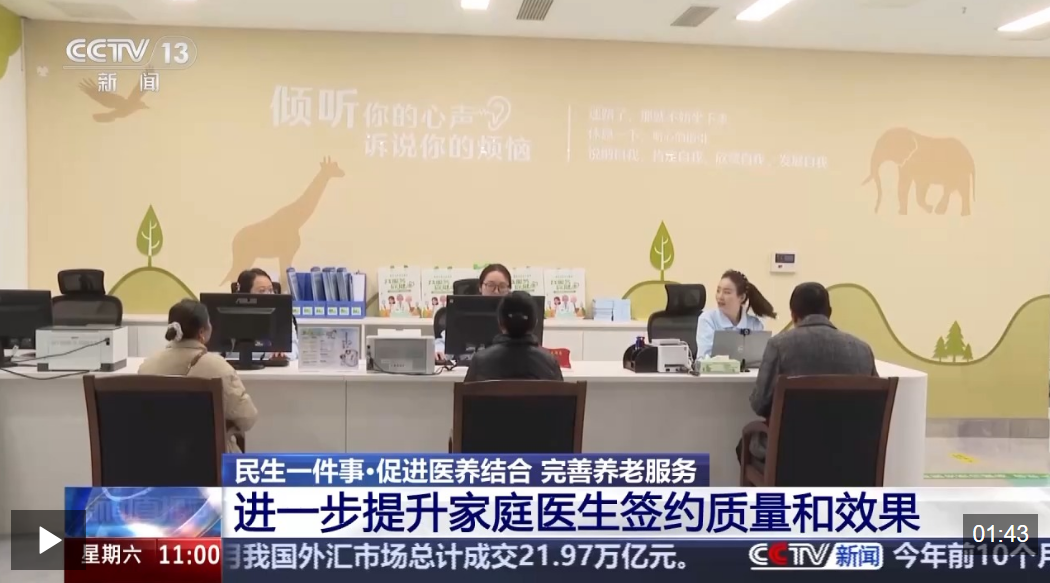
视频丨“治病+养老” 我国将大力发展居家和社区医养结合服务
Yang Shi Xin Wen Ke Hu Duan· 2025-11-29 11:55
Core Viewpoint - The Chinese government has initiated a three-year action plan to promote the integration of medical and elderly care services, aiming to enhance home and community-based care for the elderly, with a target of achieving at least 80% coverage of family doctor contracts for special elderly groups by the end of 2027 [1] Group 1: Policy and Implementation - The action plan will focus on developing home and community-based medical and elderly care services, improving the quality and effectiveness of family doctor contracts [1] - By the end of 2027, the coverage rate of family doctor contracts for elderly individuals with disabilities, high age, or other special difficulties is expected to reach no less than 80% [1] Group 2: Community and Institutional Support - In Chengdu's Wenjiang District, 10 grassroots medical institutions have formed 107 family doctor service teams to provide chronic disease management and vaccination services for elderly residents [4] - In Wanyuan County, Jiangxi Province, six township health centers have been transformed into nursing homes, providing over 500 nursing beds to support elderly care [11] Group 3: Training and Workforce Development - There is a significant shortage of certified elderly care workers in China, with only 500,000 available for a population of over 40 million disabled elderly individuals, indicating a potential demand for over 10 million caregivers [13] - The government plans to expand the training of elderly care professionals and support higher education institutions in establishing related programs, with a goal of adding no less than 30 new programs by the end of 2027 [19] Group 4: Technological Integration - The integration of "Internet + healthcare" and "Internet + nursing services" is being promoted to provide home-based medical services for elderly individuals [20] - Smart wearable devices are being utilized in elderly care communities to monitor health conditions and provide timely medical responses, enhancing the reliability of care services [21][24] Group 5: Rehabilitation and Community Services - The establishment of intelligent rehabilitation centers in rural areas aims to provide convenient access to rehabilitation training for elderly individuals, improving their quality of life [25] - The integration of traditional Chinese medicine and rehabilitation services is being emphasized to enhance the overall care provided to the elderly [27]

烟台市共有34个省级中医药重点专科,创建数量位居全省首位
Qi Lu Wan Bao Wang· 2025-10-22 11:27
Core Viewpoint - Yantai City has made significant progress in enhancing traditional Chinese medicine (TCM) services, focusing on improving public health and accessibility to TCM for the community [1][2][3] Group 1: TCM Service System Improvement - The TCM service system in Yantai has been gradually perfected, led by the Yantai TCM Hospital and supported by eight county-level TCM hospitals and grassroots medical institutions [2] - All public hospitals above the secondary level have established TCM departments, and the Yantai TCM Hospital's national TCM specialty project is ongoing with a new branch now operational [2] - The city has achieved full coverage of TCM "five generalizations" in nine public TCM hospitals and "two specialties and one center" construction in eight county-level TCM hospitals [2] Group 2: Enhancement of TCM Service Capacity - Yantai has established three national TCM specialty departments and 34 provincial key TCM specialties, ranking first in the province [2] - The Yantai TCM Hospital's oncology department has led the formation of a provincial TCM oncology specialty alliance [2] - Several hospitals have been recognized as flagship institutions for TCM integration, including Yuhuangding Hospital and Baishi Anorectal Hospital [2] Group 3: Diversification of TCM Services for the Public - Two districts have built smart shared TCM pharmacies for unified management of prescriptions, adjustments, and deliveries [3] - The implementation of staggered outpatient services, including lunch and evening clinics, has greatly facilitated access for working individuals and students [3] - The city has initiated specialized clinics for children and adolescents, focusing on conditions like scoliosis and myopia, with TCM interventions planned as key public health initiatives [3] Group 4: Future Plans for TCM Services - The Yantai Health Commission aims to deepen the construction of TCM services, enhancing the quality and capacity of TCM medical resources [3] - Plans include creating a comprehensive TCM service system that integrates prevention, treatment, and rehabilitation to better meet the growing health service demands of the public [3]
京师草原携手:让中医、蒙医与现代医学在草原开出融合之花
Zhong Guo Xin Wen Wang· 2025-08-24 01:58
Core Viewpoint - The integration of traditional Chinese medicine (TCM), Mongolian medicine, and modern medicine is being promoted in Inner Mongolia, enhancing healthcare services and patient satisfaction through collaborative efforts between Beijing and Inner Mongolia [2][4][5]. Group 1: Medical Collaboration - Since the 1990s, medical experts from Beijing have been providing support to Inner Mongolia, focusing on discipline construction, technical assistance, and talent training [2]. - The Beijing-Inner Mongolia "Medical Doubling Plan" has led to significant collaboration, with Beijing University of Chinese Medicine's Dongzhimen Hospital sending 19 medical experts to Inner Mongolia, treating over 20,000 patients since 2021 [2][4]. - Specialized departments have been established, such as the "Sino-Mongolian Medicine Integration Center," which has increased outpatient visits significantly, with projected annual visits exceeding 6,000 for pain management [2][4]. Group 2: Multidisciplinary Dialogue - The integration of multiple medical systems is seen as a way to foster inclusive and innovative treatment models, with a focus on collaboration and mutual enhancement [3]. - The unique resources of Mongolian medicine and its theoretical framework complement modern medicine, creating a dynamic knowledge system that benefits patient care [3]. - The use of modern technology is encouraged to enhance traditional diagnostic and treatment methods, aiming for standardized and visualized practices [3]. Group 3: Patient-Centric Outcomes - The establishment of the "Sino-Mongolian Medicine Integration Center" has filled gaps in local healthcare services, particularly in pain management and preventive care, leading to a patient satisfaction rate of 98% [4][5]. - The hospital has seen a 103.6% increase in the number of Mongolian patients treated in the first half of 2025 compared to the previous year, indicating a growing recognition of TCM and Mongolian medicine as a distinctive health service brand along the China-Russia-Mongolia economic corridor [6].