
康复护理

Search documents
中国银河证券:医改持续推进 医保月度收支增速回正
智通财经网· 2026-01-07 01:33
Core Viewpoint - The investment outlook for the pharmaceutical industry is optimistic for 2026, with valuations having returned to relatively low levels after recent fluctuations, suggesting a potential resurgence in growth. The focus should be on hard technology in pharmaceuticals and niche segments, particularly innovative drugs, medical devices, and healthcare AI [1] Group 1: Policy and Market Dynamics - Continued deepening of medical reform and optimization of centralized procurement and medical insurance payment methods are expected. The Central Economic Work Conference highlighted the need to optimize drug procurement and enhance support for vulnerable groups [2] - The optimization of centralized procurement rules is accelerating domestic substitution. The national centralized procurement has covered 435 varieties, with the latest batch focusing on 55 clinically mature drugs, ensuring clinical accessibility and quality consistency [3] Group 2: Medical Insurance and Payment Systems - The ongoing medical reform aims to transition from a focus on "scale" to "value," with the introduction of outpatient APGs to promote integrated care. The adjustment of the national medical insurance drug list and the establishment of a commercial insurance innovative drug directory are expected to enhance coverage [4] - The expansion of rehabilitation and nursing services is driven by an aging population and the prevalence of chronic diseases. The rehabilitation market is expected to grow through hardware expansion, intelligent rehabilitation devices, community integration, and improved payment systems [5] Group 3: Financial Performance of Medical Insurance - The overall operation of the medical insurance fund is stable, with a reported income of 26,320.68 billion yuan and an expenditure of 21,100.46 billion yuan for the first 11 months of 2025, showing a year-on-year income growth of 2.92% and expenditure growth of 0.51% [6]

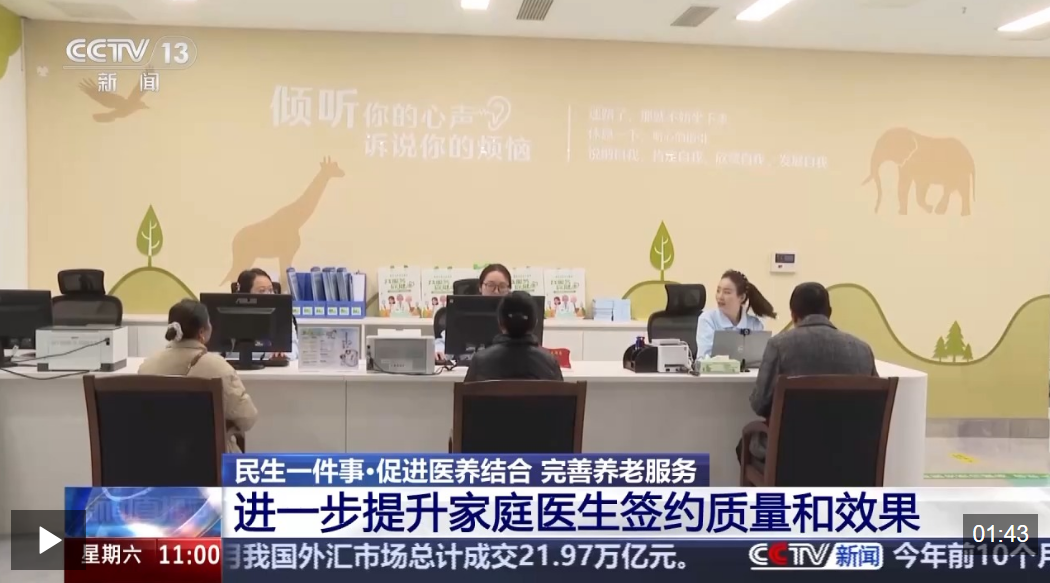
视频丨“治病+养老” 我国将大力发展居家和社区医养结合服务
Yang Shi Xin Wen Ke Hu Duan· 2025-11-29 11:55
Core Viewpoint - The Chinese government has initiated a three-year action plan to promote the integration of medical and elderly care services, aiming to enhance home and community-based care for the elderly, with a target of achieving at least 80% coverage of family doctor contracts for special elderly groups by the end of 2027 [1] Group 1: Policy and Implementation - The action plan will focus on developing home and community-based medical and elderly care services, improving the quality and effectiveness of family doctor contracts [1] - By the end of 2027, the coverage rate of family doctor contracts for elderly individuals with disabilities, high age, or other special difficulties is expected to reach no less than 80% [1] Group 2: Community and Institutional Support - In Chengdu's Wenjiang District, 10 grassroots medical institutions have formed 107 family doctor service teams to provide chronic disease management and vaccination services for elderly residents [4] - In Wanyuan County, Jiangxi Province, six township health centers have been transformed into nursing homes, providing over 500 nursing beds to support elderly care [11] Group 3: Training and Workforce Development - There is a significant shortage of certified elderly care workers in China, with only 500,000 available for a population of over 40 million disabled elderly individuals, indicating a potential demand for over 10 million caregivers [13] - The government plans to expand the training of elderly care professionals and support higher education institutions in establishing related programs, with a goal of adding no less than 30 new programs by the end of 2027 [19] Group 4: Technological Integration - The integration of "Internet + healthcare" and "Internet + nursing services" is being promoted to provide home-based medical services for elderly individuals [20] - Smart wearable devices are being utilized in elderly care communities to monitor health conditions and provide timely medical responses, enhancing the reliability of care services [21][24] Group 5: Rehabilitation and Community Services - The establishment of intelligent rehabilitation centers in rural areas aims to provide convenient access to rehabilitation training for elderly individuals, improving their quality of life [25] - The integration of traditional Chinese medicine and rehabilitation services is being emphasized to enhance the overall care provided to the elderly [27]

【环时深度】APEC为何首次将“应对人口结构变化”设为全面议题?
Huan Qiu Shi Bao· 2025-10-29 23:25
Core Viewpoint - The APEC meeting in South Korea will address the significant demographic changes in the Asia-Pacific region, with a focus on transforming demographic challenges into economic opportunities through regional cooperation [1][2]. Demographic Changes - The proportion of individuals aged 60 and above in the Asia-Pacific region is projected to rise from 15.1% in 2024 to approximately 25% by 2050, indicating a significant demographic shift [3]. - South Korea is expected to enter a "super-aged society" by 2024, with over 20.2% of its population aged 65 and older, while its total fertility rate is projected to drop to between 0.72 and 0.75, marking a historical low [2][3]. Economic Implications - The demographic transition presents both challenges and opportunities for economic restructuring, necessitating reforms to foster new growth drivers and sustainable prosperity [3][4]. - Industries such as traditional manufacturing may face pressure to relocate to regions with younger populations, while sectors related to healthcare, elder care, and technology are anticipated to experience significant growth [4][10]. Policy Responses - Various countries are implementing policies to address declining birth rates, with South Korea reporting a 7.4% increase in births in the first half of the year, attributed to government support measures [6]. - Spain has also seen a positive trend in birth rates due to family support policies, including extended parental leave and enhanced childcare services [7]. Regional Cooperation - The integration of artificial intelligence and demographic change discussions at the APEC meeting highlights the need for collaborative solutions to labor shortages and the creation of new economic opportunities [9]. - The diversity in demographic challenges across Asia-Pacific countries can be leveraged for mutual benefits through labor mobility, capital collaboration, and technology exchange [10].
优化银发经济发展路径 破解“政策热、市场难”
Zheng Quan Shi Bao· 2025-07-10 18:30
Core Insights - The silver economy in China is recognized as a high-potential sector, but challenges such as policy gaps and market difficulties persist, leading to operational hardships for market players [1][2] - The growth of the silver economy is driven by both policy and market forces, with a significant increase in the number of elderly care-related enterprises and a rise in demand for services like rehabilitation, education, and healthcare [1][3] - The current economic environment presents structural imbalances in supply and demand within the silver market, necessitating a reevaluation of consumer capabilities and willingness to spend [2][4] Current Development Trends - As of December 31, 2024, there are approximately 160,000 elderly care-related enterprises in China, marking a 24.36% increase from the end of 2023 [1] - Key sectors such as rehabilitation care, elderly education, and medical care have seen growth rates of 36.05%, 34.15%, and 31.26% respectively [1] - The demand for elderly-friendly renovations, smart elderly care, and silver tourism is rapidly increasing, with silver tourism accounting for 20% of total national tourism [1] Challenges and Market Dynamics - The silver economy faces a dual challenge of demand contraction and supply surplus, with the aging population not translating into effective demand due to economic constraints [2] - Misconceptions about potential demand versus effective demand hinder the assessment of risks and uncertainties in the silver economy [2] - The phenomenon of elderly individuals being unable to afford services or finding suitable services remains a significant issue [2] Characteristics of Silver Economy Development - The silver economy in China exhibits multi-layered and heterogeneous demand, with varying economic conditions and consumption behaviors across different elderly demographics and regions [3] - By 2035, it is anticipated that China will enter a stage of severe aging, further driving the need for diverse silver economy services [3] Strategic Recommendations - The development of the silver economy should leverage both public and private consumption resources, integrating government support with private sector engagement [6] - Policies should be optimized to facilitate demand release, transitioning from a government-led approach to a collaborative model involving both industry and service sectors [7] - A focus on technological innovation and the establishment of a comprehensive industrial chain is essential for sustainable growth in the silver economy [8][9]