企业孵化服务等

Search documents
《科技服务业标准体系建设指南(2025版)》发布
Ke Ji Ri Bao· 2026-02-11 06:50
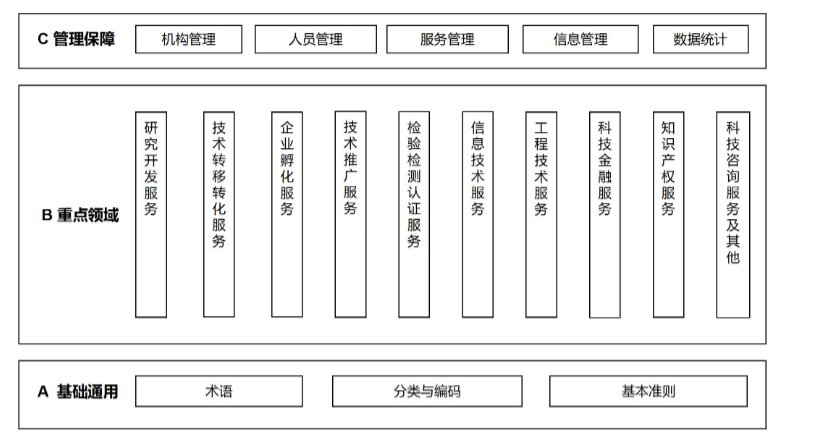
Core Viewpoint - The Ministry of Industry and Information Technology, along with other departments, has issued the "Guidelines for the Construction of the Standard System for the Technology Service Industry (2025 Edition)" to support and lead the high-quality development of the technology service industry [1] Group 1: Overview of the Technology Service Industry - The technology service industry utilizes modern scientific knowledge and technology to provide intellectual services, focusing on the entire chain of technological innovation and efficient transformation of technological achievements [1] - Key services in this industry include research and development services, technology transfer services, enterprise incubation services, technology promotion services, inspection and certification services, information technology services, engineering technology services, technology finance services, intellectual property services, and technology consulting [1] Group 2: Standard System Development Goals - By 2027, the goal is to establish over 40 new national and industry standards for the technology service industry, creating a preliminary standard system that meets high-quality development needs and engaging over 1,000 enterprises in standard implementation [1] - By 2030, the aim is to develop over 80 new national and industry standards, achieving a basic standard system that effectively serves the technology service industry [1] Group 3: Structure of the Standard System - The standard system consists of three parts: basic general standards, key area standards, and management assurance standards [2] - Basic general standards provide foundational technical and requirement guidelines for the technology service industry, while key area standards focus on specific service areas, forming the core of the standard system [2] - Management assurance standards regulate service processes and risk control requirements, providing management and support for the technology service industry [2] Group 4: Implementation and Support - The Ministry of Industry and Information Technology will enhance collaboration among standardization technical organizations and coordinate efforts across industry, academia, research, and application to develop standards that meet industry needs [2] - There will be an emphasis on building a skilled workforce and supporting standardization organizations and professional institutions in training to improve the capabilities of standardization personnel [2]
五部门:到2027年 新制定科技服务业国家标准和行业标准40项以上
智通财经网· 2026-02-10 01:56
Core Viewpoint - The Ministry of Industry and Information Technology, along with other governmental bodies, has issued a notification regarding the "Guidelines for the Construction of the Standard System for the Technology Service Industry (2025 Edition)", aiming to enhance the standardization of the technology service industry and support its high-quality development by establishing a comprehensive standard system by 2030 [1][2][4]. Group 1: Current Development of the Technology Service Industry - The technology service industry is a new sector that provides intellectual services based on modern scientific knowledge and technology, focusing on the entire chain of technological innovation and efficient transformation of technological achievements [5]. - The industry has seen rapid growth in recent years, with new service entities emerging and service formats diversifying, making it a crucial aspect of global technological competition [5]. Group 2: Overall Requirements - The guidelines emphasize a systematic approach, innovation-driven strategies, and open cooperation to promote the formulation, implementation, and internationalization of standards in the technology service industry [6]. - By 2027, over 40 national and industry standards will be established, targeting more than 1,000 enterprises for standard implementation, with a goal of 80 standards by 2030 [6]. Group 3: Construction Ideas - The standard system structure includes three parts: basic general standards, key area standards, and management assurance standards [7]. - Basic general standards will provide foundational support for other standards, while key area standards will focus on specific service domains such as research and development, technology transfer, and consulting services [7]. Group 4: Construction Content - Basic general standards will cover terminology, classification and coding, and basic principles to support standardization activities [11][12]. - Key area standards will address various services including research and development, technology transfer, enterprise incubation, and technology promotion, among others [13][14][15][16][17][18][19][20][21][22][23][24]. - Management assurance standards will regulate aspects such as organizational management, personnel management, service management, information management, and data statistics [25][26][27][28][29][30]. Group 5: Organizational Implementation - The guidelines call for enhanced coordination among standardization organizations and collaboration across academia, industry, and research to develop standards that meet industry needs [31]. - There will be a focus on promoting and training for key standards, guiding enterprises to meet these standards, and fostering international cooperation in standardization activities [31].