
技术转移转化服务

Search documents
《科技服务业标准体系建设指南(2025版)》发布
Ke Ji Ri Bao· 2026-02-11 06:50
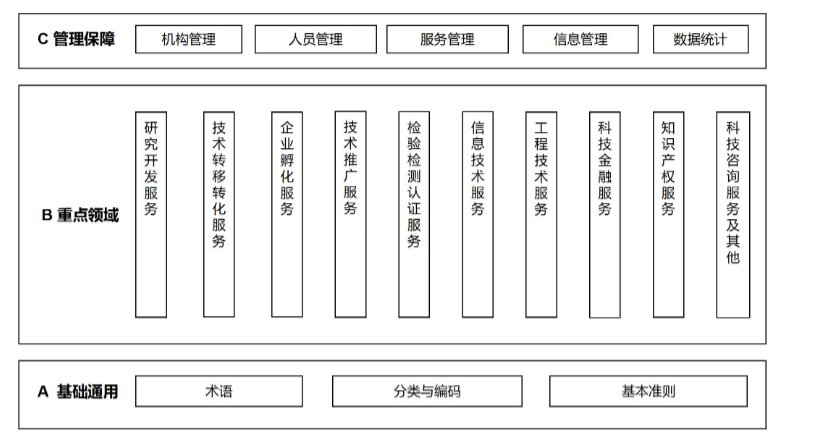
Core Viewpoint - The Ministry of Industry and Information Technology, along with other departments, has issued the "Guidelines for the Construction of the Standard System for the Technology Service Industry (2025 Edition)" to support and lead the high-quality development of the technology service industry [1] Group 1: Overview of the Technology Service Industry - The technology service industry utilizes modern scientific knowledge and technology to provide intellectual services, focusing on the entire chain of technological innovation and efficient transformation of technological achievements [1] - Key services in this industry include research and development services, technology transfer services, enterprise incubation services, technology promotion services, inspection and certification services, information technology services, engineering technology services, technology finance services, intellectual property services, and technology consulting [1] Group 2: Standard System Development Goals - By 2027, the goal is to establish over 40 new national and industry standards for the technology service industry, creating a preliminary standard system that meets high-quality development needs and engaging over 1,000 enterprises in standard implementation [1] - By 2030, the aim is to develop over 80 new national and industry standards, achieving a basic standard system that effectively serves the technology service industry [1] Group 3: Structure of the Standard System - The standard system consists of three parts: basic general standards, key area standards, and management assurance standards [2] - Basic general standards provide foundational technical and requirement guidelines for the technology service industry, while key area standards focus on specific service areas, forming the core of the standard system [2] - Management assurance standards regulate service processes and risk control requirements, providing management and support for the technology service industry [2] Group 4: Implementation and Support - The Ministry of Industry and Information Technology will enhance collaboration among standardization technical organizations and coordinate efforts across industry, academia, research, and application to develop standards that meet industry needs [2] - There will be an emphasis on building a skilled workforce and supporting standardization organizations and professional institutions in training to improve the capabilities of standardization personnel [2]
五部门:到2027年 新制定科技服务业国家标准和行业标准40项以上
智通财经网· 2026-02-10 01:56
Core Viewpoint - The Ministry of Industry and Information Technology, along with other governmental bodies, has issued a notification regarding the "Guidelines for the Construction of the Standard System for the Technology Service Industry (2025 Edition)", aiming to enhance the standardization of the technology service industry and support its high-quality development by establishing a comprehensive standard system by 2030 [1][2][4]. Group 1: Current Development of the Technology Service Industry - The technology service industry is a new sector that provides intellectual services based on modern scientific knowledge and technology, focusing on the entire chain of technological innovation and efficient transformation of technological achievements [5]. - The industry has seen rapid growth in recent years, with new service entities emerging and service formats diversifying, making it a crucial aspect of global technological competition [5]. Group 2: Overall Requirements - The guidelines emphasize a systematic approach, innovation-driven strategies, and open cooperation to promote the formulation, implementation, and internationalization of standards in the technology service industry [6]. - By 2027, over 40 national and industry standards will be established, targeting more than 1,000 enterprises for standard implementation, with a goal of 80 standards by 2030 [6]. Group 3: Construction Ideas - The standard system structure includes three parts: basic general standards, key area standards, and management assurance standards [7]. - Basic general standards will provide foundational support for other standards, while key area standards will focus on specific service domains such as research and development, technology transfer, and consulting services [7]. Group 4: Construction Content - Basic general standards will cover terminology, classification and coding, and basic principles to support standardization activities [11][12]. - Key area standards will address various services including research and development, technology transfer, enterprise incubation, and technology promotion, among others [13][14][15][16][17][18][19][20][21][22][23][24]. - Management assurance standards will regulate aspects such as organizational management, personnel management, service management, information management, and data statistics [25][26][27][28][29][30]. Group 5: Organizational Implementation - The guidelines call for enhanced coordination among standardization organizations and collaboration across academia, industry, and research to develop standards that meet industry needs [31]. - There will be a focus on promoting and training for key standards, guiding enterprises to meet these standards, and fostering international cooperation in standardization activities [31].

集聚5.5万家科技企业 前海科技服务业政策再加码
2 1 Shi Ji Jing Ji Bao Dao· 2025-10-21 15:03
Core Insights - The recent release of the "Measures to Support the High-Quality Development of the Technology Service Industry" by the Qianhai Management Bureau aims to enhance the technology service sector in the Qianhai area, effective from October 9, 2025 [1][2] Group 1: Policy Measures - The measures include support for key areas such as research and experimental development, intellectual property, industrial design, technology transfer, and enterprise incubation, with individual institutions eligible for up to 10 million yuan in annual support [2][3] - Specific incentives include 1 million yuan annually for national-level intellectual property platforms and 200,000 yuan for technology transfer institutions achieving over 10 million yuan in technology transactions [2] Group 2: Industry Growth - Since 2021, the number of technology service enterprises in Qianhai has grown by over 10% annually, with over 55,000 technology companies and more than 120,000 modern service enterprises as of September this year [1][3] - The modern service sector, including information and technology services, accounts for over 35% of the total modern service industry in Qianhai [1] Group 3: Infrastructure and Talent Support - The measures provide comprehensive support for space, talent, funding, and cross-border data flow, enhancing the region's capacity to host emerging industries and service scenarios [4][5] - Tax incentives are offered to Hong Kong residents working in Qianhai, exempting them from personal income tax exceeding their tax burden in Hong Kong [5] Group 4: Research and Development - Qianhai has established 191 innovation carriers, with significant growth in engineering technology research centers and public technology service platforms, fostering a robust ecosystem for innovation [3][4] - The measures encourage the transformation of major research outcomes from Hong Kong and international sources, with financial rewards for qualifying projects [5][6] Group 5: Economic Impact - The initiative aims to create a technology service industry cluster, promoting deep integration of technological and industrial innovation, thereby nurturing new economic growth drivers in the Guangdong-Hong Kong-Macao Greater Bay Area [6][7]
陕西五部门制定方案——到2027年培养技术经理人5000名
Shan Xi Ri Bao· 2025-08-25 23:46
Core Viewpoint - The "Action Plan for the Construction of Technical Manager Teams in Shaanxi Province (2025-2027)" aims to cultivate 5,000 technical managers with strong professional skills, practical abilities, and innovative spirit by 2027 [1][2] Group 1: Objectives and Goals - The plan includes the establishment of a talent pool of at least 200 outstanding technical managers and 60 gold medal technical managers, along with the addition of 1,000 professionals with technical transfer qualifications [1] - The initiative aims to enhance both the quantity and quality of the technical manager workforce in the province [1] Group 2: Key Tasks - The plan outlines four key tasks: promoting the training of technical managers, facilitating their career development, improving the recognition and evaluation mechanisms, and establishing reward and incentive systems [1] - It emphasizes the creation of a professional talent team covering the entire chain of technology transfer, relying on institutions like Xi'an Jiaotong University and the Qin Chuang Yuan Innovation Promotion Center [1] Group 3: Training and Development - The plan sets targets for training, including at least 1,000 short-term training sessions annually, 300 long-term advanced training sessions, and a minimum of 30 annual enrollments in degree programs [1] - It aims to establish no fewer than 80 training bases for technical managers across the province, serving at least 1,000 individuals each year [1] Group 4: Recognition and Compensation - The plan optimizes the recognition process for technical managers, introducing a full-cycle management model that includes training, qualification recognition, continuous education, and dynamic assessment [2] - It encourages a market-oriented compensation structure for technical managers, combining base salary, transformation rewards, and equity appreciation [2] - The plan also provides up to 200,000 yuan in technical maturation support for transformation enterprises based on project quantity [2]