
研究开发服务

Search documents
《科技服务业标准体系建设指南(2025版)》发布
Ke Ji Ri Bao· 2026-02-11 06:50
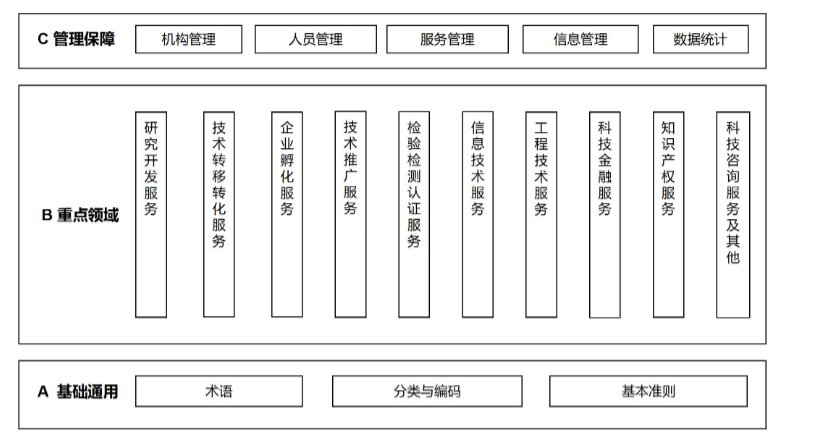
Core Viewpoint - The Ministry of Industry and Information Technology, along with other departments, has issued the "Guidelines for the Construction of the Standard System for the Technology Service Industry (2025 Edition)" to support and lead the high-quality development of the technology service industry [1] Group 1: Overview of the Technology Service Industry - The technology service industry utilizes modern scientific knowledge and technology to provide intellectual services, focusing on the entire chain of technological innovation and efficient transformation of technological achievements [1] - Key services in this industry include research and development services, technology transfer services, enterprise incubation services, technology promotion services, inspection and certification services, information technology services, engineering technology services, technology finance services, intellectual property services, and technology consulting [1] Group 2: Standard System Development Goals - By 2027, the goal is to establish over 40 new national and industry standards for the technology service industry, creating a preliminary standard system that meets high-quality development needs and engaging over 1,000 enterprises in standard implementation [1] - By 2030, the aim is to develop over 80 new national and industry standards, achieving a basic standard system that effectively serves the technology service industry [1] Group 3: Structure of the Standard System - The standard system consists of three parts: basic general standards, key area standards, and management assurance standards [2] - Basic general standards provide foundational technical and requirement guidelines for the technology service industry, while key area standards focus on specific service areas, forming the core of the standard system [2] - Management assurance standards regulate service processes and risk control requirements, providing management and support for the technology service industry [2] Group 4: Implementation and Support - The Ministry of Industry and Information Technology will enhance collaboration among standardization technical organizations and coordinate efforts across industry, academia, research, and application to develop standards that meet industry needs [2] - There will be an emphasis on building a skilled workforce and supporting standardization organizations and professional institutions in training to improve the capabilities of standardization personnel [2]
五部门:到2027年 新制定科技服务业国家标准和行业标准40项以上
智通财经网· 2026-02-10 01:56
Core Viewpoint - The Ministry of Industry and Information Technology, along with other governmental bodies, has issued a notification regarding the "Guidelines for the Construction of the Standard System for the Technology Service Industry (2025 Edition)", aiming to enhance the standardization of the technology service industry and support its high-quality development by establishing a comprehensive standard system by 2030 [1][2][4]. Group 1: Current Development of the Technology Service Industry - The technology service industry is a new sector that provides intellectual services based on modern scientific knowledge and technology, focusing on the entire chain of technological innovation and efficient transformation of technological achievements [5]. - The industry has seen rapid growth in recent years, with new service entities emerging and service formats diversifying, making it a crucial aspect of global technological competition [5]. Group 2: Overall Requirements - The guidelines emphasize a systematic approach, innovation-driven strategies, and open cooperation to promote the formulation, implementation, and internationalization of standards in the technology service industry [6]. - By 2027, over 40 national and industry standards will be established, targeting more than 1,000 enterprises for standard implementation, with a goal of 80 standards by 2030 [6]. Group 3: Construction Ideas - The standard system structure includes three parts: basic general standards, key area standards, and management assurance standards [7]. - Basic general standards will provide foundational support for other standards, while key area standards will focus on specific service domains such as research and development, technology transfer, and consulting services [7]. Group 4: Construction Content - Basic general standards will cover terminology, classification and coding, and basic principles to support standardization activities [11][12]. - Key area standards will address various services including research and development, technology transfer, enterprise incubation, and technology promotion, among others [13][14][15][16][17][18][19][20][21][22][23][24]. - Management assurance standards will regulate aspects such as organizational management, personnel management, service management, information management, and data statistics [25][26][27][28][29][30]. Group 5: Organizational Implementation - The guidelines call for enhanced coordination among standardization organizations and collaboration across academia, industry, and research to develop standards that meet industry needs [31]. - There will be a focus on promoting and training for key standards, guiding enterprises to meet these standards, and fostering international cooperation in standardization activities [31].

黄奇帆:“十五五”期间,要把生产性服务业搞上去
Xin Lang Cai Jing· 2026-02-03 07:24
Core Viewpoint - The Fifth Enterprise Innovation Development Conference highlighted the importance of integrating technological and industrial innovation through five key stages, as emphasized by Huang Qifan, a prominent figure in China's innovation strategy [1][6]. Group 1: Five Stages of Innovation - The first stage, from 0 to 1, involves original accumulation where 20% of R&D expenses should be allocated to self-reliant original innovation, including technological, theoretical, and scientific tool innovations [3][8]. - The second stage, from 1 to 100, focuses on transformation, ensuring that transformers hold patents and that the distribution of benefits among inventors, investors, and transformers is equitable, similar to the U.S. model [3][8]. - The third stage, from 100 to 1 million, encourages private equity, public funds, and venture capital to invest early, small, and in hard technology to create unicorn companies [3][8]. - The fourth stage, from 1 million to 10 billion, involves leading enterprises forming industrial clusters around major products, incorporating various productive service industries such as R&D, logistics, and finance [3][8]. - The fifth stage addresses market access, which includes standards for production systems, output scale, and product quality to prevent overcapacity [3][8]. Group 2: Role of Productive Services - Huang Qifan stated that each stage of innovation is linked to productive services, which stem from manufacturing and can significantly enhance the manufacturing sector by improving technological innovation, operational efficiency, profit generation, and the development of industrial clusters [3][8]. - Productive services can become the largest economic sector within a country, city, or society, contributing to GDP, unicorn development, and service trade [3][8]. Group 3: Strategic Importance - During the "14th Five-Year Plan" period, the key to implementing the central strategy of integrating innovation and industrial development lies in enhancing productive services, which will benefit GDP growth, unicorn development, and overall factor development [4][9].
科技服务业高质量发展“施工图”出炉 明确11项重点任务
Si Chuan Ri Bao· 2025-10-21 06:16
Core Points - The Sichuan Provincial Government has issued the "Implementation Plan for Accelerating the High-Quality Development of the Technology Service Industry (2025-2030)" to enhance the growth of the technology service sector [1][2] - By 2027, the technology service industry is expected to achieve significant results, with revenue from scientific research and technical services reaching 250 billion yuan, and the establishment of 20 strong technology service institutions [1] - The plan aims to cultivate a competitive technology service industry that integrates technological and industrial innovation, positioning it among the top in the country by 2030 [1] Summary by Categories - **Goals and Targets** - By 2027, the technology service industry revenue is projected to reach 250 billion yuan, with 20 strong institutions and 9,000 trained technical managers [1] - By 2030, the industry aims to be a key driver of innovation, with a focus on developing leading technology service organizations [1] - **Key Tasks** - The plan outlines 11 key tasks including research and development services, technology transfer, and enterprise incubation [2] - It emphasizes the need for systematic and professional services, promoting "smart transformation, digital transformation, and network connectivity" in the technology service sector [2] - **Infrastructure and Support** - The establishment of an integrated big data center system is highlighted to enhance data management and software development capabilities [2] - The plan includes actions for the digital transformation of the manufacturing sector, aiming to create a one-stop, intelligent transformation platform [2]