企业工作流自动化软件

Search documents
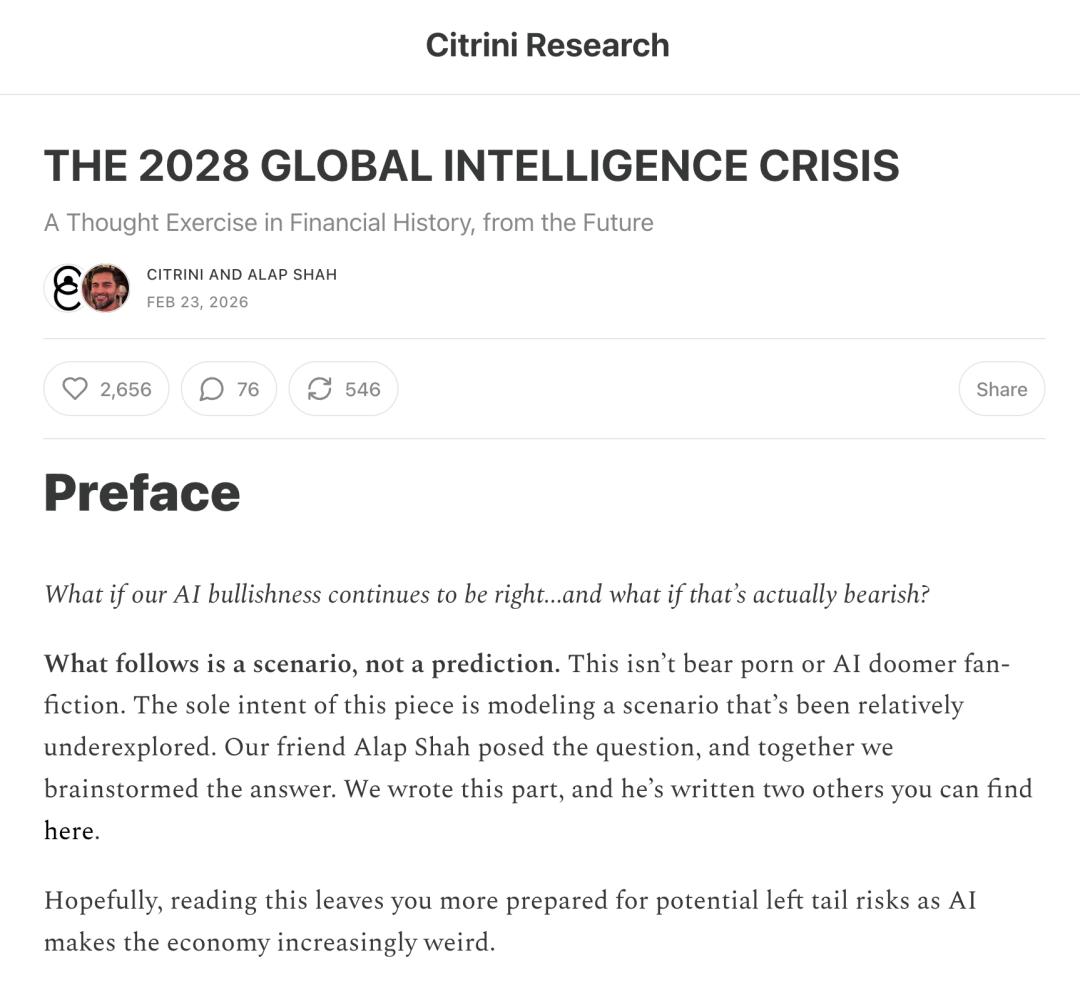
《2028全球智能危机》:一篇雄文引发股市恐慌背后的十个逻辑
3 6 Ke· 2026-02-25 05:52
Core Viewpoint - The article discusses the potential risks associated with the rapid advancement of AI technology, suggesting that the optimism surrounding AI may signal a bear market rather than economic growth. It highlights the disconnect between GDP growth driven by AI and the actual economic benefits experienced by the general population [5][45]. Group 1: Market Reaction - On February 23, 2026, the U.S. stock market experienced a significant drop, with the Dow Jones falling over 800 points and only 27% of stocks rising [5]. - Major companies like DoorDash, MongoDB, ServiceNow, and Salesforce saw declines of 7%, 6%, and 4% respectively, while financial firms like American Express and KKR dropped over 8% [5]. Group 2: Economic Implications of AI - The article introduces the concept of "Ghost GDP," where economic output increases without benefiting the average person, as AI-driven productivity bypasses human consumption [7][25]. - A negative feedback loop is described, where AI advancements lead to layoffs, which in turn drive further investment in AI, perpetuating job losses without a self-correcting mechanism [9][10]. Group 3: Corporate Behavior - Companies threatened by AI, such as ServiceNow, are becoming aggressive adopters of AI technologies, often resulting in significant layoffs to fund these investments [12][19]. - The article notes that traditional companies are rapidly embracing AI due to the immediate threats they face, contrasting with past scenarios where new entrants disrupted established firms [19][20]. Group 4: Consumer Spending Dynamics - The article emphasizes that machines do not spend money, which poses a risk to the consumer-driven economy, as 70% of U.S. GDP is derived from human consumption [25]. - The impact of white-collar job losses on consumer spending is highlighted, noting that the affluent contribute significantly to overall consumption, and their job losses could lead to a substantial decline in spending [29][30]. Group 5: Financial Sector Risks - The growth of private credit in the U.S. has led to increased funding for software companies, which may face revenue declines as AI replaces traditional roles [30][31]. - The article warns that even high-quality mortgage loans may become problematic as borrowers lose jobs or face salary reductions due to AI advancements [33][34]. Group 6: Policy Limitations - Traditional monetary policy tools, such as interest rate cuts, may not effectively address the structural unemployment caused by AI advancements [36][38]. - The article argues that existing economic frameworks are based on the assumption of human labor scarcity, which is being challenged by AI's capabilities [40][41].