企业金融

Search documents
申万宏源1月15日获融资买入1.69亿元,融资余额34.44亿元
Xin Lang Cai Jing· 2026-01-16 01:41
Core Viewpoint - Shenwan Hongyuan experienced a decline of 1.69% on January 15, with a trading volume of 701 million yuan, indicating a potential market reaction to recent financial activities [1] Financing Summary - On January 15, Shenwan Hongyuan had a financing buy-in amount of 169 million yuan, with a net financing buy of approximately 80.46 million yuan after repayments [1] - The total financing and securities lending balance reached 3.445 billion yuan, with the financing balance accounting for 2.91% of the circulating market value, indicating a high level compared to the past year [1] - The company repaid 205,800 shares in securities lending and sold 74,400 shares, with a selling amount of 390,600 yuan, while the securities lending balance was 1.3466 million yuan, which is below the 40th percentile of the past year [1] Company Profile - Shenwan Hongyuan Group Co., Ltd. is located in Urumqi, Xinjiang, and was established on September 16, 1996, with its listing date on January 26, 2015 [2] - The company's main business includes financial investment and equity investment, with revenue composition as follows: institutional services and trading 43.86%, personal finance 35.58%, and corporate finance 15.31% [2] - As of September 30, the company reported a total revenue of 19.499 billion yuan for the first nine months of 2025, reflecting a year-on-year growth of 11.70%, and a net profit attributable to shareholders of 8.016 billion yuan, up 108.22% year-on-year [2] Dividend Information - Since its A-share listing, Shenwan Hongyuan has distributed a total of 18.106 billion yuan in dividends, with 4.607 billion yuan distributed over the past three years [3] Shareholding Structure - As of September 30, 2025, the top ten circulating shareholders include China Securities Finance Corporation, holding 635 million shares, and Hong Kong Central Clearing Limited, which increased its holdings by 6.838 million shares to 395 million shares [3]

酒店商家三年0佣金,京东凭什么敢掀OTA的桌子?
3 6 Ke· 2025-06-19 02:49
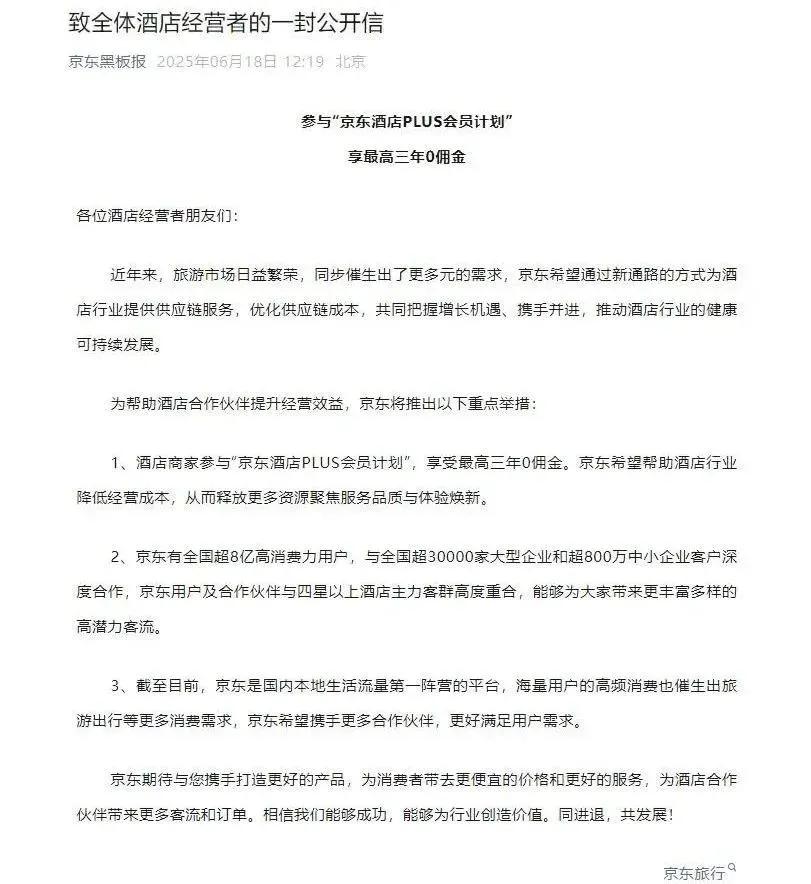
Core Viewpoint - JD.com has launched a zero-commission policy to aggressively enter the OTA market, aiming to leverage its extensive user base and supply chain capabilities to disrupt traditional hotel booking platforms [1][2][4]. Group 1: Zero-Commission Policy - JD.com announced the "JD Hotel PLUS Membership Plan," allowing hotel merchants to enjoy up to three years of zero commission, with no additional fees or complex performance metrics required [2][8]. - The zero-commission strategy is not new for JD.com, as it previously implemented a similar approach in the food delivery sector [3][4]. - The policy is designed to integrate with JD's membership system, creating a closed-loop for user traffic and enhancing customer loyalty [10]. Group 2: Strategic Intent - JD.com's entry into the hotel industry is driven by a focus on supply chain optimization, aiming to reduce procurement costs for hotels significantly [10][11]. - The company plans to leverage its existing partnerships with over 30,000 large enterprises and 8 million SMEs to tap into the business travel market, which aligns with its high-value user base [16]. - JD's approach contrasts with traditional OTA models by prioritizing membership benefits and user data accumulation before platform development [15][16]. Group 3: Competitive Landscape - The OTA market is becoming increasingly competitive, with various platforms adopting similar zero-commission strategies, which may lead to a dilution of profit margins across the industry [12][30]. - JD.com faces challenges in establishing a robust supply chain and acquiring exclusive hotel partnerships, particularly in the high-star hotel segment [21][25]. - The long-term success of JD's hotel business will depend on its ability to convert its large user base into loyal customers, overcoming the entrenched brand loyalty of established OTAs [26][28]. Group 4: Future Outlook - The competition in the OTA space is shifting from a focus on traffic acquisition to ecosystem building and service enhancement, indicating a potential transformation in the industry [31][32]. - JD.com's zero-commission initiative may signal the beginning of a new phase in the hotel booking sector, emphasizing supply chain efficiency and user value [29][32].