便携式辐射巡测仪

Search documents
研判2025!中国便携式辐射巡测仪行业产业链、市场规模及重点企业分析:技术赋能国产化加速,政策护航核能环保双驱动行业未来增长新空间[图]
Chan Ye Xin Xi Wang· 2025-11-11 01:16
Core Insights - The portable radiation survey meter industry in China is experiencing steady growth, with a market size projected to reach 484 million yuan in 2024, reflecting a year-on-year increase of 6.84% [1][4][5] - The industry is supported by strong demand in key sectors such as nuclear energy and environmental safety, bolstered by favorable national policies [1][4] Industry Overview - Portable radiation survey meters are handheld devices used for rapid detection of radioactive material concentrations or radiation intensity, suitable for various applications including nuclear facilities, research institutions, and environmental monitoring [2] - The industry is characterized by a concentrated market structure, with leading companies holding significant market shares [5] Industry Value Chain - The upstream of the industry includes essential raw materials and components such as GM counting tubes, NaI(Tl) scintillators, and microprocessors [2] - The midstream involves the manufacturing of portable radiation survey meters, while the downstream applications span nuclear industry, healthcare, and environmental monitoring [2] Market Size - The market for portable radiation survey meters is projected to grow to 484 million yuan in 2024, indicating a robust demand and strong industry momentum [4][5] Key Companies - Major players in the industry include China Nuclear Control Systems Engineering Co., Ltd., which has achieved significant technological breakthroughs and holds over 35% market share in domestic markets [6] - Other notable companies include West China Nuclear Instrument Co., Ltd., which focuses on radiation monitoring systems and has developed advanced detection technologies [8] Industry Development Trends 1. **Technological Innovation**: The industry is expected to integrate AI, IoT, and quantum dot detector technologies, enhancing precision and intelligence in devices [9] 2. **Policy and Demand Drivers**: The dual push from policies and increasing demand in nuclear energy and healthcare sectors is anticipated to expand market opportunities [9] 3. **Accelerated Domestic Replacement**: The self-sufficiency of core materials is expected to rise, reshaping the global competitive landscape [10]


行业聚焦:全球便携式辐射巡测仪市场头部企业份额调研(附Top 10 厂商名单)
QYResearch· 2025-10-21 09:22
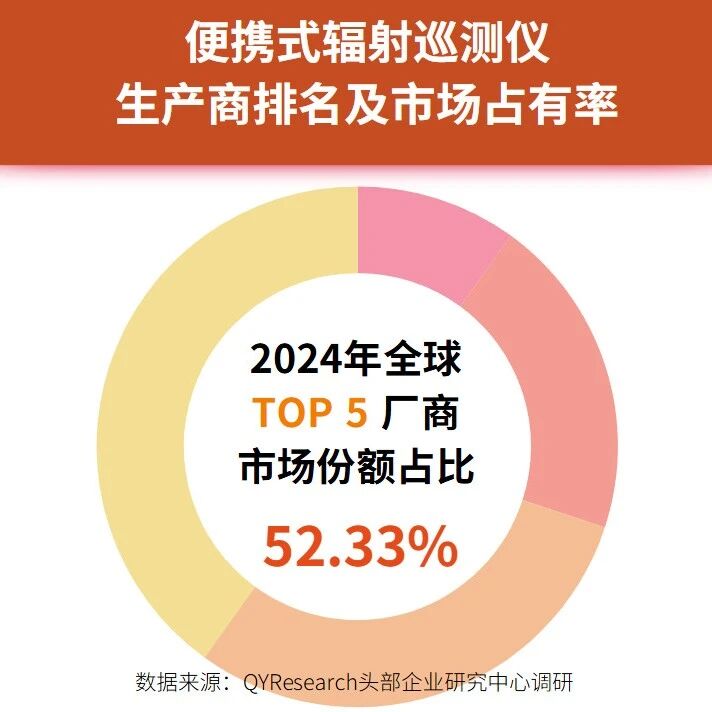
Core Viewpoint - The portable radiation survey instrument market is projected to reach $87.9 million by 2031, with a compound annual growth rate (CAGR) of 4.12% in the coming years [1]. Market Overview - The global market for portable radiation survey instruments is expanding, driven by increasing applications in nuclear energy, healthcare, and environmental monitoring [7]. - The top 12 manufacturers in the global market hold approximately 52.33% of the market share, with key players including Thermo Fisher Scientific, Mirion Technologies, and Fluke Corporation [6]. Key Drivers - Expansion of nuclear energy and radiation source applications, particularly in Asia and the Middle East, is increasing the demand for portable radiation detection equipment [7]. - Heightened awareness of nuclear safety and public health, influenced by historical incidents like Fukushima and Chernobyl, is leading to stricter regulations and increased demand for monitoring equipment [7]. - Government regulations and standards are mandating the use of portable radiation survey instruments in various sectors, including nuclear facilities and emergency response [7]. - Rising concerns over potential radiological threats, such as dirty bomb attacks and nuclear leaks, are driving emergency services to equip themselves with portable survey instruments [7]. Major Challenges - High costs of advanced equipment limit accessibility for small and medium enterprises, with some devices priced in the thousands to tens of thousands of dollars [8]. - Lack of awareness among non-professional users regarding radiation risks can lead to passive demand for monitoring devices [8]. - Issues with false alarms and environmental interference can undermine trust in the devices, particularly in complex electromagnetic environments [8]. - Inconsistent enforcement of regulations in smaller cities or non-priority industries results in low equipment penetration rates [9]. Industry Opportunities - Accelerated domestic substitution is occurring as the government encourages the development of high-end instruments, with local manufacturers gaining advantages in cost and service [10]. - Export opportunities are emerging in countries along the Belt and Road Initiative, as well as in regions like Africa and Southeast Asia where emergency response systems are underdeveloped [10]. - There is a trend towards multi-functional integrated devices that combine gas, radiation, and meteorological monitoring capabilities, enhancing comprehensive environmental monitoring [10].