信用报告

Search documents
征信“斩杀线”:美国吃干抹净,中国能走出另一条路吗?
Guan Cha Zhe Wang· 2026-02-12 05:33
Core Viewpoint - The People's Bank of China (PBOC) has introduced a one-time credit repair policy that allows individuals with overdue accounts of less than 10,000 yuan to have their credit records automatically cleared if they settle their debts by March 31, 2026, signaling a shift in the credit system from punishment to assistance [1][9][10]. Group 1: Current State of Credit Repair - Prior to the PBOC's policy, individuals with damaged credit had limited legal avenues for relief, with the official stance being that "credit repair" did not exist, leading to a lack of awareness and complex processes for legitimate appeals [2][3]. - The absence of legitimate options has allowed a gray market to flourish, with scams promising credit repair services that often result in victims losing personal information and money [3][4]. - The financial black market has seen a tenfold increase since 2021, leading to significant financial losses, with victims often facing harassment from debt collectors [3][4]. Group 2: Comparison with the U.S. System - The U.S. has a well-established credit repair industry, regulated by the Credit Repair Organizations Act (CROA), which allows consumers to seek assistance from legitimate agencies for a fee, while also having a darker side involving debt buying and collection practices that exploit consumers [5][6][7]. - The U.S. system emphasizes the monetization of credit scores, creating a complex industry where consumers are repeatedly charged for services related to their credit status [7][8]. Group 3: Future Directions for China's Credit System - The PBOC's policy reflects a different approach, aiming to provide a corrective opportunity for individuals with non-malicious credit issues, rather than forcing them to pay for score improvement [9][10]. - There is a growing consensus in the industry about the need for a market-oriented, sustainable service system that assists credit-damaged individuals in rebuilding their lives, rather than merely punishing them [11][12]. - A report suggests a comprehensive personal credit management service that extends beyond punitive measures to include proactive support in various life scenarios, such as employment and housing [12][13][14]. Group 4: Challenges and Opportunities - The main challenge for the credit industry in China is to develop legitimate market solutions quickly enough to outpace the black market, which continues to exploit consumer anxiety [15][16]. - The potential market for personal credit services is projected to reach between 80 billion to 100 billion yuan during the 14th Five-Year Plan period, indicating significant growth opportunities for legitimate service providers [15]. - The success of the credit repair initiative will depend on the collaboration between regulatory bodies, financial institutions, and the integration of public data to create a supportive environment for individuals seeking to improve their credit status [15][16].


交汇枢纽 通达四方
Sou Hu Cai Jing· 2026-02-02 23:14
Core Insights - The article highlights the significant growth and achievements of the Huai'an Transportation Investment Development Group during the 14th Five-Year Plan period, emphasizing its focus on high-quality development and integration of party leadership with corporate governance [3][4][11] Group 1: Financial Performance and Growth - The asset scale of the Huai'an Transportation Investment Development Group increased from approximately 51 billion to over 60 billion, reflecting an 18% growth rate, with an average annual revenue growth rate exceeding 10% [3] - The group has invested 5.592 billion in 75 projects during the 14th Five-Year Plan, leading to substantial increases in key economic indicators [8] - The public transportation group achieved over 88 million in revenue last year, with a year-on-year increase of approximately 11.23% in market-oriented income [10] Group 2: Operational Achievements - Huai'an Port has been recognized as a major inland port, with container throughput capacity projected to reach 1 million TEUs and cargo volume of 50 million tons upon completion of ongoing projects [6][7] - The public transportation group operates 1,089 buses and 26 trams, with an annual passenger volume exceeding 93 million, marking a nearly 10% year-on-year increase [7] - The data group has successfully launched over 20 data products, including the Huai'an Bus Data Set, marking a significant step in transforming public data into assets [9] Group 3: Strategic Initiatives and Reforms - The group has implemented various reform initiatives, including the "1030" and "1+7+N" actions, aimed at enhancing operational efficiency and governance structures [11] - A comprehensive risk management framework has been established, focusing on debt, operations, safety, and integrity, with over 95% of identified issues rectified [12] - The group has achieved a significant reduction in financing costs, with new financing rates dropping from 4.38% in 2022 to 3.41% currently [12]
山东省昌邑市:筑牢信用“硬支撑”,激发发展“新动能”
Zhong Guo Fa Zhan Wang· 2026-01-08 06:59
Core Viewpoint - The city of Changyi in Shandong Province has made significant strides in building a social credit system, enhancing the business environment, and innovating social governance models, transitioning from foundational infrastructure to deeper application and value realization, thereby providing robust credit support for high-quality economic and social development [1] Group 1: Credit Information Sharing and Application - Changyi has established a comprehensive database of personal and enterprise credit information, integrating over 1 million pieces of data across key areas such as administrative permits, penalties, market regulation, judicial rulings, and public services, effectively breaking down "information silos" [2] - The "Credit China (Weifang)" platform offers a one-stop authoritative credit information query service, supporting the development of a new regulatory mechanism based on credit and promoting a culture of integrity [2] Group 2: Regulatory Optimization and Support for Enterprises - A synchronized delivery mechanism for administrative penalty decisions and credit repair notifications has been implemented, addressing the challenges faced by enterprises in credit repair processes, achieving 100% coverage of notifications, and assisting over 500 enterprises in efficient credit restoration [3] - This initiative balances regulatory enforcement with supportive services, fostering stability and confidence among businesses [3] Group 3: Credit Empowerment and Efficiency Enhancement - The introduction of "credit reports" to replace traditional certificates has streamlined the process for enterprises, covering 52 fields and allowing for a "menu-style" selection based on specific needs, significantly reducing bureaucratic hurdles [4] - This reform enables enterprises to focus on innovation and development by minimizing administrative burdens [4] Group 4: Expanding Credit Value Applications - The "Credit+" initiative promotes the practical application of credit, such as the "Xinyi Loan" platform, which has facilitated loans totaling 4.716 billion yuan for enterprises with good credit status [5] - The implementation of a credit commitment system in administrative approvals allows eligible entities to substitute certain documentation with credit commitments, greatly enhancing efficiency [5] - The integration of credit into urban operations transforms it into a valuable asset, yielding tangible benefits for individuals and enterprises, and continuously injecting new momentum into the city's high-quality development [5]
多地网友“信用刷新”晒修复征信报告
Xin Jing Bao· 2026-01-05 00:21
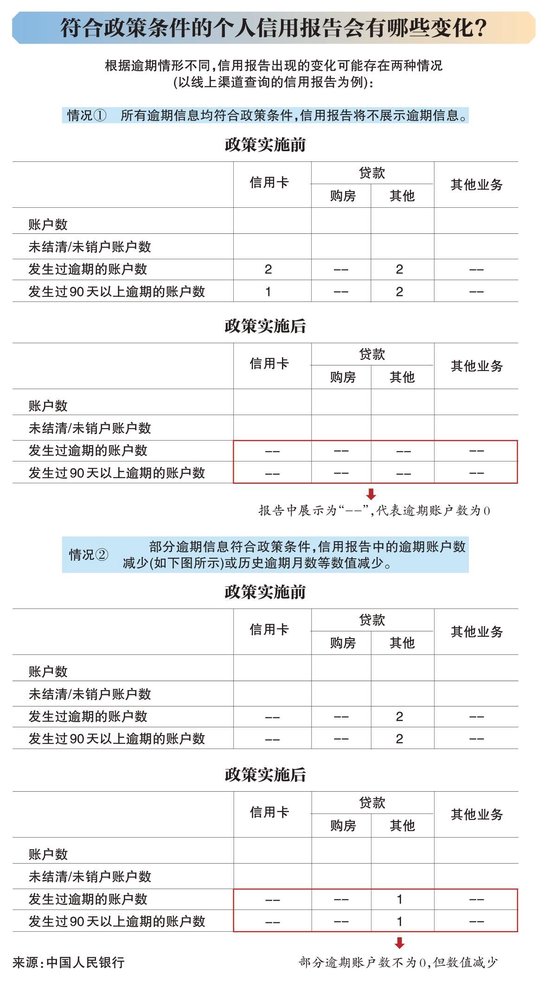
Core Viewpoint - The People's Bank of China has implemented a "one-time credit repair policy" that allows individuals with overdue debts of less than 10,000 RMB to have their credit records cleared if they repay their debts by March 31, 2026 [1][15]. Policy Details - The policy applies to personal overdue information generated between January 1, 2020, and December 31, 2025, for single overdue amounts not exceeding 10,000 RMB [1][17][18]. - Individuals must fully repay their overdue debts by March 31, 2026, for the credit information to not be displayed in the credit system [1][19]. - The policy does not differentiate between types of lending institutions or credit business categories [1][20]. Implementation and Impact - Many individuals have reported on social media that their overdue records have been removed from their credit reports after repayment, indicating the policy's effectiveness [11][29]. - The policy is designed to assist those who are not malicious defaulters and have actively sought to correct their credit status [30]. - A grace period is provided for individuals who repay their overdue debts between December 1, 2025, and March 31, 2026, allowing for the removal of related overdue information by the end of the following month [30]. Additional Features - The policy is automatic, meaning individuals do not need to apply or submit documentation for their credit records to be updated [31]. - The People's Bank of China has increased the number of free credit report checks to four for individuals in the first half of 2026, facilitating access to credit information [31]. - Individuals are advised to confirm repayment amounts with financial institutions to avoid issues that could prevent the application of the policy [32].
钱塘征信成为信用服务领域公共数据授权运营商
Zhong Guo Jing Ji Wang· 2025-10-22 05:40
Core Viewpoint - Qiantang Credit has been designated as a public data authorization operator in the credit service sector in Zhejiang Province, marking a significant step in exploring the "personal credit economy" and unlocking the value of data elements [1] Group 1: Company Overview - Qiantang Credit aims to create a digital credit profile for individuals based on user authorization, utilizing credit evaluation and reporting tools to enhance personal credit value recognition and self-management capabilities [1] - The company is positioned as a licensed personal credit institution in China, potentially serving as a replicable model for personal credit data circulation [1] Group 2: Market Context - The personal credit economy is defined as an emerging economic form centered around personal credit data, providing new credit services to individuals, financial institutions, and businesses [1] - Qiantang Credit plans to implement its services in various scenarios such as credit services, flexible employment, and grassroots governance, aiming to reduce information asymmetry and transaction costs [2] Group 3: Comparative Analysis - The model of Qiantang Credit bears similarities to South Korea's MyData service, which allows individuals to control their data and apply it across various management scenarios [2] - South Korea's MyData service has seen significant adoption, with over 50 million users and revenue reaching 2.5 trillion KRW (approximately 13 billion RMB) in 2023 [2] Group 4: Data Integration - Qiantang Credit has integrated nearly a hundred compliant commercial data sources, showcasing a new development in the fusion of public and commercial data in the data element sector [3] - The demand for personal credit management services based on public data is substantial, given the higher level of digital governance and public data infrastructure in China compared to South Korea [3]
浙江推出全国首个面向个人的可信数据空间 探索“个人信用经济”新赛道
Zheng Quan Ri Bao Wang· 2025-10-21 13:19
Core Insights - Qiantang Credit has been designated as the public data authorized operator in the credit service sector in Zhejiang Province, aiming to create the first trustworthy data space for individuals in China [1][2] - The initiative represents an exploration of the "personal credit economy," which focuses on the circulation of personal credit data and aims to provide new economic services based on credit for individuals, financial institutions, and businesses [1] - The construction of the trustworthy data space will enable the creation of digital credit profiles for users, enhancing their ability to connect with financial, commercial, and social services [1] Group 1 - Qiantang Credit will implement its services in various fields such as credit services, flexible employment, and grassroots governance, aiming to reduce information asymmetry and transaction costs [2] - The integration of public and commercial data sources is expected to improve risk management capabilities for institutions and provide better opportunities and services for consumers [2] - Qiantang Credit has already connected with nearly 100 compliant commercial data sources, showcasing a new development in the fusion of public and commercial data [2]
以信筑城 以诚兴城——包头市政务改革绘就便民利企新图景
Nei Meng Gu Ri Bao· 2025-09-18 01:19
Core Insights - The article highlights the significant reforms in Baotou's administrative services, particularly the "extremely simplified approval" process, which has streamlined procedures and reduced the time required for business operations by 80% and material requirements by 25% [1] - The establishment of a comprehensive credit system has improved operational efficiency for businesses, allowing for a 70% increase in efficiency and enabling companies to access government projects with zero deposit requirements [1][2] - The implementation of a risk grading system for businesses has enhanced consumer trust and market dynamics, with a notable increase in sales for businesses displaying high credit ratings [2] Group 1 - The "extremely simplified approval" process in Baotou has led to a reduction of 80% in processing time and a 25% decrease in required documentation for business operations [1] - A single credit report now replaces multiple documents previously needed for bidding processes, significantly improving efficiency and reducing the burden on businesses [1] - The credit application reform has released 250 million yuan in liquidity for businesses, demonstrating the positive impact of credit systems on market activity [1] Group 2 - The risk grading system covers 17,452 business units, allowing consumers to make informed purchasing decisions based on safety ratings [2] - The integration of credit systems into various sectors, including food sales and market measurements, has created a comprehensive regulatory network that promotes trust and accountability [2] - The shift from traditional government oversight to a proactive service model has reduced transaction costs and improved regulatory efficiency [3] Group 3 - The transformation in governance through the establishment of a cross-departmental credit data pool has broken down information barriers across 40 sectors [3] - The societal effects of these reforms are evident as consumers and businesses increasingly rely on credit ratings for decision-making, fostering a culture of integrity [3] - Baotou's approach serves as a model for modern governance, emphasizing the importance of integrating credit systems into public services and market regulation to create a sustainable economic environment [3]
福建“金服云”平台破解融资难题
Jing Ji Ri Bao· 2025-07-24 22:07
Core Viewpoint - The Fujian Jinfu Cloud Credit Company is enhancing financial services for enterprises through a digital platform that connects government policies, financial institutions, and businesses, facilitating easier access to financing and support for small and micro enterprises [1][2][3]. Group 1: Platform Overview - The Fujian Jinfu Cloud Credit Company, established in 2022, operates as a provincial financial infrastructure, serving as a bridge between government, finance, and enterprises [1]. - The platform has onboarded 286 financial institutions and offers over 1,200 financial products, with more than 173 million registered users [1]. - The platform has disbursed over 3.8 billion yuan in policy interest subsidies to more than 68,000 enterprises through various loan products [1]. Group 2: Service Expansion - The platform is expanding its services from simple financing to a "four-chain" integration, which includes innovation, industry, funding, and talent chains, to better meet enterprise needs [2]. - It has developed a smart matching system that connects enterprises with suitable financial products based on their needs and credit status [2]. Group 3: Financing Mechanism - A dedicated "Small and Micro Enterprise Financing Coordination Work Mechanism" has been established to streamline the process from demand publication to loan disbursement [3]. - The platform has facilitated over 850 billion yuan in non-repayable loans for more than 90,000 business entities, with over 20% of financing needs met through credit loans [3]. Group 4: Data Utilization - The platform integrates public and commercial data to create comprehensive credit profiles for over 7.6 million enterprises in Fujian, enhancing the decision-making process for financial institutions [3]. - It has launched 20 credit products and services, improving the efficiency of the loan approval process through data-driven insights [3]. Group 5: User Experience - Users have reported significant improvements in the loan application process, with one company successfully securing 9.35 million yuan in specialized loans through the platform, alleviating financial pressure and enabling growth [4]. - Financial institutions have praised the platform for its user-friendly interface and the ability to quickly access relevant data for lending decisions [5]. Group 6: Future Outlook - The company plans to continue enhancing and promoting the Jinfu Cloud platform to improve financial services for the real economy and contribute to high-quality economic development in Fujian [5].
发挥好“经济身份证”作用
Jing Ji Ri Bao· 2025-04-12 03:02
Core Viewpoint - The construction of a social credit system is crucial for enhancing the socialist market economy, improving social governance efficiency, and increasing national competitiveness [1][2] Group 1: Progress in Social Credit System - Recent initiatives from various regions, including Shanghai, Tianjin, and Hunan, outline the 2025 work points for social credit system construction, emphasizing the importance of innovation in credit regulation [1] - China has established a leading global public credit system in terms of data scale and service coverage, with the People's Bank of China's financial credit information database serving as a comprehensive reflection of credit status [1] Group 2: Importance of Credit in Digital Economy - The "economic ID card" represented by credit records is increasingly significant in the digital economy, influencing loan rates, consumer services, and employment opportunities [1] Group 3: Challenges in Credit System Construction - The social credit system faces challenges such as incomplete coverage, regional imbalances, the need for improved credit repair mechanisms, and data silos [1] - There is an urgent need to enhance credit data security and protect the legal rights and information security of credit subjects [1] Group 4: Future Directions for Credit System Development - The recent guidelines from the Central and State Offices emphasize the need for a unified, shared social credit system across various sectors, with a focus on government guidance and top-level design [2] - Key areas for development include fostering the credit service market, implementing reasonable credit rewards and penalties, and promoting innovative credit practices to optimize the business environment [2] - The construction of the social credit system is a complex, long-term task that requires collaboration and active participation from various stakeholders [2]
国家发改委:已建立全国一体化融资信用服务平台网络
Bei Jing Shang Bao· 2025-04-02 08:57
Core Viewpoint - The establishment of a national integrated financing credit service platform network is crucial for alleviating the financing difficulties faced by private small and micro enterprises in China [3][4][6]. Group 1: Financing Credit Service Platform - The national integrated financing credit service platform network has been established, allowing for the mechanized collection and sharing of 74 key enterprise credit information items, including business registration, tax, social security, and housing fund [1][4]. - As of February 2025, banks have issued loans totaling 37.3 trillion yuan through this platform, with credit loans amounting to 9.4 trillion yuan, effectively addressing the financing needs of private small and micro enterprises [4]. Group 2: Credit Information Sharing - The credit information sharing level has significantly improved, with over 807 billion pieces of credit information collected from 1.8 million business entities, establishing a central hub for credit information sharing [4][6]. - The "Credit China" website has been launched to publicly disclose administrative licenses and penalties, with daily query volumes exceeding 200 million [4]. Group 3: Credit System Development - The mechanisms for incentivizing trust and punishing dishonesty are being gradually improved, with a focus on key sectors such as healthcare, childcare, and tourism [5]. - Legislative efforts are underway to enhance the legal and standardized foundation of the social credit system, with 27 provinces having introduced relevant regulations and over 60 credit standards published [5][9]. Group 4: Future Directions - The "Opinions on Improving the Social Credit System" outlines the need for a unified and shared social credit system that integrates with various aspects of economic and social development, detailing 23 key tasks [9][10]. - The national development and reform commission will continue to strengthen the role of the national credit information sharing platform and enhance data governance and sharing practices [10].