
儿童蚕丝润护洗发水「非按压泵款」

Search documents
知名婴童品牌兔头妈妈道歉:旗下一款洗发水全部销毁
Zhong Guo Jing Ji Wang· 2025-11-26 03:50
Group 1 - The core issue involves the detection of non-compliance in a children's shampoo product from the brand Rabbit Head Mama, specifically the "Children's Silk Nourishing Shampoo" which was found to have excessive bacterial counts [1][2] - The Guangzhou Market Supervision Administration conducted inspections revealing that out of 2066 tested samples, 40 batches were non-compliant, including products specifically for children [2] - The Rabbit Head Mama brand reported that the problematic batch consisted of 6864 bottles, which were not released to the market and were subsequently destroyed in August 2024 [1] Group 2 - The Rabbit Head Mama shampoo was found to have bacterial counts exceeding the standard by 48 times, while another product, the Beishanjian Children's Moisturizing Lotion, was reported to exceed the standard by 820 times [2] - Despite the issues, the Rabbit Head Mama Children's Silk Nourishing Shampoo is still available for sale online, priced at 49 yuan per 335ml bottle [5] - The Beishanjian Children's Vaseline Tea Seed Oil Moisturizing Lotion is also still being sold, priced at 24.9 yuan per 600ml bottle, with total sales exceeding 40,000 units [5]

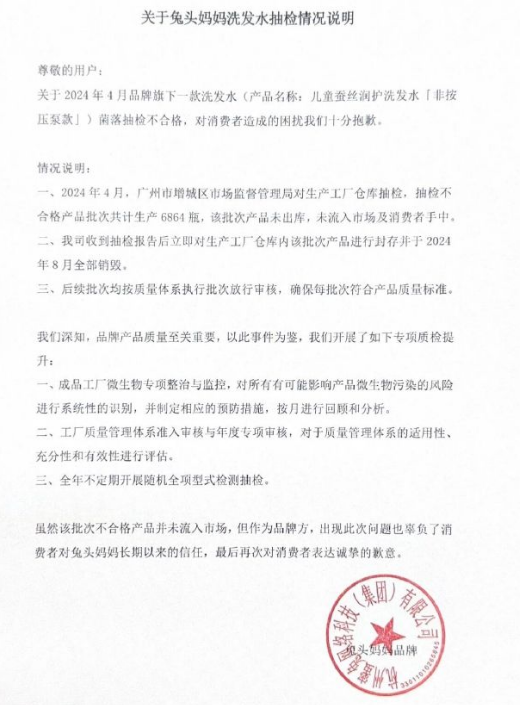
知名品牌道歉:产品并未流入市场,已全部销毁
第一财经· 2025-11-26 00:59
Core Viewpoint - The article discusses the quality control issue faced by the baby care brand "兔头妈妈" (Rabbit Mom), specifically regarding a non-compliant batch of children's silk nourishing shampoo that was detected during an inspection, although the affected products did not reach consumers [3][4][10]. Summary by Sections Inspection Results - In April 2024, the Guangzhou Zengcheng Market Supervision Administration conducted an inspection and found that a batch of 6,864 bottles of the children's silk nourishing shampoo was non-compliant, with a bacterial count exceeding the standard limit of ≤500 CFU/g, recorded at 24,000 CFU/g, which is 48 times over the limit [6][8]. Company Response - The company immediately sealed the non-compliant batch upon receiving the inspection report and destroyed all affected products by August 2024. It emphasized that subsequent batches would adhere to quality control standards [6][10]. - The brand expressed sincere apologies to consumers for the incident, acknowledging that it undermined the trust built over time [4][10]. Quality Control Measures - In response to the incident, the company initiated a series of quality control enhancements, including: - Monthly reviews and analyses of potential microbial contamination risks in the production facility [6]. - Annual audits of the quality management system to assess its applicability, sufficiency, and effectiveness [6]. - Random inspections throughout the year to ensure compliance with quality standards [4][10].

洗发水抽检不合格?兔头妈妈:未流入市场、已全部销毁
Guan Cha Zhe Wang· 2025-11-25 10:22
Core Viewpoint - Rabbit Mom publicly apologized for the non-compliance of a batch of children's shampoo due to bacterial contamination, despite the affected products not reaching consumers [1][4] Group 1: Company Response - Rabbit Mom produced a total of 6,864 bottles of the non-compliant shampoo batch, which was sealed and destroyed in August 2024 after the inspection report was received [1][4] - The company emphasized that subsequent batches will adhere to quality control systems to ensure compliance with product quality standards [1][4] Group 2: Inspection Details - In April 2024, the Guangzhou Market Supervision Administration conducted a special inspection of 2,066 batches of cosmetic products, covering nine categories including children's skincare [3] - The inspection revealed 40 batches of products that did not meet standards, with two batches in the children's cosmetics category found to have bacterial counts exceeding the national limit by 820 times and 48 times, respectively [4] Group 3: Industry Insights - The incident highlights systemic quality control issues within some companies in the production chain, particularly concerning children's products which are sensitive to microbial contamination [5] - The trend of reducing traditional preservatives to meet consumer preferences for "natural" products may lead to increased risks of bacterial growth if companies lack the capability to implement effective alternative preservation systems [6]
