光伏围栏

Search documents
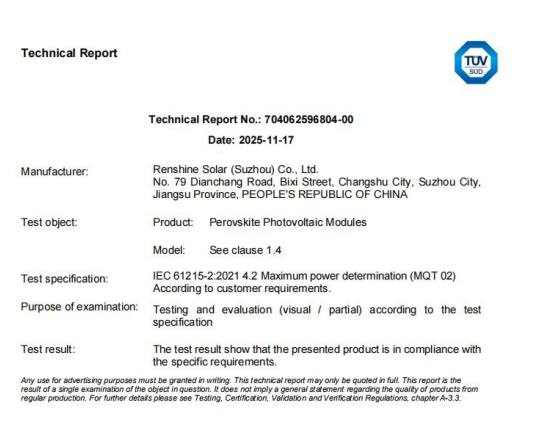
量产效率22%,钙钛矿产业化取得突破性进展
Zhong Guo Neng Yuan Wang· 2025-11-27 08:42
Core Insights - Renshine Solar (Suzhou) Co., Ltd. has achieved a stable efficiency of over 22% for its perovskite photovoltaic modules, marking a significant milestone in the commercialization of perovskite solar technology, comparable to traditional silicon photovoltaics [1][4] Industry Development - The theoretical photoelectric conversion efficiency of perovskite materials can reach 45%, with production costs being one-tenth of silicon [2][3] - China is leading the global development of perovskite photovoltaics, with notable research efficiencies achieved by institutions such as the Chinese Academy of Sciences and Renshine Solar [3] - The perovskite technology is recognized in national planning documents as a key direction for development, receiving strong policy support [2][3] Market Trends - The perovskite industry is experiencing rapid technological advancements, with Renshine Solar's 22% efficiency being a critical performance threshold for full commercialization [4] - Perovskite modules exhibit over 10% higher actual power generation efficiency compared to silicon under the same conversion efficiency, with Renshine Solar's modules achieving over 24% actual power generation efficiency [4] - The market for perovskite applications is diversifying, with products like photovoltaic tiles and flexible outdoor power sources being developed to meet various customer needs [5] Investment and Ecosystem - The perovskite industry ecosystem is becoming increasingly robust, with various companies investing in R&D and production capabilities [6] - The Ministry of Industry and Information Technology of China has emphasized support for the industrialization of perovskite materials, indicating a commitment to advancing high-efficiency photovoltaic technologies [6] - The global market for perovskite photovoltaic modules is projected to reach approximately 20 GW by 2030, with a market space of around 20 billion yuan, reflecting a compound annual growth rate (CAGR) of 243% from 2025 to 2030 [5][6]