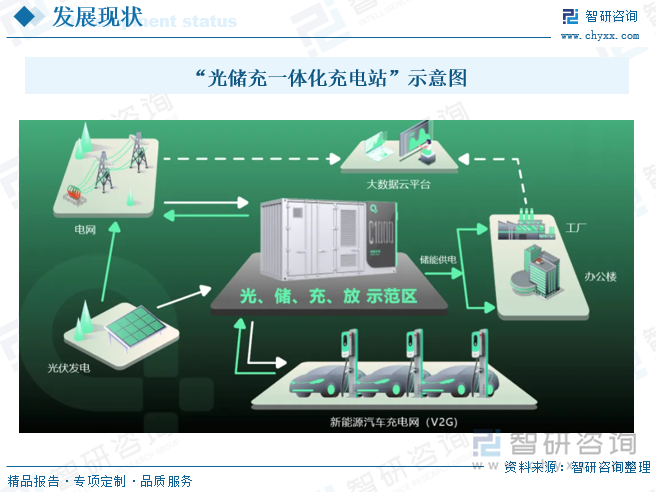
光储充一体化超充站

Search documents
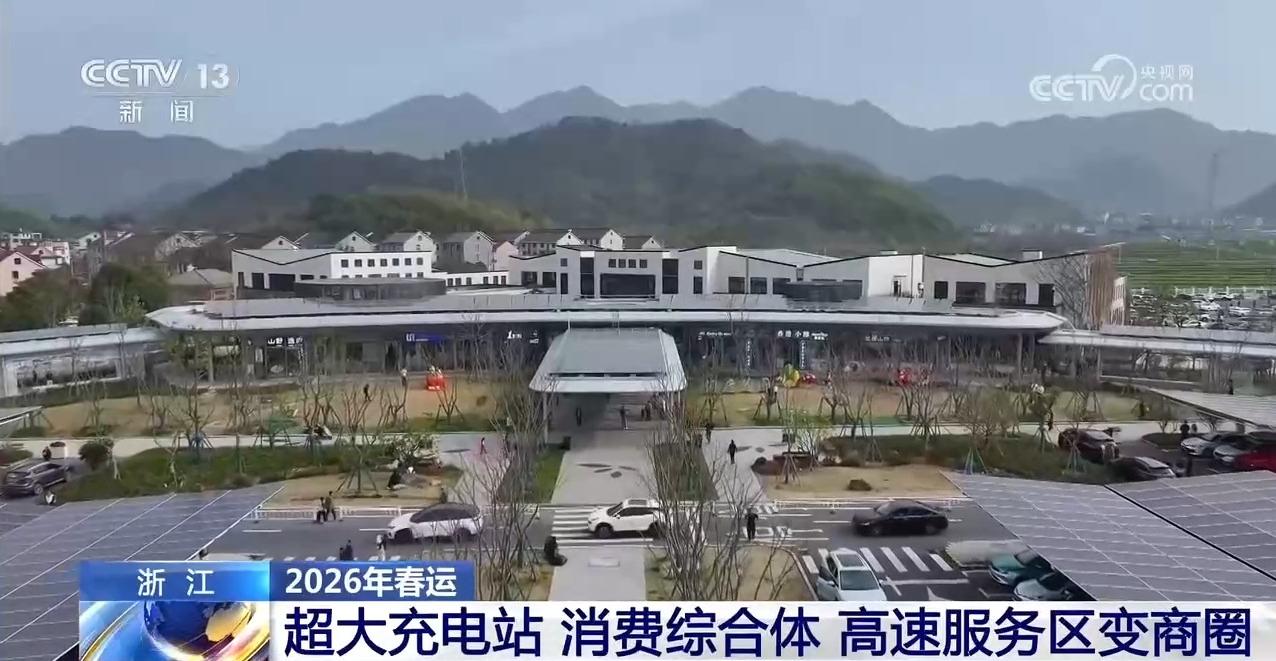
停车充电、吃饭逛街 高速服务区变“商圈”
Yang Shi Wang· 2026-02-24 06:19
Core Insights - The article highlights the transformation and upgrade of highway service areas during the Spring Festival, focusing on the G25 Changshen Expressway service area in Zhejiang Tonglu, which now offers diverse consumer experiences including dining and shopping [1][3]. Group 1: Service Area Upgrades - The G25 Changshen Expressway service area has evolved to include facilities for electric vehicle charging, dining, and shopping, catering to the needs of modern travelers [1][3]. - The upgrades reflect a shift in infrastructure services from merely meeting basic needs to enhancing quality and integrating various industries, positioning service areas as "urban windows" that showcase local characteristics and stimulate consumer activity [3]. Group 2: Charging Station Technology - The service area features a "light-storage-charging integrated supercharging station," which combines photovoltaic power generation, tiered energy storage, and liquid cooling charging technologies, functioning as both a charging and power generation station [4].

2025年中国光储充一体化超充站行业发展背景、市场现状及未来趋势研判:政策支持下,光储充一体化超充站加速落地[图]
Chan Ye Xin Xi Wang· 2025-05-14 01:17
Core Viewpoint - The integration of solar energy, storage, and charging (光储充一体化) is emerging as a new power system that addresses the increasing demand for charging infrastructure due to the growth of electric vehicles (EVs) and the challenges posed to the existing grid [1][12]. Group 1: Overview of Integrated Solar Storage Charging Stations - The core of the integrated solar storage charging model is the coordination of photovoltaic systems, energy storage, and charging stations through power electronics technology, forming a new "source-network-load-storage" power system [2][4]. - This model reduces charging losses and addresses issues of charging difficulty and duration for EV users, while also contributing to lower carbon emissions in the transportation sector [1][12]. Group 2: Market Development Background - China's automotive industry has significantly embraced the transition to electric vehicles, with 2024 projected production and sales of 12.888 million and 12.866 million units, respectively, marking year-on-year growth of 34.4% and 35.5% [6][8]. - By the end of 2024, the total number of electric vehicles in China is expected to reach 31.4 million, accounting for 8.90% of the total vehicle population [8][10]. Group 3: Current Market Status - The market for integrated solar storage charging solutions in China is projected to reach approximately 5.78 billion yuan in 2024, representing 51% of the global market [16]. - The number of charging infrastructure units in China reached 12.818 million by the end of 2024, reflecting a year-on-year increase of 49.1% [10]. Group 4: Policy Support - The Chinese government has introduced various policies to support the development of integrated solar storage charging stations, including the 2021-2035 New Energy Vehicle Industry Development Plan and the 2023 guidelines for high-quality charging infrastructure [13][15]. - Local governments are also providing land and tax incentives to facilitate the construction of integrated solar storage projects [13]. Group 5: Industry Trends and Future Outlook - The integrated solar storage charging sector is rapidly evolving, driven by the dual carbon goals, the accelerated adoption of electric vehicles, and rising energy security demands [16][24]. - Future advancements in technology, such as improved photovoltaic efficiency and the maturation of energy storage systems, are expected to enhance the application of integrated solar storage charging stations [24].