光储充一体化

Search documents
年度榜单丨全球户用储能系统出货量TOP20发布
起点锂电· 2026-03-29 05:52
Core Insights - The article highlights the significant growth in the global residential energy storage market, projecting a shipment scale of 40 GWh in 2025, representing a year-on-year increase of 43.88% [1][2] - The market is driven by emerging applications such as virtual power plants and integrated solar-storage solutions, particularly in mature markets like Europe, North America, and Australia, as well as in emerging markets facing high electricity prices and unstable grid conditions [1][2] Market Growth and Projections - The global residential energy storage market is expected to reach 180 GWh by 2030, with a cumulative growth of 3.75 times over five years and a compound annual growth rate (CAGR) of 35% [2] - In 2025, the European market is anticipated to recover as inventory depletion is completed, with demand gradually increasing, particularly in Western Europe led by Germany, France, and Italy, while Eastern Europe is also seeing demand growth due to high electricity prices and unstable supply [4][5] Competitive Landscape - The top 20 companies in the global residential energy storage market are dominated by Chinese manufacturers, who hold 18 out of 20 positions, leveraging cost and technology advantages to penetrate overseas markets [5][11] - The market share of the top five companies (CR5) is 45.9%, while the top ten (CR10) accounts for over 71.8%, indicating a growing concentration of market power among leading firms [5][11] Key Players - The leading companies in the residential energy storage market include Tesla, Huawei, BYD, LG, and Sungrow, with Tesla maintaining a dominant position in North America and expanding into Europe and Australia [10][11] - The second tier of companies focuses on regional strengths and niche markets, with firms like Midea Energy and Goodwe making significant inroads in specific areas such as Australia and Europe [12]






中远通(301516) - 2026年03月19日投资者关系活动记录表
2026-03-19 09:54
Group 1: Company Overview - The company specializes in customized power supply solutions, including communication power, industrial control power, and renewable energy power [2] - The company has over 20 years of experience in R&D for customized power supplies [2] Group 2: R&D and Product Development - R&D investment accounts for 15% of revenue, with a focus on super-fast charging and integrated energy storage projects [3] - The company has developed high-voltage fast charging technology (1000V/600kW), but it has not yet been commercially released [3] - The company plans to adopt a combination of self-developed and externally sourced products for its integrated energy storage project [3] Group 3: Market Strategy and Future Plans - The company aims to continue expanding its market presence in communication power while also developing industrial control and renewable energy power markets [4] - The company emphasizes the importance of understanding the difference between plans, estimates, and commitments in its future projections [4]
从特斯拉看北美光伏产业链发展-近期光伏设备情况更新
2026-03-18 02:31
Summary of Key Points from Conference Call Records Industry Overview - The North American photovoltaic (PV) industry chain exhibits a "high at both ends, low in the middle" structure, with significant shortages in silicon wafers and solar cells, leading to a heavy reliance on overseas imports for installation demands of 30-50 GW per year [1][3][4]. Core Insights and Arguments - The Inflation Reduction Act is driving a manufacturing return to the U.S., with domestic investments and capacities reaching $28 billion, with companies like Hanwha Qcells filling the gap in silicon wafer production [1][4]. - Bifacial technology is favored in the North American Building-Integrated Photovoltaics (BIPV) market due to its efficiency improvements of 13%-17% and aesthetic appeal, establishing Tesla's early positioning in this technology [1][7]. - The investment for bifacial components exceeds $100 million per GW, significantly higher than the $50 million for traditional production lines in China, benefiting leading equipment manufacturers like Aotwei and Jincheng [1][10]. - The North American power shortage is prompting a reevaluation of the AIDC (Artificial Intelligence Data Center) supply chain, with increased orders for gas turbines, modular data centers, and AI power solutions [1][12]. Market Dynamics - The PCB industry is experiencing growth driven by Chiplet technology iterations and downstream expansions, with a focus on leading companies like Dingtai High-Tech and Chipbond [1][11]. - The export chain is benefiting from expectations of tariff relief and a declining interest rate cycle, with optimism for tools, forklifts, and high-end machinery categories [1][13]. Company-Specific Insights - Tesla's solar business, initiated with the acquisition of SolarCity in 2016, has faced challenges but began to recover from Q2 2020 through cost control and pricing strategies, although its market share remains below 1% in North America [2][4]. - First Solar, Hanwha, and Maxeon are key players in the North American PV market, with First Solar planning to expand production to 3-4 GW annually by 2026-2027, while Hanwha aims to establish a complete supply chain by 2026 [6][10]. - Hanwha's integrated factory in Georgia, set to begin operations in October 2025, will mark the first large-scale production of monocrystalline silicon in North America since 2016 [5][6]. Challenges and Opportunities - Bifacial technology faces challenges in production reliability and yield, particularly concerning the adhesive used in the manufacturing process, which can affect the overall efficiency of the solar panels [8][9]. - The introduction of bifacial technology is expected to increase the value of key equipment suppliers, with Aotwei and Jincheng positioned to benefit from this technological shift [10]. Investment Outlook - The current investment landscape favors sectors with high growth potential and pricing power, particularly in AIDC, PCB, and engineering machinery [1][11]. - The macro environment for exports is improving, with potential tariff reductions and a favorable interest rate outlook, which could enhance the profitability of Chinese enterprises [1][13]. - Despite recent declines in humanoid robots and space photovoltaics, the fundamentals remain strong, indicating potential investment opportunities in these sectors [14][15].
ESIE 2026前瞻 ① :“固定电价”退场,VPP与微电网成救命稻草?
中关村储能产业技术联盟· 2026-03-04 00:39
Core Viewpoint - The article discusses the evolution of China's electricity market towards a more dynamic and market-oriented model, emphasizing the role of virtual power plants (VPP) and independent microgrids in enhancing energy management and profitability in the context of fluctuating electricity prices and increasing competition in ancillary services [5][6][10]. Group 1: Virtual Power Plants (VPP) - VPPs are evolving into two main forms: "load aggregation" and "power source aggregation," with the former focusing on integrating industrial processes to optimize energy usage and the latter addressing the challenges faced by distributed energy sources [7][15]. - The transition from traditional electricity sales to a model where companies act as "energy partners" is crucial, requiring a deep understanding of industrial processes and collaborative optimization strategies [8][10]. - A case study of a silicon carbide smelting plant illustrates how VPPs can identify adjustable loads and optimize production schedules, resulting in significant cost savings [10][11]. - Companies like Guoneng Rixin leverage data analytics to predict market trends and optimize VPP operations, transforming from resource integrators to value-driven platforms [12][14]. Group 2: Independent Microgrids - Independent microgrids are being developed to mitigate external market price fluctuations by creating a controlled internal energy environment [20][21]. - The integration of distributed solar and storage systems within microgrids is becoming more sophisticated, moving beyond simple equipment setups to intelligent scheduling and innovative business models [20][21]. - The implementation of vehicle-to-grid (V2G) mechanisms in commercial parks can alleviate the need for costly transformer upgrades while enhancing energy supply capabilities [23]. - Achieving economic benefits from emissions reductions through digital carbon management platforms is essential for the commercial viability of microgrids [24]. Group 3: Industry Trends and Future Directions - The article highlights the increasing importance of digitalization and data-driven strategies in the energy sector, particularly for small power sources facing market challenges [16][17]. - Companies are encouraged to transition from being mere power generation units to becoming market-capable value units, enhancing their negotiation power and revenue stability [16][19]. - The upcoming ESIE 2026 forum will feature discussions on the evolution of energy business models and the role of VPPs in reshaping the energy ecosystem [26].

粤桂协作赋能绿色民生 西林光储电一体充电站投用
Ren Min Wang· 2026-02-10 01:58
Core Insights - The project, a solar energy storage and charging station in Xilin County, represents a significant investment of 1.9964 million yuan and aims to enhance green development and rural revitalization through innovative energy solutions [1] Investment and Infrastructure - The project covers an area of 1,000 square meters and includes 8 charging spaces and 10 regular parking spaces, along with supporting infrastructure such as solar canopies, energy storage systems, transformers, public lighting, and drainage [1] - It serves multiple residential communities and relocation areas, addressing the green travel needs of local residents and alleviating "range anxiety" for electric vehicle users [1] Collaboration and Technology - This initiative is a key livelihood project under the Guangdong-Guangxi cooperation framework, integrating Shenzhen's technological expertise with local needs in Xilin, showcasing resource complementarity [1] - The project marks a transition from "blood transfusion" to "blood-making" in East-West cooperation, providing hardware support for the promotion of new energy vehicles and the cultivation of energy-saving and environmental protection industries [1] Future Prospects - Xilin County plans to use this project as a foundation to deepen cooperation with Guangdong in the fields of new energy industry expansion and rural revitalization, continuously releasing collaborative benefits to support regional coordinated development and common prosperity [1]
单日可充6000车次的高速路超充站投运
Ke Ji Ri Bao· 2026-02-08 06:05
Core Insights - The G25 Changshen Expressway service area in Hangzhou, Zhejiang, has launched the largest high-speed supercharging station in China, equipped with 216 charging spots, capable of serving over 6,000 vehicle charging needs daily during the Spring Festival travel season [1] Group 1: Infrastructure and Capacity - The newly opened northern supercharging station covers an area of approximately 30,000 square meters and includes 108 standardized charging spots with 38 liquid-cooled supercharging piles, offering a maximum power of 600 kW for rapid charging [1] - The southern supercharging station, which has been operational since August 2025, also has 108 charging spots, creating a "north-south response, bidirectional guarantee" layout [1] Group 2: Environmental Impact and Technology - The supercharging stations integrate advanced technologies such as photovoltaic power generation and energy storage systems, with a total photovoltaic installed capacity of 3,096 kW, expected to reduce carbon emissions by nearly 3,000 tons annually [1] - The stations provide a "charge upon arrival, charge and go" service, addressing the issues of "charging difficulties and long waiting times" for electric vehicle owners during peak travel periods [1] Group 3: User Experience and Management - During the Spring Festival, operational staff will be on duty 24 hours a day, and the "E Charging" app will provide real-time information on parking availability and pricing to guide drivers for orderly charging [1] - It is anticipated that over 80% of self-driving trips in Zhejiang during the Spring Festival will involve small passenger vehicles, with an expected 481 million trips, indicating a strong demand for electric vehicle charging [1]
目标2800万!我国充电桩“三年倍增”,2027年剑指8000万辆车需求
Zhong Guo Neng Yuan Wang· 2026-02-07 04:08
Core Insights - The rapid expansion of electric vehicle (EV) charging infrastructure in China is highlighted, with projections indicating that by the end of 2025, there will be 20.09 million charging facilities, supporting over 40 million new energy vehicles [1][2] - The charging infrastructure is evolving from quantity to quality, with technological advancements and innovative models expected to drive further upgrades in the industry [1][4] Infrastructure Development - The construction of charging facilities has accelerated significantly, with the number of charging stations increasing from 1 million in 2019 to over 10 million by mid-2024, and reaching 20 million in just 18 months [2] - In 2025, the incremental growth of charging infrastructure is projected to be 7.274 million, a year-on-year increase of 72.3%, with a charging pile to vehicle ratio of 1:1.9, indicating that infrastructure development is keeping pace with the rapid growth of new energy vehicles [2] - Currently, 19 provinces have achieved full coverage of charging facilities, and over 98% of highway service areas have charging stations [2] Future Projections - By the end of 2027, the goal is to establish 28 million charging facilities nationwide, providing over 300 million kilowatts of public charging capacity to meet the needs of more than 80 million electric vehicles [3] Technological and Ecological Innovation - The expansion of charging facilities is accompanied by continuous innovation in technology and service models, with a focus on high-power charging and standardized solutions to enhance user experience [4] - The average charging power at public stations has reached 46.5 kW, with a 33% year-on-year improvement in charging efficiency [4] - The development of vehicle-to-grid (V2G) technology is being prioritized, allowing electric vehicles to act as mobile energy storage units, which supports the efficient operation of new energy systems [4][5] Service Optimization and Coverage Expansion - Despite rapid development, there are still areas for improvement in layout optimization and user experience, particularly in rural regions where charging convenience varies significantly [7] - The Action Plan aims to address the shortfall in rural charging infrastructure, with plans to add at least 14,000 direct current charging guns in towns lacking public charging stations by 2027 [7] - The industry is entering a new phase of simultaneous large-scale construction and model innovation, with strong policy guidance and collaborative innovation expected to lead to a more balanced public charging network and improved operational efficiency [8]
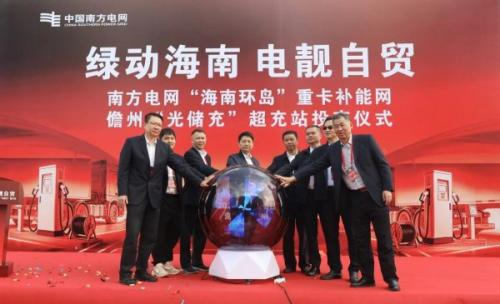
海南儋州白马井“光储充”超充站正式投产!
Zhong Guo Dian Li Bao· 2026-02-02 02:39
Core Insights - The newly launched "light-storage-charging" supercharging station in Hainan's Danzhou Baima Jing has a total installed capacity of 8,000 kW, making it the largest new energy heavy truck charging station in Hainan Province [1] - The station enhances the reliability and efficiency of the new energy heavy truck refueling network in Hainan, supporting the island's green logistics infrastructure [1] Group 1 - The supercharging station was jointly invested by Southern Power Grid Hainan Electric Vehicle Company and Hainan Sushutong Supply Chain Co., Ltd., with a total investment of 12 million yuan, and was completed in two months [1] - It features 40 high-power charging terminals, capable of simultaneously charging 20 heavy trucks, with a daily service capacity exceeding 200 vehicle charging sessions [1] - The station employs integrated "light-storage-charging" technology, combining photovoltaic power generation, intelligent energy storage, and high-power charging technology, expected to reduce carbon dioxide emissions by approximately 200,000 kg annually [1] Group 2 - Future expansion plans for the station include an additional investment of about 17 million yuan, aiming to establish a diversified comprehensive demonstration station with supercharging, battery swapping, and light-storage integration [2] - Upon completion, the station's total installed capacity is projected to reach 12,000 kW, with an annual charging capacity of approximately 35.76 million kWh, more than three times the current capacity, and expected annual carbon dioxide reduction exceeding 500,000 kg [2] - Hainan's electric heavy truck electrification rate has rapidly increased to 36.1%, with 13 heavy truck charging and swapping stations built across the province, totaling an installed capacity of about 35,000 kW [2]
挚达科技成立合资公司以推进新能源充电补能业务并加速全球生态布局
Zhi Tong Cai Jing· 2026-01-29 13:01
Core Viewpoint - The collaboration between Zhidatech and Chery Green Energy aims to enhance the global strategic layout in the smart charging sector for electric vehicles, focusing on resource synergy and comprehensive ecosystem development [1][2] Group 1: Joint Venture Details - Zhidatech and Chery Green Energy have established a joint venture named Anhui Ruizhi New Energy Technology Co., Ltd. with a registered capital of RMB 20 million, where Chery Green Energy holds 60% and Zhidatech holds 40% [1] - The headquarters of the joint venture is located in Anqing Economic Development Zone, Anhui Province, with a business duration of 5 years, covering manufacturing and sales of charging piles and automatic charging robots, energy storage technology services, international freight forwarding, and technology import and export [1] Group 2: Strategic Focus Areas - The partnership will focus on three global strategies: integrating charging pile and automatic charging robot technologies to create a highly automated and adaptable next-generation energy replenishment solution, establishing R&D centers overseas for developing smart charging products suitable for international markets [2] - Leveraging Chery Automobile's established channels in Europe, the Middle East, Latin America, and Southeast Asia to localize charging infrastructure, ensuring that charging stations are available wherever vehicles are [2] - Integrating solar energy storage with intelligent scheduling algorithms to transition from equipment supply to comprehensive services in mobile travel and distributed energy management, particularly aiding green transitions in emerging markets [2]
海南儋州白马井"光储充"超充站正式投产!
Zhong Guo Dian Li Bao· 2026-01-29 08:19
Group 1 - The "光储充" supercharging station in Hainan Danzhou officially commenced operations on January 28, with a total installed capacity of 8000 kW, making it the largest new energy heavy truck charging station in Hainan Province [1] - The station was jointly invested by Southern Power Grid Hainan Electric Vehicle Company and Hainan Sushutong Supply Chain Co., Ltd., with a total investment of 12 million yuan, and it took two months to complete [3] - The station features 40 high-power charging terminals, capable of servicing over 200 vehicle charging sessions daily, and is designed to meet the fast charging needs of various new energy vehicles [3] Group 2 - The station employs integrated "光储充" technology, combining photovoltaic power generation, intelligent energy storage, and high-power supercharging technology, which is expected to reduce carbon dioxide emissions by approximately 200,000 kg annually [3] - Future expansion plans include an additional investment of about 17 million yuan to increase the total installed capacity to 12,000 kW, with an expected annual charging capacity of approximately 35.76 million kWh, more than three times the current capacity [3] - The electrification rate of heavy trucks in Hainan has rapidly increased to 36.1%, with 13 heavy truck charging and swapping stations built across the province, totaling an installed capacity of about 35,000 kW [5] Group 3 - The heavy truck charging and swapping volume is projected to reach 2,302.94 million kWh in 2025, representing a year-on-year increase of over 10 times [6] - The company aims to support the construction of a comprehensive charging network, including county-level supercharging stations and a rapid charging network for towns, to enhance the clean, low-carbon, and efficient green energy system in Hainan [6]