光伏系统

Search documents
光伏巨头天合光能两年“血亏”104亿元
Shen Zhen Shang Bao· 2026-02-26 22:54
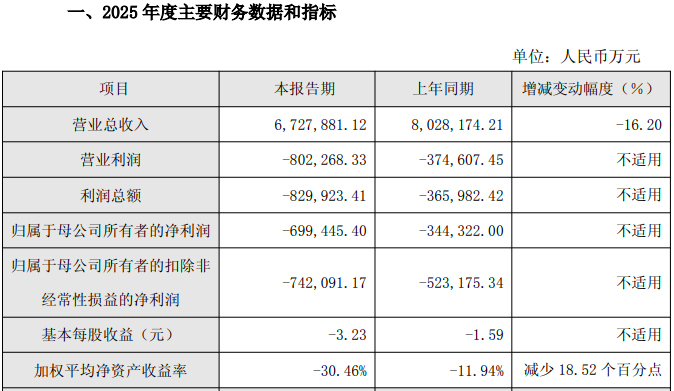
Core Viewpoint - Trina Solar, a leading domestic photovoltaic module manufacturer, continues to face significant losses, reporting a net loss of 6.994 billion yuan for 2025, which is an increase from the previous year's loss of 3.443 billion yuan, resulting in a cumulative loss of 10.4 billion yuan over two years [1][2]. Financial Performance - In 2025, the total operating revenue was 67.28 billion yuan, a decrease of 16.20% compared to the previous year [2]. - The operating profit was -802.27 million yuan, and the total profit was -829.92 million yuan, both showing a decline from the previous year's figures [2]. - The basic earnings per share were -3.23 yuan, worsening from -1.59 yuan in the previous year [2]. - The weighted average return on net assets dropped to -30.46%, down 18.52 percentage points from the previous year [2]. Asset and Equity Status - As of the end of the reporting period, total assets amounted to 116.28 billion yuan, a decrease of 6.18% from the beginning of the year [3]. - The equity attributable to shareholders of the listed company was 21.77 billion yuan, down 17.47% from the beginning of the year [3]. Quarterly Performance - The company has reported losses for six consecutive quarters since Q3 2024, with Q4 2025 estimated net loss at 2.794 billion yuan, a 7.59% increase year-on-year [4]. Industry Challenges - The photovoltaic industry is experiencing a phase of supply-demand imbalance, with low operating rates across the industry chain and intensified market competition [5]. - Despite a slight recovery in product prices in the second half of the year, the rapid increase in costs of key raw materials like silicon and silver paste has negatively impacted the profitability of the company's module business [5]. Future Outlook - Trina Solar has set ambitious profit targets for the next three years, aiming for a cumulative profit of nearly 10 billion yuan, with specific net profit goals for 2026 and 2027 [6]. - The company is actively pursuing opportunities in the energy storage sector and is increasing its R&D investments to enhance its global marketing network [5]. Stock Performance - As of February 26, the stock price was 19.28 yuan per share, a 76% decline from its historical peak of 87.22 yuan per share in August 2022, resulting in a market capitalization loss exceeding 100 billion yuan [8].


天合光能涨2.04%,成交额1.57亿元,主力资金净流入80.81万元
Xin Lang Cai Jing· 2026-02-25 02:06
Core Viewpoint - Trina Solar's stock has shown a significant increase of 20.60% year-to-date, despite a recent decline of 2.68% over the last five trading days, indicating volatility in its stock performance [1]. Group 1: Stock Performance and Market Data - As of February 25, Trina Solar's stock price reached 19.96 CNY per share, with a market capitalization of 46.758 billion CNY [1]. - The trading volume was 1.57 billion CNY, with a turnover rate of 0.34% [1]. - The net inflow of main funds was 808,100 CNY, with large orders accounting for 23.25% of purchases and 22.19% of sales [1]. Group 2: Company Overview - Trina Solar, established on December 26, 1997, is located in Changzhou, Jiangsu Province, and was listed on June 10, 2020 [1]. - The company operates in three main business segments: photovoltaic products (64.66% of revenue), system solutions (21.23%), and other services including digital energy and storage (9.56%) [1]. Group 3: Financial Performance - For the period from January to September 2025, Trina Solar reported a revenue of 49.970 billion CNY, a year-on-year decrease of 20.87%, and a net profit loss of 4.201 billion CNY, a significant decline of 396.22% [2]. - The company has distributed a total of 3.487 billion CNY in dividends since its A-share listing, with 2.410 billion CNY distributed over the last three years [3]. Group 4: Shareholder Information - As of January 31, 2025, Trina Solar had 66,400 shareholders, an increase of 15.93%, with an average of 35,264 shares held per shareholder, a decrease of 13.74% [2]. - Major shareholders include Hong Kong Central Clearing Limited and various ETFs, with notable reductions in their holdings [3].
天合光能股价涨5.35%,易方达基金旗下1只基金位居十大流通股东,持有4726.24万股浮盈赚取5246.12万元
Xin Lang Ji Jin· 2026-02-09 01:56
Core Viewpoint - Trina Solar's stock rose by 5.35% to 21.85 CNY per share, with a trading volume of 581 million CNY and a market capitalization of 51.185 billion CNY as of February 9 [1] Company Overview - Trina Solar, established on December 26, 1997, is located in Changzhou, Jiangsu Province, and was listed on June 10, 2020 [1] - The company operates in three main business segments: photovoltaic products, photovoltaic systems, and smart energy [1] - Revenue composition: photovoltaic products account for 64.66%, system solutions 21.23%, other services 5.54%, digital energy services 4.42%, and energy storage 4.14% [1] Shareholder Insights - E Fund's ETF, the E Fund SSE STAR 50 ETF (588080), is among the top ten circulating shareholders of Trina Solar, having reduced its holdings by 6.8877 million shares in Q3, now holding 47.2624 million shares, representing 2.17% of circulating shares [2] - The ETF has generated an estimated floating profit of approximately 52.4612 million CNY today [2] Fund Performance - The E Fund SSE STAR 50 ETF (588080) has a total asset size of 70.597 billion CNY, with a year-to-date return of 5.81% and a one-year return of 41.36% [2] - The fund manager, Lin Weibin, has a tenure of 12 years and 344 days, with the best fund return during his tenure being 84.18% [3] Additional Fund Insights - E Fund's E Fund SSE STAR New Energy ETF (589960) holds 907,900 shares of Trina Solar, making it the third-largest holding, with a net asset proportion of 6.05% [4] - This ETF has an estimated floating profit of about 1.0078 million CNY today [4] - The fund manager, Li Boyang, has a tenure of 1 year and 303 days, with the best return during his tenure being 120.78% [5]
电网投资、光伏、AI算力三轮驱动 哪些需求被重新定义?
Qi Huo Ri Bao Wang· 2026-02-02 01:25
Group 1: Power Grid Investment - China's power grid investment has transitioned from scale expansion to high-quality development, focusing on building a new power system, which is expected to drive copper and aluminum consumption significantly [2][4] - In 2025, the State Grid's fixed asset investment reached 560.4 billion yuan, a year-on-year increase of 5.9%, with total investments expected to exceed 650 billion yuan for the first time [4] - The total investment in the national power grid during the "14th Five-Year Plan" period is projected to exceed 4.1 trillion yuan, significantly higher than the previous estimate of 2.8 trillion yuan [4][5] Group 2: Photovoltaic Industry - In 2025, China's photovoltaic industry added 315.07 GW of new capacity, a year-on-year increase of 13.67%, marking a significant policy-driven market transformation [7][9] - The global photovoltaic market is expected to enter a rational platform period in 2026, with China's new installations projected to decline by 14% to approximately 341 GW [10] - Copper demand in the photovoltaic sector is expected to reach 228,000 to 285,000 tons due to the projected global installation scale, constituting about 10% of global copper consumption [12] Group 3: AI Computing Power - The global AI computing power construction has entered an explosive growth phase, significantly increasing the demand for copper and aluminum due to the high power requirements of data centers [14][15] - AI-driven data centers are projected to increase copper consumption from approximately 500,000 tons in 2025 to 740,000 tons in 2026, contributing significantly to global copper demand growth [15] - The competition for scarce electricity resources between AI data centers and the electrolytic aluminum industry is expected to create systemic constraints on aluminum supply, impacting its market dynamics [16] Group 4: Demand and Supply Dynamics - The investment in power grids, the photovoltaic industry, and AI data centers is reshaping the demand for copper and aluminum, with copper benefiting from strong demand driven by high-quality infrastructure and digitalization [17] - Aluminum demand is stable but faces pressure from cost competition and supply constraints, particularly due to the energy-intensive nature of both AI data centers and aluminum production [17]

创维集团:拟回购股份、申请退市,分派「创维光伏」并将以介绍形式在香港上市
Sou Hu Cai Jing· 2026-01-21 06:11
Core Viewpoint - Skyworth Group Limited is proposing a series of strategic actions including a conditional share buyback, distribution of shares in Skyworth Photovoltaic, and plans for the delisting of its shares, aimed at enhancing the value of its renewable energy segment and addressing the underperformance of its traditional smart appliance business [1][10]. Group 1: Proposed Actions - The company plans to distribute its shares in Skyworth Photovoltaic to all shareholders, contingent upon meeting certain conditions, and intends to list Skyworth Photovoltaic on the main board of the Hong Kong Stock Exchange [2][3]. - A share buyback plan is proposed under Section 99 of the Companies Ordinance, which involves the cancellation of shares in exchange for either cash at HKD 4.03 per share or new shares [2][8]. - The completion of the distribution, listing of Skyworth Photovoltaic, and share buyback plan are interdependent and expected to occur simultaneously [1][8]. Group 2: Financial Implications - The theoretical total value of the distributed Skyworth Photovoltaic shares is approximately HKD 10.16 per share, representing a premium of about 96.14% over the last closing price of HKD 5.18 [8]. - The maximum cash consideration payable by the company under this proposal is estimated at around HKD 25.57 billion, which will be financed through internal resources and/or external debt [8]. - Following the completion of these proposals, Skyworth Group will retain its remaining businesses, which include smart TVs, smart home systems, and other services, while the renewable energy segment is expected to drive future growth [10][11]. Group 3: Market Context - The traditional smart appliance and smart systems business of the group has experienced slow growth due to market saturation and increased competition, while the renewable energy segment has become a key growth driver [10]. - The global demand for photovoltaic and energy storage industries is continuously increasing, driven by energy transition policies, technological advancements, and geopolitical factors [11]. - The company aims to enhance the core competitiveness of Skyworth Photovoltaic and secure more effective financial resources for independent development through its proposed actions [10][11].
铜、白银等需求暴涨,马斯克AI+能源叙事下有色金属资源战略
高工锂电· 2026-01-14 12:48
Core Viewpoint - The future of AI development is closely tied to energy infrastructure and the demand for colored metals, with a significant shift towards renewable energy sources like solar power and the need for efficient cooling systems in AI factories [4][5][11]. Energy Infrastructure - High-performance AI chips are experiencing exponential growth in computational power, which directly correlates with increased electricity consumption [4]. - The current state of the U.S. power grid is a bottleneck for AI development due to lengthy construction and expansion timelines [5]. - Elon Musk is independently building power plants that utilize solar energy and energy storage systems to create a self-sufficient power grid for AI operations [5]. Cooling Systems - Traditional air cooling methods are becoming ineffective due to increased chip density, necessitating the use of liquid cooling systems in AI factories [5]. - The failure of cooling components, such as liquid cooling plates, can lead to significant financial losses, emphasizing the importance of reliable cooling systems [5]. Demand for Colored Metals - The construction of AI factories and energy infrastructure will significantly increase the demand for copper, which is essential for heat conduction and system stability [5]. - Silver is highlighted as a critical material in the photovoltaic industry, particularly for its use in solar cells, with each gigawatt of solar capacity requiring approximately 15-20 tons of silver [9][10]. - The recent surge in silver prices, reaching historical highs, reflects the growing demand driven by the expansion of the solar energy sector [10]. Solar Energy Initiatives - Musk is advocating for a large-scale solar energy initiative that involves launching numerous solar satellites to create a vast solar energy collection network in space [8]. - The efficiency and cost-effectiveness of solar energy are emphasized as key factors in its future adoption [8].
天合光能跌2.04%,成交额4.96亿元,主力资金净流出1963.50万元
Xin Lang Cai Jing· 2025-12-18 06:57
Core Viewpoint - Trina Solar's stock has experienced a decline of 15.39% year-to-date, with a recent drop of 2.04% on December 18, 2023, reflecting ongoing challenges in the solar energy market [1][2]. Company Overview - Trina Solar, established on December 26, 1997, and listed on June 10, 2020, is located in Changzhou, Jiangsu Province. The company operates in three main business segments: photovoltaic products, photovoltaic systems, and smart energy [2]. - The revenue composition of Trina Solar includes photovoltaic products (64.66%), system solutions (21.23%), other services (5.54%), digital energy services (4.42%), and storage business (4.14%) [2]. Financial Performance - As of November 10, 2023, Trina Solar reported a total revenue of 49.97 billion yuan for the first nine months of 2025, a year-on-year decrease of 20.87%. The net profit attributable to shareholders was -4.20 billion yuan, reflecting a significant decline of 396.22% [3]. - The company has distributed a total of 3.49 billion yuan in dividends since its A-share listing, with 2.41 billion yuan distributed over the past three years [4]. Shareholder Information - As of November 10, 2023, Trina Solar had 54,800 shareholders, an increase of 16.75% from the previous period. The average number of tradable shares per shareholder decreased by 14.35% to 39,803 shares [3]. - Major shareholders include Hong Kong Central Clearing Limited, holding 130 million shares, and various ETFs, which have seen reductions in their holdings [4].
霸王茶姬创始人张俊杰发文辟谣!从未有过婚姻 从未发生“茶叶富商残疾女儿”的故事
Mei Ri Jing Ji Xin Wen· 2025-11-21 15:49
Group 1 - Zhang Junjie, the founder of Bawang Tea Ji, confirmed his marriage and addressed rumors surrounding his personal life, stating he had never been married before meeting his wife, Gao Haichun [2] - Gao Haichun, daughter of Trina Solar's founder, is recognized as a prominent figure in the photovoltaic industry and has held various leadership roles within Trina Solar [6][7] - Bawang Tea Ji, a well-known brand in China's new-style tea beverage market, has expanded significantly since its establishment in 2017, with over 7,000 stores globally [6][7] Group 2 - Trina Solar is a leading global provider of photovoltaic smart energy solutions, with its main business segments including photovoltaic products, systems, and smart energy [6] - The families of both Zhang Junjie and Gao Haichun are notable in the business community, with Zhang Junjie being listed as one of the youngest billionaires in the 2025 Hurun Rich List [7] - The marriage of Zhang Junjie and Gao Haichun has attracted public interest, but both parties have requested privacy regarding their personal affairs [5]
属实!霸王茶姬创始人张俊杰,将迎娶天合光能联席董事长高海纯
Sou Hu Cai Jing· 2025-11-20 12:59
Core Insights - The wedding of Zhang Junjie, founder of Bawang Chaji (stock code: CHA), and Gao Haichun, co-chairman of Trina Solar (stock code: 688599), is confirmed to take place on December 15 [1][3] - Gao Haichun, known as the "most beautiful second generation of light" and "photovoltaic goddess," is the daughter of Gao Jifan, the founder of Trina Solar [1][3] - Bawang Chaji is set to go public on NASDAQ in April 2025, becoming the fifth listed company in the new tea beverage industry and the first in the U.S. stock market [4] Company Overview - Trina Solar is a leading global provider of photovoltaic smart energy solutions, with a market capitalization exceeding 40 billion [3] - Gao Haichun has held various significant positions within Trina Solar, including Senior Manager of Investor Relations and Vice General Manager of Strategic Investment [3] - Bawang Chaji, founded in 2017 by Zhang Junjie, has grown to over 7,000 stores by mid-2025 [7]


属实!霸王茶姬创始人张俊杰将和天合光能联席董事长高海纯结婚,12月举办婚宴
Zhong Guo Ji Jin Bao· 2025-11-20 09:35
Core Points - The wedding of Zhang Junjie, founder of Bawang Chaji, and Gao Haichun, co-chairman of Trina Solar, is scheduled for December 15 [1][4] - Gao Haichun is recognized as a prominent figure in the photovoltaic industry and is the daughter of Trina Solar's founder [4][6] - Bawang Chaji is set to become the fifth listed company in the new tea beverage sector and the first to be listed on the US stock market [8][9] Company Overview - Trina Solar is a leading global provider of photovoltaic smart energy solutions, with a market capitalization exceeding 40 billion [6] - Bawang Chaji, founded in 2017, has grown to over 7,000 stores by mid-2025 [9] Leadership Background - Gao Haichun has held various significant positions within Trina Solar, including roles in investor relations and strategic investment [6] - Zhang Junjie, a grassroots entrepreneur, transitioned from regional manager roles to founding Bawang Chaji [6]