
内坑拖鞋

Search documents
一双拖鞋的环球之旅
Ren Min Ri Bao· 2026-02-04 03:35
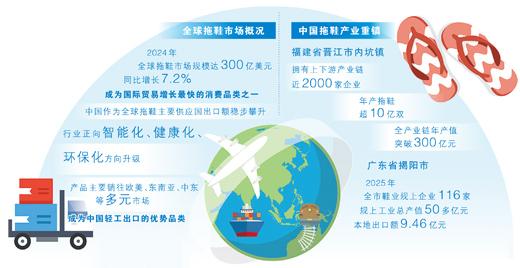
Core Insights - The article highlights the global popularity of Chinese slippers, particularly the "inner pit slippers," which have become a cultural phenomenon and a symbol of China's manufacturing upgrade and cultural dissemination [1][2]. Group 1: Market Overview - The global market for slippers is substantial, with one in eight people worldwide wearing "inner pit slippers," and 40 pairs being exported from Jinjiang every second, contributing to an annual production of over 1 billion pairs and a total industry value exceeding 30 billion yuan [1][4]. - The global slipper market is projected to reach $30 billion by 2024, with a year-on-year growth of 7.2%, making it one of the fastest-growing consumer categories in international trade [4][6]. Group 2: Technological Innovation - Chinese slipper manufacturers are leveraging technological innovations such as supercritical foaming technology and antibacterial materials to enhance product quality and comfort [6][5]. - The use of advanced materials, like phase change temperature-regulating materials and biodegradable shoe materials, is becoming standard in the industry, with patent applications for innovations increasing by over 30% annually [5][6]. Group 3: Production and Supply Chain - The production process has been digitized, allowing for rapid response to market demands, with the development cycle for new products reduced from 45 days to 15 days [8][7]. - The complete industrial chain in regions like Jinjiang and Jieyang covers all aspects from raw material production to logistics, ensuring a robust supply chain [9]. Group 4: Brand Development and Cultural Resonance - The article emphasizes the shift from product export to brand export, with companies focusing on cultural resonance and value competition rather than just price competition [10][11]. - The establishment of brand collective stores in international markets is a strategy to enhance brand visibility and facilitate easier access for foreign buyers [11]. Group 5: E-commerce and Global Expansion - The rise of cross-border e-commerce has opened new channels for small and medium enterprises to enter international markets, with online platforms serving as both sales channels and brand showcases [12][13]. - Companies are adopting a dual-channel strategy, combining online sales with partnerships in physical retail to enhance market penetration and brand recognition [13].

晋江内坑:年产超10亿双!这双拖鞋,从晋江走向世界
Xin Hua Wang· 2025-12-21 03:16
Core Insights - The global average indicates that 1 in every 8 people wears slippers, highlighting the widespread popularity of this product category [1] - The town of Neikeng in Fujian, China, has developed a complete industrial chain for slippers, with nearly a thousand enterprises involved, producing over 1 billion pairs annually and achieving an annual output value exceeding 30 billion yuan [1] Industry Overview - The Neikeng slippers have evolved from traditional designs to modern versions featuring advanced technologies, such as supercritical foaming for ultra-lightweight options, environmentally friendly variants made from coffee grounds, and low-carbon models created from recycled materials [1] - The diverse range of slippers from Neikeng has gained international recognition, being found in markets across Africa and supermarkets in Europe, showcasing the global reach of this local industry [1] Market Dynamics - The transformation of Neikeng's slipper industry from small family workshops to a global phenomenon illustrates significant growth and market penetration, indicating strong demand and potential for further expansion [1]