制鞋业

Search documents
华利集团(300979):2025年业绩快报点评:Q4净利率未能延续修复,全年累计分红比例提至76.4%
Changjiang Securities· 2026-03-24 09:19
Investment Rating - The investment rating for the company is "Buy" and is maintained [6]. Core Views - In 2025, the company reported a revenue of 24.98 billion yuan, a year-on-year increase of 4.1%, while the net profit attributable to the parent company was 3.21 billion yuan, a year-on-year decrease of 16.5% [4][6]. - The net profit margin for 2025 decreased by 3.1 percentage points to 12.8% [4]. - The company plans to increase its dividend payout ratio to 76.4%, which is a year-on-year increase of 6.5 percentage points [4]. - For Q4 2025, the revenue was 6.3 billion yuan, a year-on-year decrease of 3.0%, and the net profit was 770 million yuan, a year-on-year decrease of 22.7% [4]. - The company expects a slight recovery in the short term due to a low base from existing customers and new customer contributions, with profit margins expected to improve through capacity optimization and new factory ramp-up [2][4]. - For 2026 and 2027, the projected net profit attributable to the parent company is 3.55 billion yuan and 3.97 billion yuan, respectively, representing year-on-year growth of 11% and 12% [2][4]. Financial Summary - The company's total revenue for 2025 was 24.98 billion yuan, with a gross profit of 5.42 billion yuan, resulting in a gross margin of 22% [16]. - The earnings per share (EPS) for 2025 is projected to be 2.75 yuan, with a price-to-earnings (PE) ratio of 16.93 for 2026 [16]. - The company anticipates a dividend yield of approximately 5% in 2026 based on the 76% dividend payout ratio [2][4].
华利集团(300979):4Q25营收利润不及预期,2026年盈利修复可期
Haitong Securities International· 2026-03-11 23:30
Investment Rating - The report maintains an "Outperform" rating for Huali Industrial Group, with a target price of RMB 56.50, indicating a potential upside of 17.6% from the current price of RMB 48.05 [2][3]. Core Insights - Huali Group experienced intensified short-term revenue pressure in 4Q25, with revenue of RMB 6.3 billion, down 3.0% year-on-year, and net profit attributable to shareholders declining 22.6% year-on-year to RMB 770 million. However, there are early signs of operational recovery as margins improved sequentially, with the operating margin at 17.0%, reflecting a recovery in operational efficiency [3][8]. - The company reported a total revenue of RMB 24.98 billion for 2025, a 4.1% increase year-on-year, but below the forecast of 4.9%. The net profit attributable to shareholders for 2025 was RMB 3.21 billion, down 16.5% year-on-year [3][8]. - The management has increased the payout ratio to 76% for 2025, up from 70% in 2024, demonstrating a commitment to shareholder returns [3][8]. Financial Summary - Revenue projections for Huali Group are expected to grow from RMB 25.17 billion in 2025 to RMB 27.11 billion in 2026, reflecting a year-on-year growth of 8% [2][3]. - The net profit is projected to recover to RMB 3.88 billion in 2026, representing a 15% increase from 2025 [2][3]. - The diluted EPS is expected to increase from RMB 2.90 in 2025 to RMB 3.33 in 2026, indicating a positive trend in earnings per share [2][3]. Market Outlook - Looking ahead to 2026, the visibility of net margin improvement has increased, with expectations that earnings elasticity will be gradually released as customer destocking ends and the ramp-up of new factories is completed [4][9]. - Key customers such as Adidas, On, and New Balance are expected to drive growth, while smaller clients like Asics and Anta may provide new incremental sources of revenue [4][9]. - The company anticipates a significant reduction in disruptions from new capacity additions, leading to further improvements in capacity utilization and cost efficiency [4][9].
华利集团(300979) - 300979华利集团投资者关系管理信息20260303
2026-03-03 12:00
Group 1: Impact of U.S. Tariff Policies - The U.S. Supreme Court ruled that the imposition of comprehensive tariffs by President Trump is unconstitutional, leading to a 150-day period of "global import tariffs" [2] - Increased tariffs on imports to the U.S. will raise costs for clients exporting to the U.S., while exports to non-U.S. regions remain unaffected [2] - The company is closely monitoring tariff policy developments and maintaining communication with clients and suppliers, with no current reports of order cancellations or adjustments due to tariff issues [2] Group 2: Order Outlook for 2026 - The company anticipates a conservative order forecast for 2026 due to uncertainties in the international political and economic landscape [2] - The company is implementing a diversified client strategy to enhance resilience against macroeconomic uncertainties, with management remaining optimistic about performance in 2026 [2] Group 3: Gross Margin and Production Capacity - The gross margin for the first nine months of 2025 saw a decline due to new factories ramping up operations [3] - Three out of four new sneaker production factories launched in 2024 have achieved profitability benchmarks by Q3 2025 [6] - The company plans to continue expanding production capacity in line with client demand, with new factories expected to be established in Indonesia [6] Group 4: Average Selling Price and Client Diversification - Changes in average selling price are influenced by client and product mix, with fluctuations in brand representation directly affecting pricing [4] - The company is pursuing a diversified brand strategy to optimize client and product structures, impacting average selling prices [4] Group 5: Future Profitability and Dividend Policy - The company has confidence in the profitability of its Indonesian factory, which has reached profitability benchmarks [5] - The dividend payout ratio has been significant, with cash dividends accounting for approximately 89% of net profit in 2021 and around 70% projected for 2024 [8] - As of September 2025, the company has accumulated approximately 9 billion RMB in undistributed profits, indicating strong cash flow and a commitment to shareholder returns [8]
拖欠65名工人工资近40万元,惠州一鞋业公司领罚单
Nan Fang Du Shi Bao· 2026-02-25 05:03
Group 1 - The core issue involves Huizhou Yimei Footwear Co., Ltd. being penalized for failing to pay wages to 65 workers, totaling 395,770 yuan [1] - The administrative penalty imposed by the Huizhou Dong District Human Resources and Social Security Bureau amounts to 10,000 yuan [1] - The company’s actions were found to violate Article 50 of the Labor Law of the People's Republic of China and Article 10 of the Guangdong Province Wage Payment Regulations [1]
海外订单排到6月底
Xin Lang Cai Jing· 2026-02-09 22:25
Core Viewpoint - Guizhou Longwei Footwear Co., Ltd. is experiencing a surge in overseas orders, with production running at full capacity to meet demand, indicating strong market performance and growth potential in the footwear industry [1] Company Summary - Guizhou Longwei Footwear Co., Ltd. has been operational in Dejiang Economic Development Zone for four years, focusing on the production of women's and children's footwear for export [1] - The company produces nearly 1 million pairs of shoes annually, with products exported to Europe and the United States, providing stable employment for approximately 200 local residents [1] - The company is currently producing an average of 3,000 pairs of shoes daily to fulfill overseas orders, which are booked until the end of June [1] Production and Quality - The company emphasizes quality as a key factor in securing continuous overseas orders, having invested in advanced equipment and processes from the outset [1] - Ongoing product development and adherence to fashion trends are central to the company's strategy, ensuring high-quality products that attract international customers [1] - To accommodate the increasing volume of orders, the company plans to add a new production line in April to ensure timely delivery of all orders [1]
一双拖鞋的环球之旅(看中国好物七十二变)
Ren Min Ri Bao· 2026-02-04 02:21
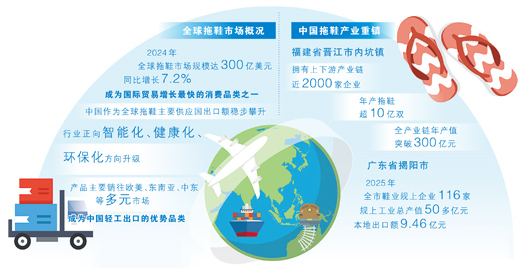
Core Insights - The article highlights the rising popularity of Chinese slippers in global markets, driven by cultural recognition and lifestyle adoption among foreign consumers [1][10] - The transformation of Chinese slippers from low-cost products to trendy items reflects the broader upgrade of China's manufacturing industry and its cultural influence [1][6] Group 1: Market Dynamics - One in every eight people globally wears "Nekeng slippers," with 40 pairs shipped from Jinjiang to the global market every second, indicating a massive production scale [1][4] - Jinjiang, a small town in Fujian, produces over 1 billion pairs of slippers annually, with an industry output value exceeding 30 billion yuan [1][4] - The global slipper market is projected to reach $30 billion in 2024, growing at 7.2% year-on-year, making it one of the fastest-growing consumer categories in international trade [4][6] Group 2: Technological Innovation - The use of advanced materials and technologies, such as phase change temperature-regulating materials and antibacterial EVA composites, enhances product quality and comfort [5][6] - The introduction of digital manufacturing systems allows for rapid production and customization, significantly reducing the time from concept to market [8][13] Group 3: Brand Development - The shift from product export to brand export is evident, with companies focusing on cultural resonance and value competition rather than just price [10][11] - The establishment of "Yiwu Good Goods" brand outlet stores in multiple countries aims to enhance brand visibility and facilitate international trade [11][12] Group 4: E-commerce and Global Reach - The rise of cross-border e-commerce has opened new channels for small and medium enterprises to enter international markets, enhancing their competitiveness [12][13] - Companies are leveraging both online platforms and offline partnerships with regional retailers to expand their market presence and brand recognition [13]

看中国好物七十二变|一双拖鞋的环球之旅
Ren Min Ri Bao· 2026-02-04 01:45
Core Viewpoint - The article highlights the global rise of Chinese slippers, showcasing their transformation from ordinary products to trendy items, driven by cultural resonance and technological innovation. Group 1: Market Dynamics - One in every eight people globally wears "Nekeng slippers," with 40 pairs shipped from Jinjiang every second, indicating a massive market presence [1] - Jinjiang produces over 1 billion pairs of slippers annually, with an industry output value exceeding 30 billion yuan [1] - The global slipper market is projected to reach $30 billion in 2024, growing at 7.2% year-on-year, making it one of the fastest-growing consumer categories in international trade [3] Group 2: Technological Innovation - Companies are utilizing advanced materials and technologies, such as phase change temperature-regulating materials and antibacterial EVA composites, to enhance product quality [5][6] - The use of digital systems has reduced product development cycles from 3-6 months to 1 month, allowing for rapid market response [8] Group 3: Cultural Resonance and Branding - The design of slippers incorporates traditional Chinese cultural elements, enhancing their appeal in international markets [9] - Companies are focusing on brand building and IP strategies to improve product value and market competitiveness [10] Group 4: E-commerce and Global Expansion - The rise of cross-border e-commerce has facilitated smoother market entry for small and medium enterprises, allowing them to reach global consumers effectively [11] - Companies are leveraging both online platforms and offline partnerships with regional retailers to expand their market presence [11]
从“中国制造”到“全球青睐”——一双拖鞋的环球之旅
Xin Hua Wang· 2026-02-03 23:53
Core Viewpoint - The article highlights the global rise of Chinese slippers, showcasing their transformation from ordinary products to trendy items that resonate with international consumers, driven by cultural appreciation and technological innovation. Group 1: Market Dynamics - One in every eight people globally wears "Nekeng slippers," with 40 pairs shipped from Jinjiang every second, indicating a massive market presence [1] - Jinjiang produces over 1 billion pairs of slippers annually, with an industry output value exceeding 30 billion yuan [1] - The global slipper market is projected to reach $30 billion in 2024, growing at 7.2% year-on-year, making it one of the fastest-growing consumer categories in international trade [3] Group 2: Technological Innovation - The use of advanced materials and technologies, such as phase change temperature-regulating materials and antibacterial EVA composites, enhances product quality and comfort [4][5] - The introduction of smart manufacturing and digital transformation allows for rapid product development and customization, significantly reducing production cycles [6] Group 3: Cultural Resonance and Branding - The design of slippers incorporates traditional Chinese cultural elements, enhancing their appeal in international markets and facilitating cultural recognition [8] - Companies are shifting from product output to brand output, focusing on value competition rather than price competition [9] Group 4: E-commerce and Global Expansion - The rise of cross-border e-commerce has opened new channels for small and medium enterprises to enter international markets, facilitating brand recognition and sales [10] - Companies are leveraging both online platforms and offline partnerships with regional retailers to enhance market penetration and consumer engagement [10]
“地摊货”变身“全球潮”,中国拖鞋经历了怎样的变化?
Xin Lang Cai Jing· 2026-02-03 23:52
Core Insights - The article discusses the global rise of Chinese slippers, highlighting their transformation from ordinary products to trendy items that resonate with international consumers [2][10] - It emphasizes the role of innovation, cultural resonance, and digital transformation in the success of Chinese slipper brands in the global market [6][12] Market Overview - The global slipper market is projected to reach $30 billion by 2024, with a year-on-year growth of 7.2%, making it one of the fastest-growing consumer categories in international trade [4] - China is a major supplier in the global slipper market, with production and export values steadily increasing, primarily targeting diverse markets including Europe, Southeast Asia, and the Middle East [4][9] Production and Innovation - The production hub of Jinjiang, Fujian, produces over 1 billion pairs of slippers annually, with a total industry output value exceeding 30 billion yuan [2][9] - Companies are leveraging advanced technologies such as phase change materials and antibacterial composites to enhance product quality and comfort [5][6] - The use of digital systems has significantly reduced product development cycles, allowing for rapid response to market trends [8][12] Cultural and Brand Development - The article highlights the importance of cultural identity in the branding of Chinese slippers, with designs reflecting traditional Chinese aesthetics [10][11] - Companies are increasingly focusing on brand building and IP strategies to enhance product value and market presence [11][12] E-commerce and Global Reach - The rise of cross-border e-commerce has facilitated easier access for small and medium enterprises to international markets, enhancing their growth potential [12][13] - Companies are adopting a dual-channel strategy, combining online platforms with offline retail partnerships to maximize market penetration [13]
山东省滨州市市场监督管理局发布2025年产品质量市级监督抽查统计表(1老年健步鞋)
Zhong Guo Zhi Liang Xin Wen Wang· 2026-02-02 09:16
Core Viewpoint - The report from the Binzhou Market Supervision Administration highlights the results of the 2025 product quality supervision inspection for elderly walking shoes, indicating compliance and non-compliance rates among various manufacturers [2]. Group 1: Inspection Results - The inspection covered multiple enterprises producing elderly walking shoes, with a focus on their compliance with quality standards [2]. - Several brands were tested, including those from Shenzhen Yingbo, Beijing Fuliansheng, and others, with varying results in terms of compliance [2][3]. - Specific models and their compliance status were documented, showing that some products met the required standards while others did not [2]. Group 2: Manufacturer Information - The report lists various manufacturers, including their names, production dates, and specific product details such as model numbers and trademarks [2][3]. - Notable manufacturers include Shanghai Huoli Shoes Industry Co., Beijing Dongli Jian Technology Co., and others, with detailed information on their products [2][3]. - The inspection results indicate that some manufacturers consistently produced compliant products, while others had instances of non-compliance [2].