刀郎农民画

Search documents
乡土间绽放艺术之花
Ren Min Ri Bao Hai Wai Ban· 2026-01-24 00:05
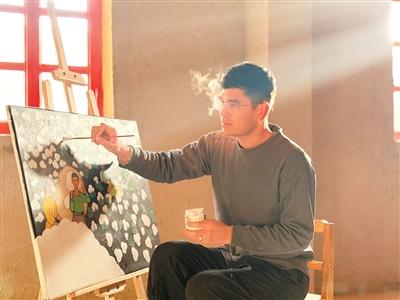
Core Viewpoint - The article highlights the cultural significance and evolution of the Daolang folk painting, emphasizing its roots in the daily lives of farmers and its transformation into a recognized art form in Xinjiang, China [12]. Group 1: Historical Background - Daolang folk painting originated in the 1970s as a leisure activity for farmers during their off-seasons, where they painted on various surfaces, capturing scenes of daily life such as livestock, celebrations, and nature [12]. - The style of Daolang painting has evolved by incorporating elements from Uyghur carpet patterns, wood carvings, embroidery, and Han Chinese New Year paintings, leading to a unique artistic expression characterized by vibrant colors and a lack of perspective [12]. Group 2: Personal Journey of the Artist - The artist, Naibijiang Abudureheman, has a personal connection to Daolang painting, having been inspired by his mother’s simple drawings during his childhood, which instilled a passion for art in him [12]. - In 2015, Naibijiang enrolled in a training program at the county cultural center, learning from the third-generation inheritor, Eliyas Bawudong, emphasizing the importance of grounding art in everyday life [12]. Group 3: Current Developments and Impact - As a non-material cultural heritage inheritor and cooperative leader, Naibijiang now leads a group of 13 folk painters, developing a model that integrates creation, teaching, and industry, with individual paintings selling for 500 to 1,000 yuan, generating over 100,000 yuan annually [12]. - The initiative has also led to the establishment of public training classes, with over 50 community members now engaged in painting, allowing visitors to connect with the cultural essence of Daolang through these artworks [12].

展现新疆多彩生活 刀郎农民画走进中央美术学院
Zhong Guo Xin Wen Wang· 2025-09-17 07:40
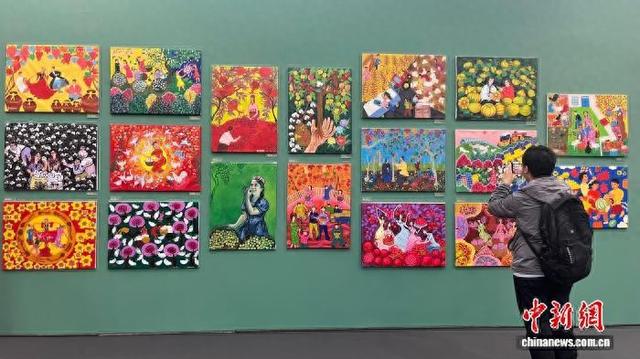
Core Viewpoint - The exhibition of Dao Lang farmer paintings from Awati County, Xinjiang, opened at the Central Academy of Fine Arts in Beijing, showcasing the vibrant local culture and artistic expression of the region [1][3]. Group 1: Exhibition Details - The exhibition features a 7-meter long scroll titled "The Bright Moon Reflects on Tianshan" as the visual centerpiece, along with 70 works from local Dao Lang farmer artists [1]. - The event is organized by the Awati County Committee of the Communist Party of China, the Awati County People's Government, and the Zhejiang Province Shaoxing Aid Xinjiang Command [6]. Group 2: Cultural Significance - Awati County is recognized as the "Hometown of Dao Lang Farmer Paintings," with this art form emerging in the 1970s, characterized by bright colors and strong ethnic features that depict the daily lives of local farmers [1][3]. - Wang Meng, a renowned writer and recipient of the "People's Artist" national honor, described the exhibition as vibrant and reflective of the artists' love for life and the spirit of the local people, contributing to the narrative of Chinese-style modernization in Xinjiang [3]. Group 3: Artist Insights - Artist Nabi Jiang Abdu Rehman shared his personal journey, stating that his interest in painting was sparked by observing his mother create patterns with charcoal, leading him to learn from older artists in the community [3][6]. - Nabi Jiang's work, "The Flower of Happiness," illustrates a scene of his mother and sister picking cotton, emphasizing the connection between his art and real-life experiences [6].