列车运行图调整服务

Search documents
全国铁路今起实行新的列车运行图
新华网财经· 2026-01-26 01:19
Core Viewpoint - The new train operation schedule implemented on January 26 aims to enhance the efficiency and capacity of China's railway system, supporting high-quality economic and social development through optimized passenger and freight services [2][5]. Group 1: Train Operation Adjustments - The new schedule includes 12,130 scheduled passenger trains and 23,748 freight trains, improving overall railway transport capacity and efficiency [2]. - The adjustments are part of a broader strategy to align with the spirit of the 20th National Congress of the Communist Party of China, focusing on a people-centered development approach and market demand [5]. Group 2: Regional Enhancements - New lines such as the Baotou-Yinchuan and Xi'an-Extension high-speed rail are utilized to optimize train operations in central and western regions, facilitating economic development [6]. - Specific improvements include the introduction of benchmark high-speed trains between Yinchuan and Beijing, reducing travel time by 1 hour and 14 minutes compared to previous schedules [6]. Group 3: High-Speed Rail Developments - The new schedule enhances connectivity in the Guangdong-Hong Kong-Macao Greater Bay Area, with 100 trains from Zhanjiang North to Guangzhou and additional services to Hong Kong [15]. - The introduction of high-speed sleeper trains and adjustments to existing services aim to improve travel convenience and promote regional integration [15]. Group 4: Service Quality Improvements - The railway system is enhancing passenger services, including real-time ticket monitoring and improved booking options for seniors and students, ensuring a better travel experience [37][38]. - Initiatives such as themed tourist trains and enhanced in-transit services aim to create new consumption scenarios and improve overall passenger satisfaction [37]. Group 5: Freight Transport Enhancements - The new schedule includes 473 freight trains, increasing capacity for essential goods like coal and grain, thereby supporting national economic stability [40]. - The optimization of logistics services and the introduction of new international freight routes aim to enhance supply chain efficiency and reduce logistics costs [40].


增开客货列车、试点同城行李搬运 铁路全方位服务暑运高峰
Yang Shi Wang· 2025-07-01 03:15
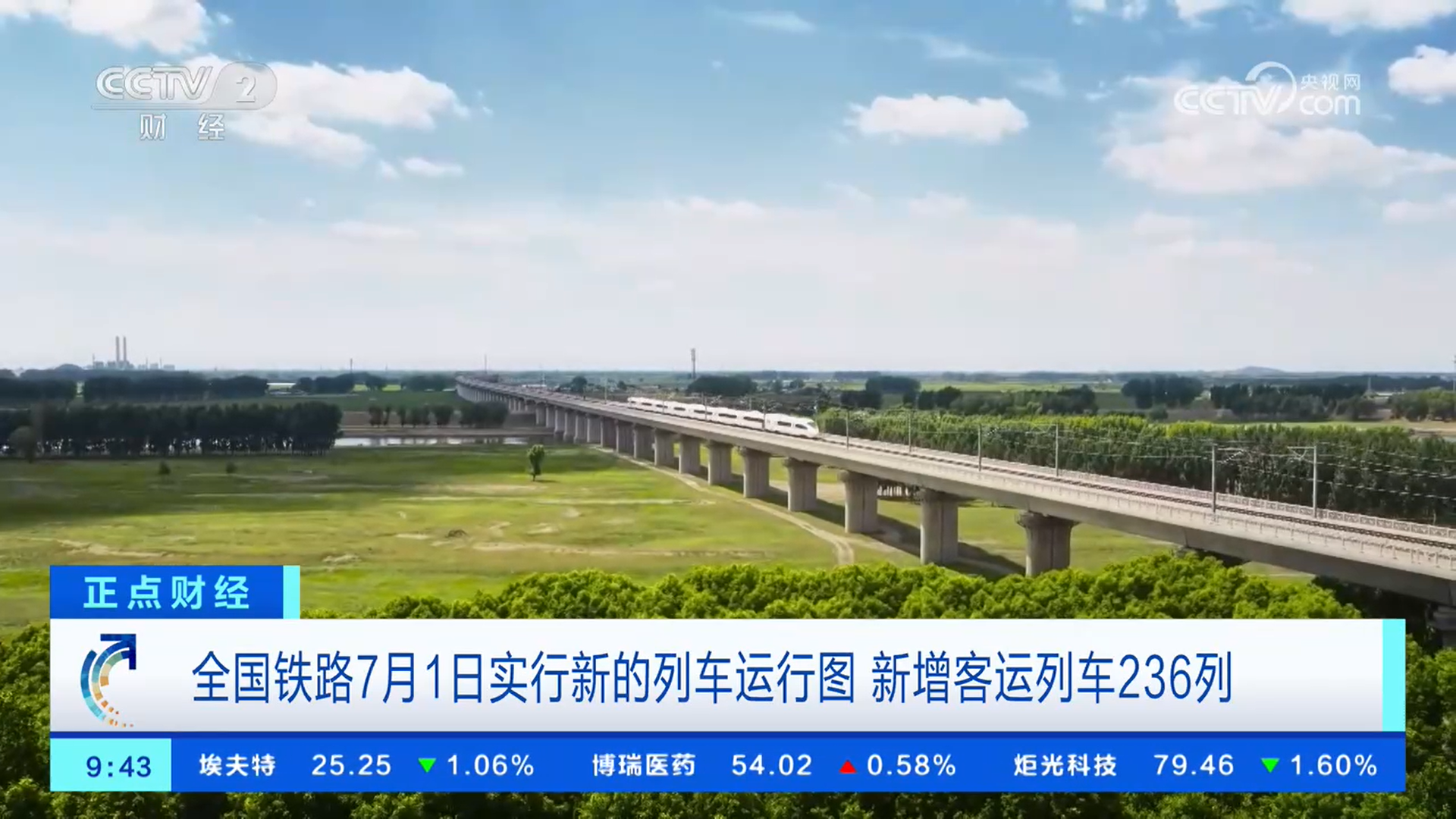
Summary of Key Points Core Viewpoint - The new train operation schedule implemented by the national railway starting from July 1 has increased the number of scheduled passenger trains to 13,302, an increase of 236 trains compared to the previous schedule [1]. Group 1: Passenger Train Operations - The new schedule allows for multiple lines to operate at a speed of 350 km/h, including the Hangzhou-Changsha and Beijing-Harbin high-speed rail lines, significantly reducing travel times between major cities [1]. - The Chongqing station will operate 396 pairs of passenger trains, an increase of 45.5 pairs compared to the second quarter, with new routes connecting to popular tourist destinations [3]. - Special summer tourist trains have been introduced, including a "coastal tourism special line" that connects southeastern coastal cities, with trains running every 15 minutes between key locations [3]. Group 2: Freight Train Operations - The total number of freight trains scheduled nationwide has increased to 23,635, with an addition of 39 trains, enhancing the railway's freight transport capacity and efficiency [4]. - Long-distance freight trains across railway bureaus have been increased to 424, with new routes connecting various provinces, thereby improving the logistics network [6]. Group 3: Service Enhancements - A pilot program for same-city luggage transportation services has been launched at 19 railway stations, allowing passengers to book luggage transport within 35 kilometers of the station [7]. - The service includes options for transporting luggage from the departure point to the station and vice versa, with specific pricing structures for different transport types [7][9]. - The summer travel season is expected to see a significant increase in passenger numbers, with the Kunming Bureau anticipating 26 million passengers, a year-on-year increase of 8.3% [10][12].