加密卡

Search documents
稳定币支付:加密卡如何连接数字资产与全球商业
Xin Lang Cai Jing· 2026-01-31 15:25
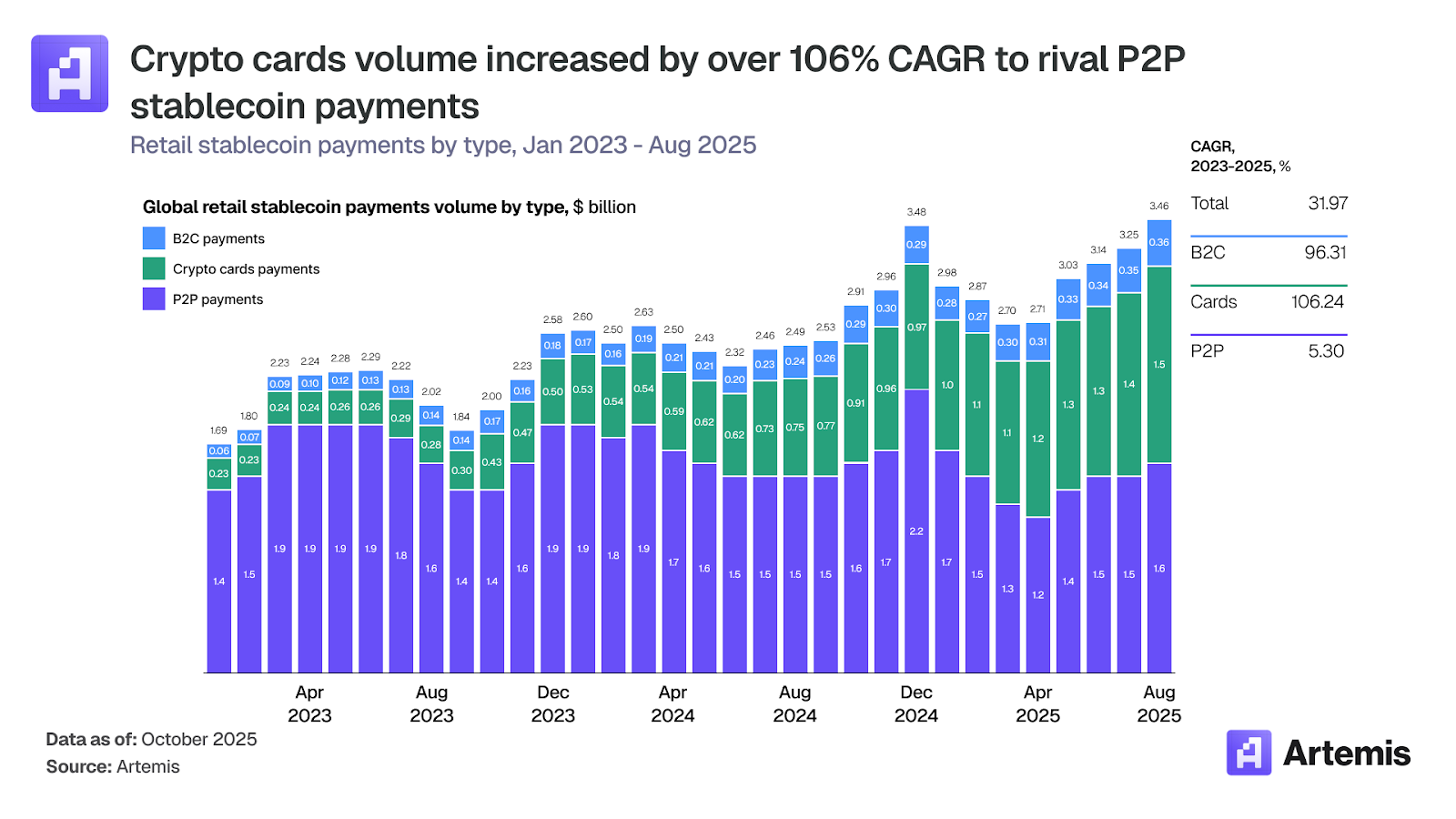
Core Insights - The crypto card market is experiencing rapid growth, with transaction volumes projected to increase from approximately $100 million per month in early 2023 to over $1.5 billion by the end of 2025, representing a compound annual growth rate (CAGR) of 106% [1][12] - The market size for crypto cards has surpassed $18 billion annually, comparable to the $19 billion in peer-to-peer (P2P) stablecoin transfers, which have only grown by 5% during the same period [1][12] Market Structure - The crypto card business consists of three layers: payment networks (Visa, Mastercard), card program managers and issuers, and consumer-facing products [4][28] - Visa holds over 90% of on-chain card transaction volume due to early partnerships with infrastructure providers, while Mastercard focuses on direct partnerships with centralized exchanges (CEX) [4][25][27] Geographic Opportunities - The potential for stablecoin cards is particularly strong in regions where stablecoins address real issues, such as India and Argentina, where stablecoins are used for inflation hedging and digital payments [6][66] - In India, the Unified Payments Interface (UPI) has transformed digital payments, creating a favorable environment for crypto card integration [70][71] Transaction Mechanisms - Most crypto card transactions are settled in fiat currency, with the conversion from cryptocurrency to fiat occurring before reaching the payment network [20][62] - Visa's projected annualized run rate for stablecoin-related card consumption is expected to reach $3.5 billion by Q4 2025, marking a 460% year-over-year increase [20] Consumer Product Categories - Consumer-facing products can be categorized into four types: CEX cards, self-custody/protocol-native cards, crypto-native neobanks, and traditional fintech neobanks [34] - Each category has distinct strategic motivations, user bases, and business models, impacting their market positioning [34][35] Funding Mechanisms - Incentives driving the adoption of crypto payment cards vary by ecosystem, often serving as user acquisition tools for exchanges and DeFi protocols [36][45] - Crypto wallets like MetaMask and Phantom issue payment cards to enhance user engagement and diversify revenue streams, as they cannot earn custodial income [45][48] Emerging Markets - Financial technology companies in regions with significant financial friction view crypto cards as a means to access digital dollars, addressing issues like inflation and high cross-border payment costs [55][58] - These cards allow users to hold savings in dollar-pegged assets, circumventing local currency restrictions [58][61] Future Outlook - The transition to a system where merchants can directly accept stablecoins poses a strategic question for the continued relevance of crypto cards [79][80] - Despite the potential for stablecoin-native payment systems, the existing infrastructure and consumer preferences suggest that crypto cards will remain a vital bridge between digital asset holders and merchants for the foreseeable future [81][84]