
数字资产支付

Search documents
稳定币支付:加密卡如何连接数字资产与全球商业
Xin Lang Cai Jing· 2026-01-31 15:25
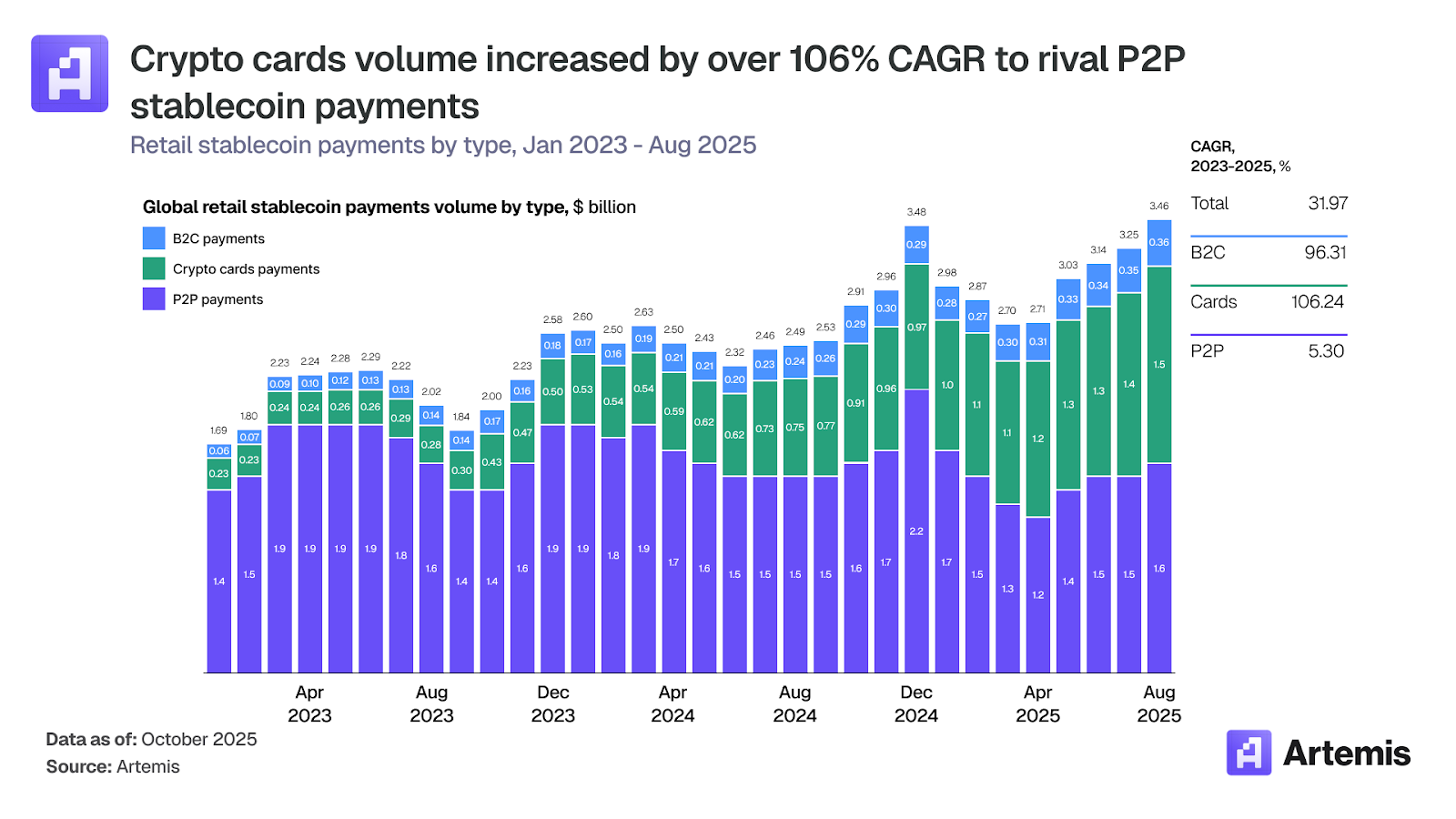
Core Insights - The crypto card market is experiencing rapid growth, with transaction volumes projected to increase from approximately $100 million per month in early 2023 to over $1.5 billion by the end of 2025, representing a compound annual growth rate (CAGR) of 106% [1][12] - The market size for crypto cards has surpassed $18 billion annually, comparable to the $19 billion in peer-to-peer (P2P) stablecoin transfers, which have only grown by 5% during the same period [1][12] Market Structure - The crypto card business consists of three layers: payment networks (Visa, Mastercard), card program managers and issuers, and consumer-facing products [4][28] - Visa holds over 90% of on-chain card transaction volume due to early partnerships with infrastructure providers, while Mastercard focuses on direct partnerships with centralized exchanges (CEX) [4][25][27] Geographic Opportunities - The potential for stablecoin cards is particularly strong in regions where stablecoins address real issues, such as India and Argentina, where stablecoins are used for inflation hedging and digital payments [6][66] - In India, the Unified Payments Interface (UPI) has transformed digital payments, creating a favorable environment for crypto card integration [70][71] Transaction Mechanisms - Most crypto card transactions are settled in fiat currency, with the conversion from cryptocurrency to fiat occurring before reaching the payment network [20][62] - Visa's projected annualized run rate for stablecoin-related card consumption is expected to reach $3.5 billion by Q4 2025, marking a 460% year-over-year increase [20] Consumer Product Categories - Consumer-facing products can be categorized into four types: CEX cards, self-custody/protocol-native cards, crypto-native neobanks, and traditional fintech neobanks [34] - Each category has distinct strategic motivations, user bases, and business models, impacting their market positioning [34][35] Funding Mechanisms - Incentives driving the adoption of crypto payment cards vary by ecosystem, often serving as user acquisition tools for exchanges and DeFi protocols [36][45] - Crypto wallets like MetaMask and Phantom issue payment cards to enhance user engagement and diversify revenue streams, as they cannot earn custodial income [45][48] Emerging Markets - Financial technology companies in regions with significant financial friction view crypto cards as a means to access digital dollars, addressing issues like inflation and high cross-border payment costs [55][58] - These cards allow users to hold savings in dollar-pegged assets, circumventing local currency restrictions [58][61] Future Outlook - The transition to a system where merchants can directly accept stablecoins poses a strategic question for the continued relevance of crypto cards [79][80] - Despite the potential for stablecoin-native payment systems, the existing infrastructure and consumer preferences suggest that crypto cards will remain a vital bridge between digital asset holders and merchants for the foreseeable future [81][84]

Mastercard(MA) - 2025 Q4 - Earnings Call Transcript
2026-01-29 15:02
Financial Data and Key Metrics Changes - For Q4 2025, net revenues increased by 15%, with value-added services and solutions net revenue up 22% on a non-GAAP currency-neutral basis [4][22] - Operating income rose by 17%, while net income and EPS increased by 17% and 20% respectively, with EPS at $4.76, including a $0.10 contribution from share repurchases [23][24] - Worldwide gross dollar volume (GDV) grew by 7% year-over-year, with U.S. GDV increasing by 4% and international volume rising by 9% [24][25] Business Line Data and Key Metrics Changes - Payment network net revenue increased by 9%, driven by domestic and cross-border transaction growth, while value-added services and solutions net revenue increased by 22% [25][26] - Commercial credit and debit volumes represented 13% of total GDV, growing at 11% year-over-year on a local currency basis [14] - The company secured over 60 new affluent programs globally in 2025, indicating strong performance in affluent segments [7][8] Market Data and Key Metrics Changes - Cross-border volume increased by 14% globally, reflecting growth in both travel and non-travel-related spending [24] - Contactless penetration reached 77% of all in-person switched purchase transactions, up 5 percentage points from the previous year [25] - The company reported a 10% year-over-year growth in switch transactions for Q4 [25][26] Company Strategy and Development Direction - The company is focused on executing its clear strategy, benefiting from a diversified business model across geographies and payment adjacencies [5][6] - Recent strategic reviews will lead to reductions in some areas but increased investment in others, indicating a commitment to innovation and agility [5][6] - The company is actively engaging in emerging opportunities such as stablecoins and agentic commerce, positioning itself as a leader in the evolving payments landscape [10][11] Management's Comments on Operating Environment and Future Outlook - Management remains optimistic about the fundamentals of the business despite geopolitical and macroeconomic uncertainties [5][30] - The company expects net revenues to grow at the high end of a low double digits range on a currency-neutral basis for 2026, with a tailwind from foreign exchange [30][32] - The macroeconomic environment is supportive, with balanced job markets underpinning healthy consumer and business spending [30] Other Important Information - The company secured various multi-year government grants that will benefit operating expenses and other income, with an expected operating expense benefit of around 5.5 percentage points [23] - A one-time restructuring charge of approximately $200 million is expected in Q1 2026, impacting about 4% of full-time employees globally [33] Q&A Session Summary Question: Details on the Capital One renegotiation - Management expressed excitement about the extension of the credit portfolio agreement with Capital One, emphasizing the value of the Mastercard network [35][36] Question: Implications of the CCCA - Management noted that there is a united opposition to the proposed Credit Card Competition Act, highlighting concerns about consumer choice and cybersecurity risks [37][39] Question: Health of the consumer - Management indicated that consumer spending remains healthy, with savvy consumers utilizing loyalty programs effectively [44][46] Question: Sensitivity to FX volatility - Management acknowledged the challenges in predicting FX volatility but emphasized the company's ability to deliver value through currency conversion services [48][49] Question: Future growth of value-added services - Management expressed confidence in the continued growth of value-added services, driven by the interconnectedness with the payment network [50][51]

国海证券:维持OSL集团“增持”评级 扩展支付产品线及全球扩张
Zhi Tong Cai Jing· 2026-01-09 08:50
Core Insights - OSL Group has completed the strategic acquisition of Banxa Holdings Inc., enhancing its position in the stablecoin trading and payment platform sector, with a focus on compliance and global expansion [1] Group 1: Company Overview - Banxa is an Australian-based payment service provider and regulatory technology company, focusing on bridging traditional financial institutions with the digital asset space since its inception in March 2014 [2] - The company has established a strong presence in the Australian market and has shifted its strategic focus towards international expansion since acquiring EU Internet Ventures B.V. in June 2020 [2] Group 2: Strategic Benefits of Acquisition - The acquisition will provide OSL Group with over 40 trading and payment licenses across the US, Canada, EU, UK, and Australia, enhancing its global payment capabilities and supporting customer needs for fiat and cryptocurrency exchanges [3] - Banxa's B2B payment solutions will complement OSL's digital asset trading and stablecoin business, creating a one-stop service for trading, payment, and fund transfers, thereby increasing customer retention [4] Group 3: Financial Impact - Banxa's revenue for the first half of 2025 was HKD 53.93 million, which is expected to significantly boost OSL's payment business revenue, which was HKD 195 million in the same period [5] - Revenue projections for OSL Group post-acquisition are estimated at HKD 514 million, HKD 873 million, and HKD 1.172 billion for 2025-2027, with year-on-year growth rates of 37.12%, 69.91%, and 34.29% respectively [5]
