
加密支付

Search documents
传香港稳定币支付公司RedotPay拟赴美IPO,募资10亿美元冲击40亿估值
智通财经网· 2026-02-24 07:43
Core Viewpoint - RedotPay, a leading fintech company in stablecoin payments based in Hong Kong, is planning an IPO in the U.S. with an initial fundraising target exceeding $1 billion and a potential valuation surpassing $4 billion by 2026 [1][3]. Group 1: Company Overview - RedotPay was established in 2023 and focuses on building a global payment infrastructure based on stablecoins, addressing high costs and inefficiencies in cross-border transactions [1]. - As of November 2025, RedotPay has over 6 million registered users and operates in more than 100 countries, achieving an annual transaction volume exceeding $10 billion and stable profitability with annual revenue of $150 million [2]. Group 2: Funding and Growth - In 2025, RedotPay accelerated its expansion with significant funding rounds, including: - March: Completed Series A funding led by Lightspeed Venture Partners [2]. - September: Received a strategic investment of $47 million from Coinbase Ventures [2]. - December: Secured $107 million in Series B funding led by Goodwater Capital, pushing its valuation past the $1 billion mark [2]. - Total funding for the year reached $194 million, with participation from top-tier venture capital firms including Accel, Blockchain Capital, HSG, Pantera Capital, and Vertex Ventures [2]. Group 3: Market Context - The U.S. capital markets are experiencing a favorable window for crypto payment companies to go public, driven by expectations of friendly policies towards the crypto industry under the Trump administration [3]. - If successful, RedotPay would join the ranks of significant players like Circle in the U.S. stock market, enhancing its influence in the crypto financial infrastructure sector [3]. - The valuation of compliant payment platforms like RedotPay is expected to have further upside as the regulatory environment for stablecoins becomes clearer [3].
币安创始人赵长鹏:隐私缺失是加密支付“最后障碍”
Xin Lang Cai Jing· 2026-02-16 07:47
Core Viewpoint - Despite technological advancements addressing high fees and low speeds, cryptocurrencies have not yet become a mainstream payment medium due to the lack of transaction privacy on public blockchains [1] Group 1: Challenges in Cryptocurrency Adoption - The primary obstacle for businesses using public blockchains for payments is the exposure of complete balances, suppliers, and cash flows, which is unacceptable for many [1] - There is a need for cryptocurrencies to resolve transparency issues while also meeting institutional compliance requirements [1] Group 2: Vision for Future Development - Zhao Changpeng proposed the "Invisible Track" vision, where blockchain serves as backend infrastructure to support existing payment providers [1] - This vision aims to facilitate faster and lower-cost transactions without users needing to directly interact with wallets or mnemonic phrases [1]
The Open Network Foundation 推出支付 SDK TON Pay
Xin Lang Cai Jing· 2026-02-09 10:59
Core Insights - The Open Network Foundation has launched a payment SDK called TON Pay, aimed at transforming Telegram into a cryptocurrency checkout layer within the TON ecosystem [1] Group 1: Product Features - TON Pay supports direct payments in Toncoin and USDT for Telegram Mini Apps, with an initial focus on Mini Apps [1] - Future plans include expanding to web platforms and supporting features such as subscriptions, gasless transactions, and local fiat currency deposits and withdrawals [1]
数据:加密支付卡在 2026 年 1 月消费交易量为 1.13 亿美元
Xin Lang Cai Jing· 2026-02-08 14:24
Core Insights - The article highlights a decline in the transaction volume of crypto payment cards, marking the end of a 12-month growth streak [1] Group 1: Transaction Volume - In January 2026, the transaction volume for crypto payment cards was $113 million, representing a slight decrease of approximately 5.8% compared to December 2025 [1] - The current month's transaction volume has reached nearly $27.5 million, with a daily average between $3.5 million and $4 million [1]
稳定币支付:加密卡如何连接数字资产与全球商业
Xin Lang Cai Jing· 2026-01-31 15:25
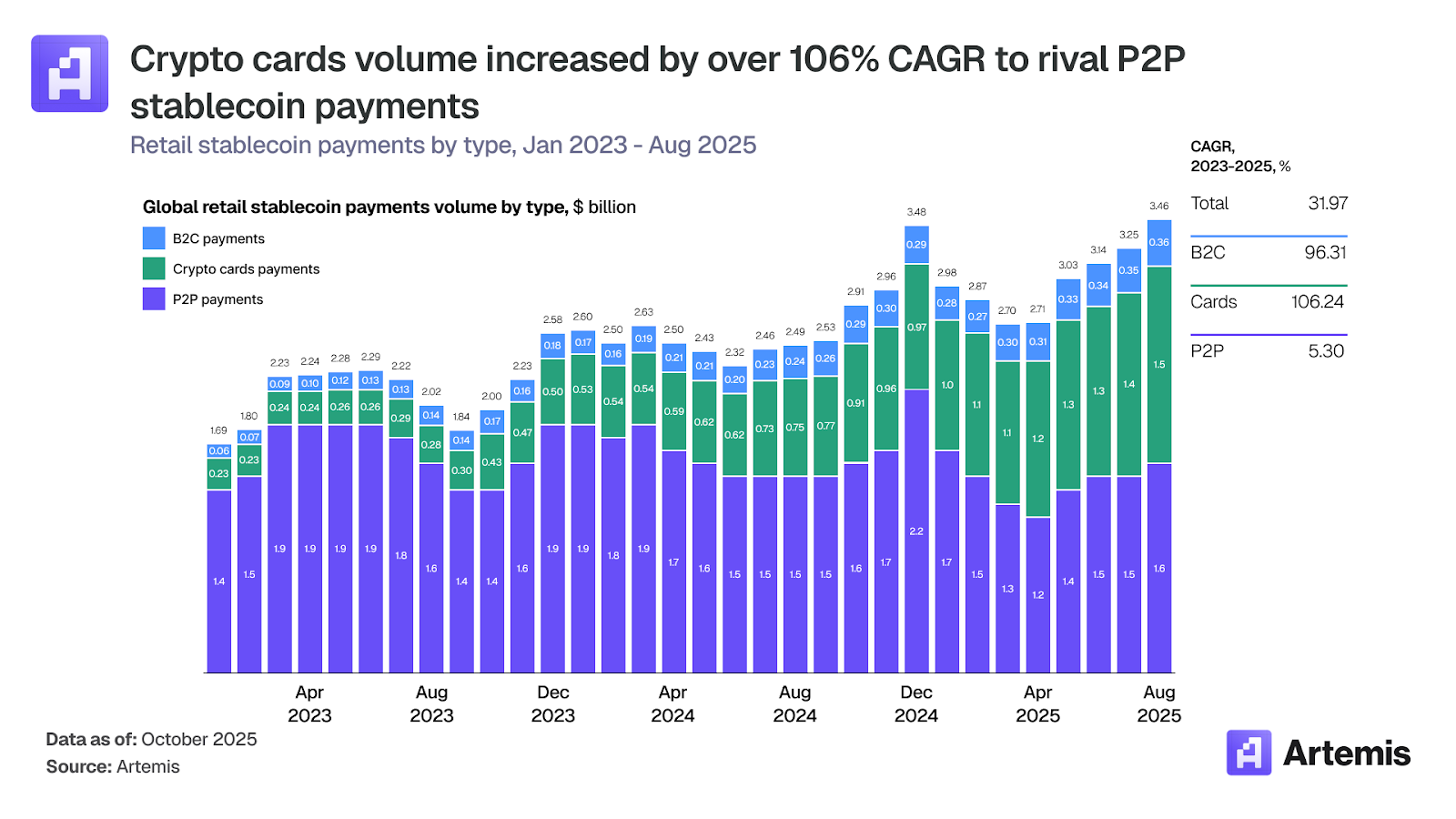
Core Insights - The crypto card market is experiencing rapid growth, with transaction volumes projected to increase from approximately $100 million per month in early 2023 to over $1.5 billion by the end of 2025, representing a compound annual growth rate (CAGR) of 106% [1][12] - The market size for crypto cards has surpassed $18 billion annually, comparable to the $19 billion in peer-to-peer (P2P) stablecoin transfers, which have only grown by 5% during the same period [1][12] Market Structure - The crypto card business consists of three layers: payment networks (Visa, Mastercard), card program managers and issuers, and consumer-facing products [4][28] - Visa holds over 90% of on-chain card transaction volume due to early partnerships with infrastructure providers, while Mastercard focuses on direct partnerships with centralized exchanges (CEX) [4][25][27] Geographic Opportunities - The potential for stablecoin cards is particularly strong in regions where stablecoins address real issues, such as India and Argentina, where stablecoins are used for inflation hedging and digital payments [6][66] - In India, the Unified Payments Interface (UPI) has transformed digital payments, creating a favorable environment for crypto card integration [70][71] Transaction Mechanisms - Most crypto card transactions are settled in fiat currency, with the conversion from cryptocurrency to fiat occurring before reaching the payment network [20][62] - Visa's projected annualized run rate for stablecoin-related card consumption is expected to reach $3.5 billion by Q4 2025, marking a 460% year-over-year increase [20] Consumer Product Categories - Consumer-facing products can be categorized into four types: CEX cards, self-custody/protocol-native cards, crypto-native neobanks, and traditional fintech neobanks [34] - Each category has distinct strategic motivations, user bases, and business models, impacting their market positioning [34][35] Funding Mechanisms - Incentives driving the adoption of crypto payment cards vary by ecosystem, often serving as user acquisition tools for exchanges and DeFi protocols [36][45] - Crypto wallets like MetaMask and Phantom issue payment cards to enhance user engagement and diversify revenue streams, as they cannot earn custodial income [45][48] Emerging Markets - Financial technology companies in regions with significant financial friction view crypto cards as a means to access digital dollars, addressing issues like inflation and high cross-border payment costs [55][58] - These cards allow users to hold savings in dollar-pegged assets, circumventing local currency restrictions [58][61] Future Outlook - The transition to a system where merchants can directly accept stablecoins poses a strategic question for the continued relevance of crypto cards [79][80] - Despite the potential for stablecoin-native payment systems, the existing infrastructure and consumer preferences suggest that crypto cards will remain a vital bridge between digital asset holders and merchants for the foreseeable future [81][84]

吴说周精选:社区压力下币安宣布购买比特币建立储备、Tether 疯狂购买黄金超 140 吨、SEC 支持退休账户配置加密货币与新闻 Top10
Xin Lang Cai Jing· 2026-01-31 00:56
Group 1: Binance and Tether Developments - Binance announced plans to convert its SAFU fund's $1 billion stablecoin reserve into Bitcoin reserves, aiming to complete the conversion within 30 days and maintain a minimum fund value of $800 million through additional Bitcoin purchases if necessary [1] - Tether has become the largest holder of gold reserves outside of sovereign nations and banks, with over 140 tons valued at approximately $24 billion, surpassing the official reserves of countries like Australia and Saudi Arabia [1] Group 2: Regulatory Updates - SEC Chairman Paul Atkins expressed support for allowing investors to allocate cryptocurrencies in 401(k) retirement accounts, emphasizing the need for clear regulatory frameworks to ensure market transparency and investor protection [2] - The SEC clarified that tokenized securities may require registration, categorizing them into issuer-led and third-party led, with the latter potentially subject to stricter regulations due to additional counterparty risks [3] - The UK government directed banks to provide services to cryptocurrency businesses, aiming to reduce the debanking phenomenon while ensuring compliance with anti-money laundering and anti-terrorism financing obligations [4] Group 3: Market Trends and Insights - PayPal's survey indicated that large enterprises are driving the adoption of cryptocurrency payments, with about 40% of merchants accepting crypto payments and a significant portion reporting increased sales [8] - Coinbase's report highlighted that Bitcoin is entering a more stable and resilient phase, with reduced sensitivity to market shocks and a shift in institutional investor preferences towards options hedging rather than high-leverage futures positions [8] Group 4: Company Activities and Financing - South Korea's third-largest cryptocurrency exchange, Coinone, is up for sale, with its major shareholder considering various options for divesting shares [5] - Tether launched USA₮, a dollar-pegged stablecoin compliant with the GENIUS Act, aimed at institutional payments and financial infrastructure [7] - Robinhood invested in the cryptocurrency trading platform Talos, which is valued at $1.5 billion, indicating ongoing interest in crypto infrastructure [10]



PayPal 调查:大型企业推动加密支付采用,约四成商户已支持
Xin Lang Cai Jing· 2026-01-27 20:00
Core Insights - The adoption of cryptocurrency payments is being led by large enterprises, with approximately 40% of merchants accepting crypto payments as of October 2025 [1] - Among enterprises with annual revenues exceeding $500 million, about 50% have integrated cryptocurrency payment options, significantly higher than small and medium-sized businesses [1] - A majority of respondents anticipate that cryptocurrency payments will become a common payment method within the next five years [1] Summary by Category Adoption Rates - Approximately 40% of merchants have accepted cryptocurrency payments [1] - Among large enterprises (annual revenue over $500 million), around 50% have adopted crypto payments [1] Sales Growth - About three-quarters of merchants that accept cryptocurrency reported an increase in related sales over the past year [1] Future Outlook - Most respondents expect cryptocurrency payments to become a standard payment method in the next five years [1]
加密支付网络 Mesh 宣布完成 7500 万美元 C 轮融资
Xin Lang Cai Jing· 2026-01-27 14:47
Group 1 - The core point of the article is that the cryptocurrency payment network Mesh has completed a Series C funding round of $75 million, bringing its total funding to over $200 million and achieving a valuation of $1 billion [1] - The funding round was led by Dragonfly Capital, with participation from Paradigm, Moderne Ventures, Coinbase Ventures, SBI Investment, and Liberty City Ventures [1]
加密支付卡交易量快速增长,日交易笔数较 2024 年底提升约 22 倍
Xin Lang Cai Jing· 2026-01-20 20:57
Core Insights - The usage of crypto-native payment cards has significantly increased from December 2024 to mid-January 2026, with daily transaction counts rising approximately 22 times to nearly 60,000 transactions, corresponding to a daily processing amount of about $4 million [1] Industry Overview - Currently, Etherfi accounts for about half of the total transaction volume, indicating a strong presence in the market, while other participants include Gnosis, MetaMask, and Solayer [1] - Some products are providing yields on card balances through on-chain methods such as DeFi lending, showcasing innovation in the crypto payment space [1] - Overall, crypto payment cards primarily operate on the Visa and Mastercard networks, reflecting the ongoing involvement of traditional payment systems in the consumption scenarios of crypto assets [1]
支无不言:在通胀率 200% 的阿根廷体验加密支付
Xin Lang Cai Jing· 2025-12-28 15:19
Core Insights - The article discusses the role of cryptocurrency payments in Argentina, particularly in the context of hyperinflation and the adoption of stablecoins as a financial tool for locals [2][11]. Group 1: Economic Context - Argentina has been battling severe inflation, with the exchange rate of the peso deteriorating from approximately 20 pesos per dollar in 2015 to around 1,400 pesos per dollar recently [6][14]. - The economic policies in Argentina have led to a lack of foreign reserves and a complex financial environment, where multiple exchange rates exist, including official and black market rates [41][42]. Group 2: Cryptocurrency Adoption - The regulatory environment for cryptocurrency payments in Argentina has become more favorable under the current administration, allowing for the growth of crypto payment solutions [17]. - Local fintech applications like Lemon Cash and Ripio are gaining traction, with Lemon Cash being noted for its comprehensive features, including bill payments and salary deposits in USDT [17][18]. Group 3: Payment Solutions - The Peanut application has emerged as a popular tool for currency exchange and payments, allowing users to recharge with stablecoins and make local purchases seamlessly [8][20]. - Traditional payment systems like Mercado Pago dominate the market, with a significant presence in everyday transactions, but new fintech solutions are providing alternatives that cater to the needs of users in a high-inflation environment [29][30]. Group 4: User Experience and Market Dynamics - The user experience with local fintech applications is generally positive, with features like virtual cards and low fees enhancing accessibility for users who may struggle with traditional banking [18][19]. - The competitive landscape for payment solutions is intense, with many new entrants attempting to capture market share by offering similar functionalities and incentives [20][21]. Group 5: Future Prospects - The potential for local fintech solutions to expand globally is debated, with some experts suggesting that local teams may lack the vision for international growth compared to European teams [60][62]. - The article highlights the importance of marketing and user acquisition strategies in establishing a foothold in both local and international markets [62][63].
