北京中轴线

Search documents
北京中轴线申遗重要推动者吕舟:把中国故事讲给世界听
Xin Lang Cai Jing· 2026-01-04 04:33
Core Viewpoint - The successful inclusion of the Beijing Central Axis in the World Heritage List in July 2024 represents a significant achievement in cultural heritage preservation, showcasing the continuity and unity of Chinese civilization [4][13][16]. Group 1: Background and Significance - The Beijing Central Axis, stretching 7.8 kilometers, is the longest urban axis in the world, originating in the 13th century and evolving through the 16th century [3][9]. - The axis embodies the pursuit of order in Chinese culture and reflects the ideal city planning of ancient China, influencing the development of modern Beijing [2][4]. Group 2: Efforts and Achievements - Since 2009, a dedicated team led by a prominent professor has worked on the application for World Heritage status, culminating in a successful bid after 15 years of effort [10][13]. - The application process involved extensive discussions on how to effectively communicate the historical and cultural significance of the Central Axis to an international audience [12][17]. Group 3: Future Directions - The recognition of the Central Axis is seen as a starting point for further urban development and cultural heritage initiatives, emphasizing the need for ongoing efforts in cultural preservation and urban renewal [5][14]. - Future projects include integrating the value of the Central Axis into educational curricula and utilizing digital technology to enhance public engagement with cultural heritage [15][19].
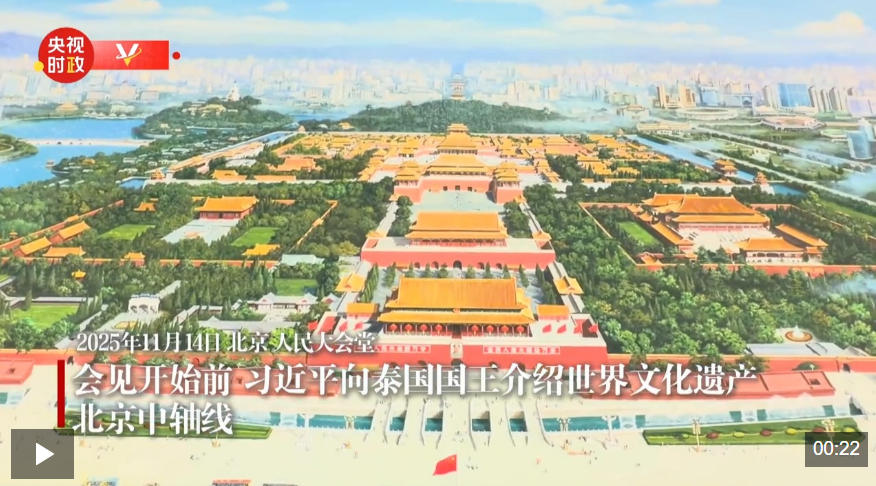
习近平向泰国国王介绍世界文化遗产北京中轴线
Yang Shi Xin Wen Ke Hu Duan· 2025-11-14 15:18
Core Viewpoint - The meeting between President Xi Jinping and Thai King Vajiralongkorn highlights the strengthening of diplomatic relations between China and Thailand, emphasizing cultural heritage and cooperation [2] Group 1 - President Xi introduced the World Cultural Heritage site, the Beijing Central Axis, to the Thai King, showcasing China's cultural significance [2]

文化遗产保护如何赋能区域“繁荣与生计”?
Zhong Guo Xin Wen Wang· 2025-11-06 05:31
Core Insights - Cultural heritage protection should actively drive regional sustainable development and improve people's lives, rather than being a static record in history books [1] - The theme for the 2025 "World Heritage Contribution to Sustainable Development Goals" is "Prosperity and Livelihood," reflecting the contemporary value and development direction of heritage protection [1] Group 1: Heritage Protection and Regional Development - High-quality cultural heritage protection is a crucial pillar for social and economic development, exemplified by the "Liangzhu Cultural Corridor," which achieved strategic integration of heritage protection and regional development [1][2] - The "Liangzhu model" provides valuable experience for collaborative development in large heritage areas through a comprehensive support system from top-level design to policy and implementation [2] Group 2: Future Exploration and Cultural Activation - Future exploration for Liangzhu should focus on deeper integration with land spatial planning and leveraging digital technologies to narrate the story of cultural heritage promoting Chinese modernization [2] - The Beijing Central Axis serves as a model for activating heritage resources, transforming a cultural concept into a walkable and experiential public cultural space, thereby enhancing urban governance and driving socio-economic development [2] Group 3: Challenges and Solutions for Jiangnan Water Towns - Jiangnan water towns face challenges such as population loss and a lack of distinctiveness, primarily due to the "homogenization" of towns [3] - Each water town must conduct in-depth cultural "archaeology" to rediscover its unique historical context and industrial heritage, which is essential for establishing its identity [3] - Collaboration and restructuring are necessary to reassess the economic value of towns within the context of the Yangtze River Delta integration, promoting balanced flows of people, capital, and technology [3] Group 4: Economic Potential and Unique Industries - The core of revitalizing ancient towns lies in developing distinctive and diverse industries, as demonstrated by Wuzhen and Xitang, which have successfully transformed from obscure towns to cultural and exhibition hubs [3] - The potential for economic growth in ancient towns is significant, contingent upon identifying unique market niches rather than merely selling local products or operating homestays [3] Group 5: Overall Vision for Cultural Heritage Protection - The vision for cultural heritage protection empowering "prosperity and livelihood" is becoming clearer, with the Liangzhu Cultural Corridor creating broad opportunities for livelihoods through systematic design [4] - The Beijing Central Axis exemplifies how cultural capital can be transformed into accessible urban spaces and tourism economies, enhancing governance and quality of life [4] - The path for Jiangnan water towns involves breaking free from homogenization by excavating historical roots and reshaping unique industrial ecosystems, enabling youth to find employment and realize dreams in their hometowns [4]
新华社权威速览·非凡“十四五”丨“十四五”时期,这些文化遗产成功申遗
Xin Hua She· 2025-09-11 01:03
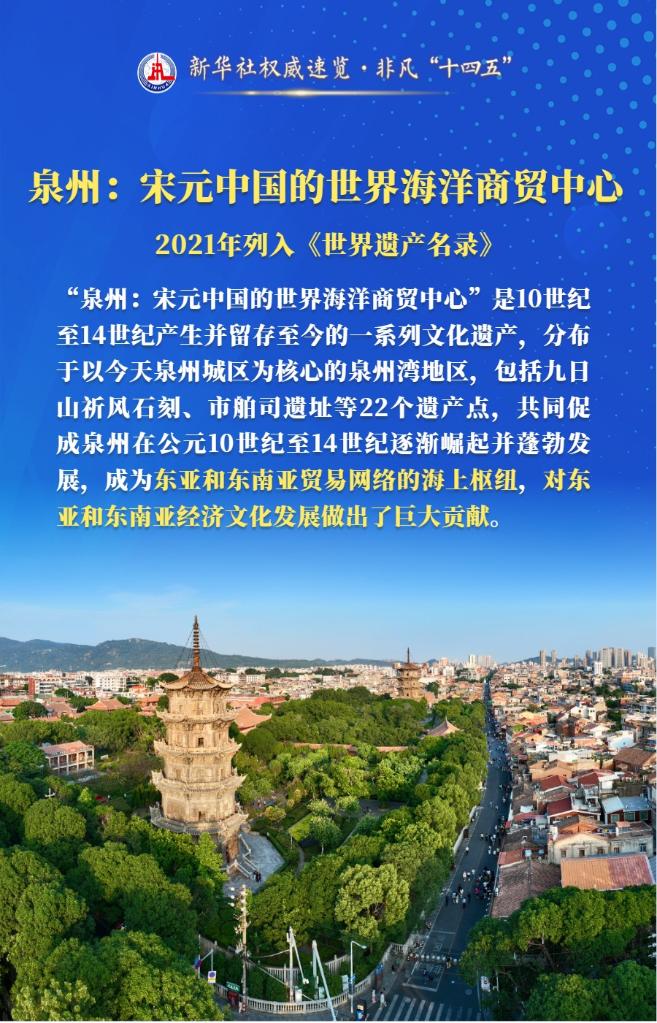
Group 1 - The "14th Five-Year Plan" period has seen the successful inclusion of four cultural heritage sites in the World Heritage List: Quanzhou, Puer Jingmai Mountain Ancient Tea Forest Cultural Landscape, Beijing Central Axis, and Xixia Tombs [1] Group 2 - Quanzhou: The "Quanzhou: Emporium of the World in Song and Yuan China" was listed in 2021, representing a series of cultural heritage from the 10th to 14th centuries, contributing significantly to the maritime trade network in East and Southeast Asia [2] Group 3 - Puer Jingmai Mountain Ancient Tea Forest Cultural Landscape was included in the World Heritage List in 2023, showcasing a well-preserved and rich cultural landscape of ancient tea forests, exemplifying sustainable development and human-nature interaction [4] Group 4 - Beijing Central Axis, recognized in 2024, is the longest urban axis in the world at 7.8 kilometers, reflecting ancient Chinese urban planning traditions and the evolution of Beijing's cityscape since the 13th century [5] Group 5 - Xixia Tombs, set to be listed in 2025, are the largest and most complete archaeological remains of the Xixia dynasty, providing crucial evidence of its historical significance and role as a hub on the Silk Road [6]