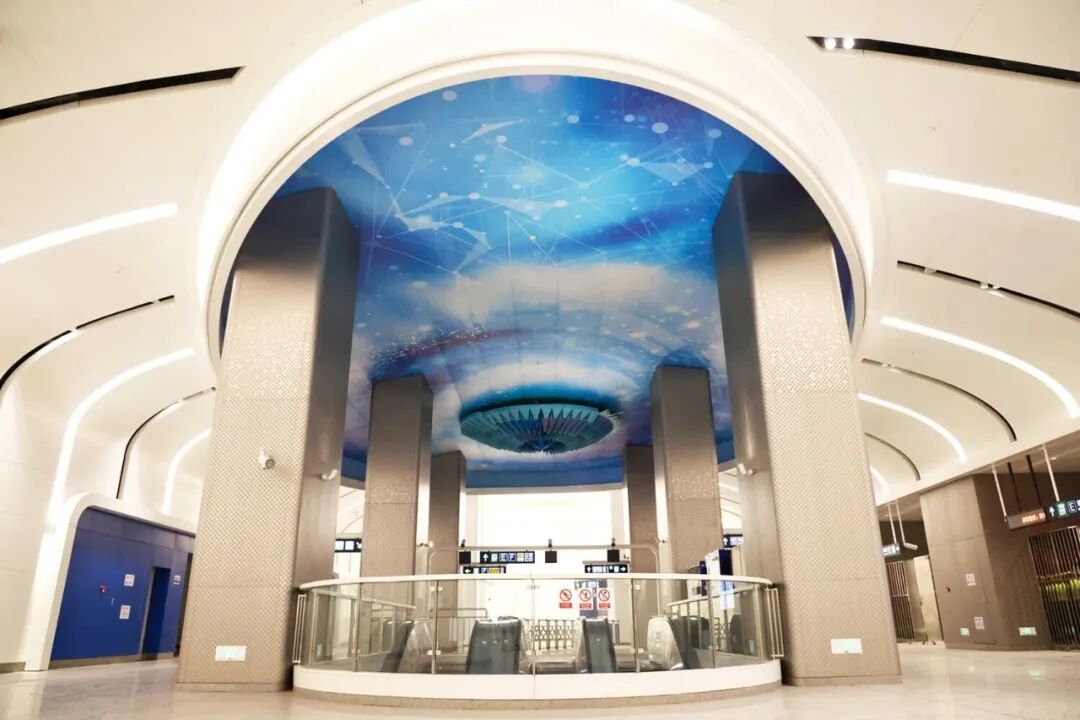
北京地铁17号线望京西站

Search documents
北京地铁17号线望京西站1月31日开通
Xin Lang Cai Jing· 2026-01-31 23:41
Core Points - The opening of Wangjing West Station on Line 17 has upgraded it to a three-line transfer station, allowing passengers to transfer freely between Line 13, Line 15, and Line 17, as well as access buses to destinations like Miyun and Huairou [1][2] - The new transfer system significantly reduces travel time for commuters, with one passenger estimating a time savings of at least 15 minutes due to the new connections [1] - The design of the new station features a modern aesthetic, including a large "flying saucer" suspended in a blue-themed environment, enhancing the technological feel of the station [1] Summary by Sections - **Transfer Experience**: The transfer time between Line 13 and Line 17 is approximately 3.5 minutes, while transferring from Line 13 to Line 15 takes about 4 minutes and 40 seconds. The previous transfer passage has been closed, and passengers are directed to the new transfer route [2] - **Wangjing West Transportation Hub**: The newly opened Wangjing West Transportation Hub features a stylish black and white design, with two levels of bus platforms. Passengers can access various bus routes, including 866, 571, and express line 197, with connections to the ground level for additional routes [3]
地铁17号线望京西站明天开通
Bei Jing Wan Bao· 2026-01-30 06:42
Core Points - The Beijing Subway Line 17's Wangjing West Station officially opens for operation, enhancing connectivity between Line 17, Line 13, and Line 15 [1] - The station serves as a key transfer hub, facilitating seamless underground transfers among three major subway lines and integrating with bus services for improved commuter options [1] - The Wangjing West Transportation Hub optimizes transfer efficiency and enhances passenger experience through a multi-level transfer space and organized traffic flow [1] - The station features a two-level underground island platform, allowing for easier transfers between lines without the need for outdoor corridors, thus improving safety and comfort [1] - The hub has been equipped with comprehensive bus facilities, accommodating seven bus routes [2]
北京地铁17号线望京西站即将开通,望京西交通枢纽同步投用
Zhong Guo Xin Wen Wang· 2026-01-30 01:00
Core Viewpoint - The opening of the Wangjing West Station on Beijing's Metro Line 17 enhances the connectivity of the northern region's rail transit network, providing more convenient travel options for residents and supporting the city's high-quality development [1][2]. Group 1: Infrastructure Development - The Wangjing West Station officially opens on January 31, serving as a key transfer hub connecting Lines 17, 13, and 15, thus eliminating a transfer gap in the northern area [1]. - The station is part of a comprehensive transportation hub that integrates various modes of transport, including metro, bus, taxi, and bicycle, improving the efficiency of rail transit connections [1]. Group 2: Impact on Urban Development - The opening of Line 17 strengthens the links between key functional areas such as Yizhuang New Town, Wangjing Business District, and Future Science City with the central urban area, facilitating a balance between living and working spaces [2]. - The new station is expected to alleviate traffic pressure on existing lines like Line 13 and Line 5, enhancing the overall accessibility of the northern region's rail network [2].
北京地铁17号线望京西站1月31日开通,实现三线换乘
Bei Jing Qing Nian Bao· 2026-01-29 12:45
Core Viewpoint - The opening of the Wangjing West Station on Beijing's Metro Line 17 on January 31 marks a significant enhancement in the city's public transportation network, facilitating seamless transfers among three major subway lines and improving overall accessibility for residents [1] Group 1: Infrastructure Development - The Wangjing West Station serves as a crucial transfer hub connecting Line 17, Line 13, and Line 15, effectively addressing the previous "transfer gap" in the northern region's rail transit system [1] - The station's operation is expected to provide residents with more diverse and convenient travel options, contributing to the high-quality development of the city [1] Group 2: Impact on Urban Mobility - The integration of the new station with bus services allows for seamless connections, enhancing the overall efficiency of urban mobility in the area [1] - The official opening follows a successful trial operation period, indicating readiness for full-scale service and operational reliability [1]
好消息!北京地铁17号线望京西站,本周六开通!
Huan Qiu Wang· 2026-01-29 12:28
Core Viewpoint - The opening of the Wangjing West Station on Beijing's Metro Line 17 enhances the connectivity of the northern region's transportation network, facilitating seamless transfers between three major subway lines and improving public transport options for residents [1][4]. Group 1: Infrastructure and Connectivity - Wangjing West Station serves as a crucial transfer hub connecting Metro Lines 17, 13, and 15, effectively eliminating a transfer gap in the northern area [1][4]. - The station is designed as a two-level island platform, allowing passengers to transfer between lines with reduced vertical movement, enhancing safety and comfort [2][4]. - The station is expected to handle approximately 73,000 passengers daily, with around 61,000 of those being transfer passengers [4]. Group 2: Transportation Hub Features - The Wangjing West Transportation Hub integrates various transport modes, including subways, buses, taxis, and bicycles, optimizing transfer efficiency and improving passenger experience [5][7]. - The hub features seven bus routes, with four on the ground level and three on an intermediate level, providing comprehensive connectivity to surrounding areas [7]. - Parking facilities include 150 car spaces, 25 taxi drop-off spots, and 3,000 bicycle parking spaces, catering to diverse commuting needs [7]. Group 3: Urban Development Impact - The opening of Wangjing West Station strengthens the connection between key functional areas such as Yizhuang New City, Wangjing Business District, and Future Science City, supporting balanced urban development and alleviating traffic pressure in the northeastern districts [4][5].