十拳剑超稳星

Search documents
我的2025|基金投顾第三年
天天基金网· 2025-12-25 09:29
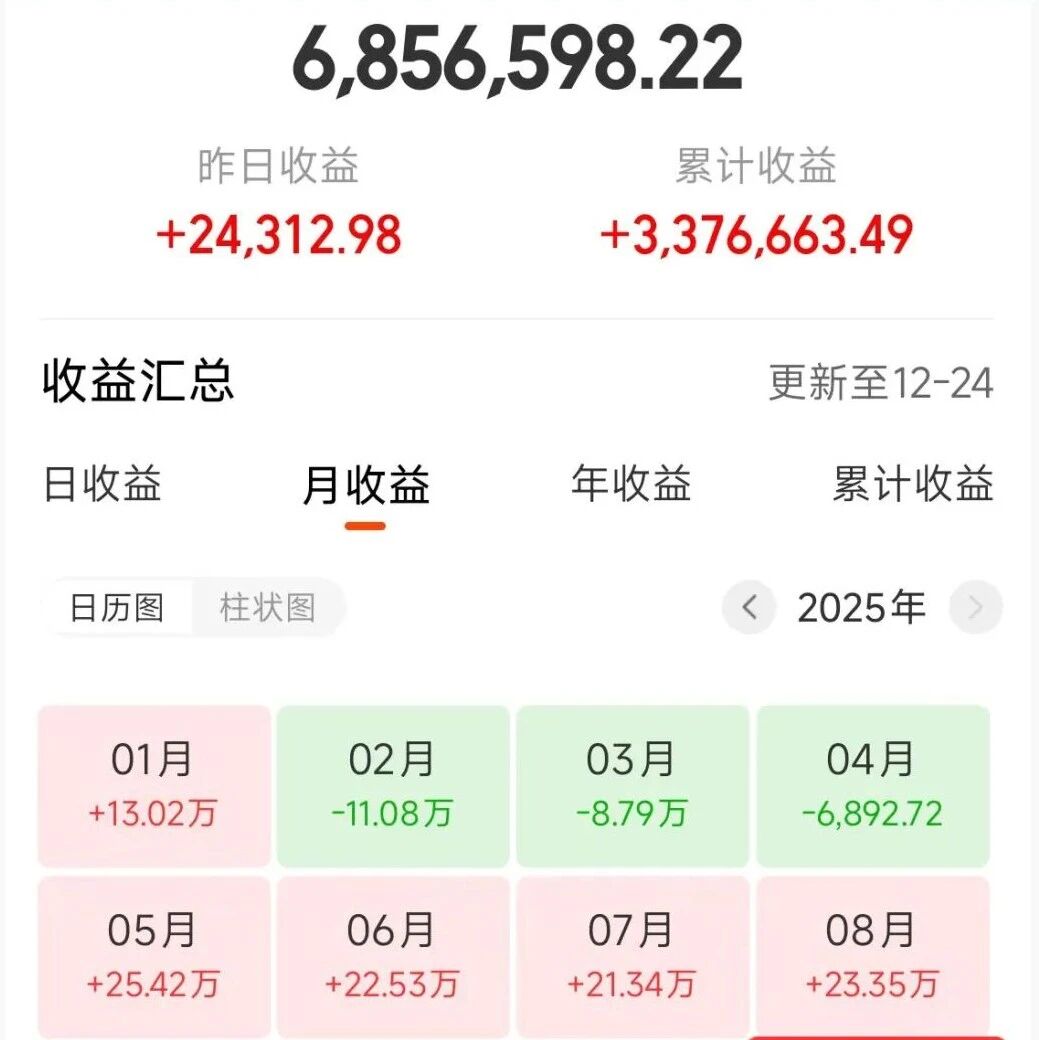
Core Insights - The article emphasizes the effectiveness of diversified investment strategies, showcasing a significant return on investment and a focus on steady growth rather than high-risk bets [2][4]. Group 1: Investment Performance - The total account value reached a historical high of 3.37 million, with a daily gain of 24,312.98 and a cumulative gain of 3,376,663.49 [3]. - The investment strategy has consistently maintained a full allocation with diversified assets, resulting in reduced volatility while keeping returns stable [4]. Group 2: Strategy Analysis - The equity portfolio, which includes a variety of asset types, outperformed major indices like the CSI 800 and CSI 300, with lower volatility and drawdowns [7]. - The strategy includes a mix of assets such as AI, Hong Kong tech stocks, CPOs, and gold ETFs, ensuring exposure to various market trends without missing out on potential gains [7]. Group 3: Risk Management - The "solid income plus" strategy is designed to allocate short-term funds into stable investments, showing resilience during market downturns while gradually increasing in value [9][11]. - The "super stable star" strategy focuses on maintaining low volatility (targeting 2%) through a structured approach that combines fixed income and equity assets, achieving a maximum drawdown of only 2.05% [22][27]. Group 4: Investment Philosophy - The investment approach is characterized by a dual strategy of "trend chasing" and "reversal betting," allowing for dynamic balance and adaptability to market changes [15][19]. - The article highlights the importance of systematic investment and discipline, advocating for a long-term perspective rather than attempting to time the market [32].

固收+:长债还是短债?三分法工具回测
雪球· 2025-06-05 07:45
Group 1 - The core idea of the article emphasizes the importance of fixed overall volatility in asset allocation to maximize returns and Sharpe ratios, derived from the pursuit of portfolio efficiency [3][41]. - The article outlines a three-step process to reconstruct investment paradigms: setting risk budgets, decomposing volatility allocation, and maximizing efficiency [6][10][11]. - The article presents backtesting results using the "three-part method" tool, comparing various strategies and highlighting the performance of long bond and equity combinations [4][12]. Group 2 - The first step involves anchoring the overall annualized volatility target, which should align with the investor's risk tolerance, with examples indicating a target of around 2% volatility corresponding to a maximum drawdown of 2% [6][7]. - The second step focuses on decomposing total volatility across asset classes using dynamic optimization models, aiming for negative correlation between asset classes to enhance returns [10][16]. - The third step aims to maximize the overall portfolio efficiency by adjusting the volatility exposure allocated to different asset classes [11][21]. Group 3 - Backtesting results show that an 88.5% long bond and 11.5% equity combination achieved a cumulative return of 22.20% with an annualized volatility of only 2.19%, significantly lower than the 17.72% volatility of the CSI 300 index [16][42]. - The long bond portion contributed an annualized volatility of 1.85%, while the equity portion contributed only 0.68% due to their negative correlation of -0.33, resulting in a compressed overall portfolio volatility [16][22]. - The article highlights that the long bond and equity strategy outperformed pure long bond strategies, achieving a higher Sharpe ratio of 2.47 compared to 2.02 for pure long bonds [21][41]. Group 4 - The article discusses the advantages of the long bond and equity strategy, noting that long bond funds have a higher unit risk-return ratio compared to equity funds in recent market conditions [44][45]. - It emphasizes that a stronger negative correlation between long bonds and equities allows for higher volatility exposure while maintaining lower overall portfolio volatility [46][47]. - The conclusion suggests that in the current market environment, anchoring around 2% volatility, the optimal solution is a combination of long bonds and equities, despite a potentially higher maximum drawdown compared to short bonds and equities [48].