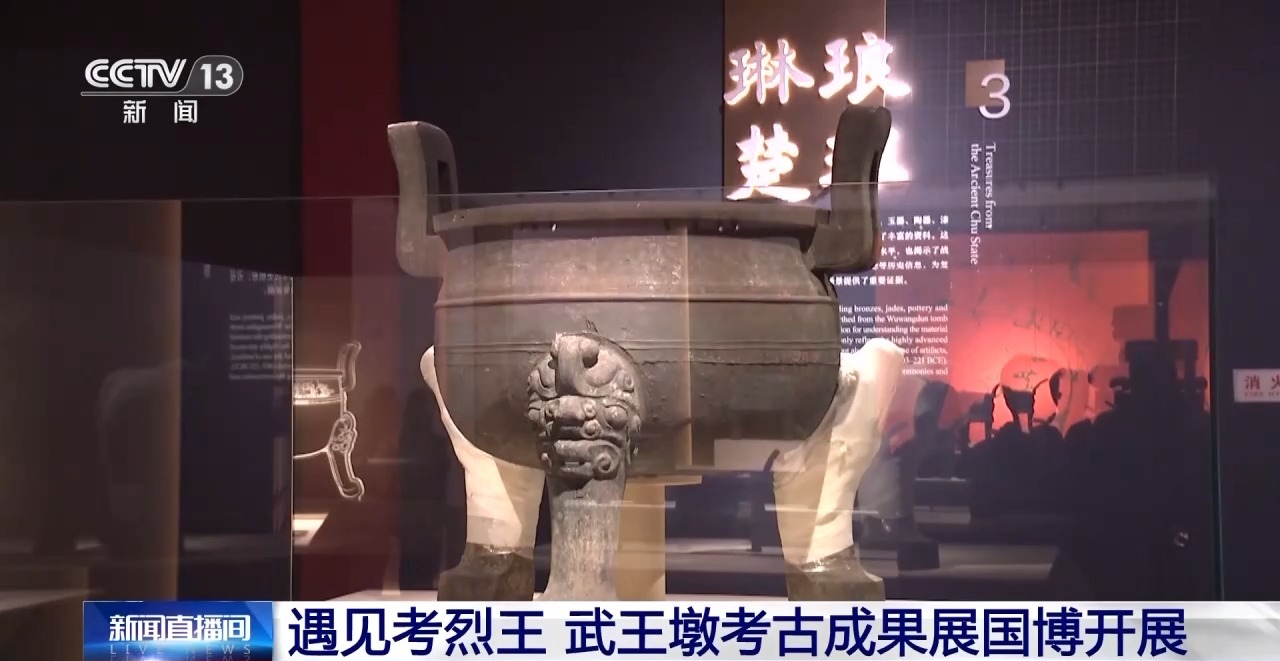
升鼎

Search documents
武王墩200多件套文物亮相国博
Xin Lang Cai Jing· 2026-01-01 23:53
Core Viewpoint - The Wuwangdun archaeological exhibition at the National Museum showcases over 200 newly unearthed artifacts, marking the first comprehensive public display of findings from the Wuwangdun tomb, which belongs to the late Warring States period of the Chu state [1][2]. Group 1: Artifacts and Their Significance - The Wuwangdun tomb is identified as the burial site of King Xiong Yuan of the Chu state, with a bronze vessel inscribed with "Chu Wang Zai Qian made a gold vessel for annual offerings," serving as a key piece of evidence for identifying the tomb's owner [1]. - Among the artifacts, the largest bronze ding (cauldron) discovered has set a new record in China's ranking of large dings [1]. - The exhibition features a significant set of nine dings, visually representing the historical Nine Ding system, with two dings showcasing intricate scales and decorative motifs, indicating the cultural context of the late Warring States period [2]. Group 2: Cultural Exchange and Artistry - The Wuwangdun tomb yielded a unique bronze ding with an iron base, notable for its 18-character inscription, which references the "Left Envoy Vehicle (Warehouse)," a term specific to the state of Zhongshan, reflecting the cultural exchanges during the late Warring States period [2]. - The exhibition includes exquisite artifacts such as bronze bells, stone chimes, jade discs, and rare ball-shaped jars, collectively illustrating the ceremonial significance and material achievements of the Chu state [2].
武王墩考古成果展开幕 200多件套文物亮相国博
Yang Shi Wang· 2025-12-26 19:18
Core Viewpoint - The archaeological exhibition of the Wuwangdun site showcases over 200 newly unearthed artifacts, marking the first comprehensive public display of these findings related to the tomb of King Koa of the late Warring States period in the Chu state [1][9]. Group 1: Artifacts and Their Significance - The exhibition features a significant bronze vessel, a bronze zun, inscribed with a key phrase that helps identify the tomb's owner, King Koa [1]. - A notable highlight is a set of nine bronze ding, which visually represents the historical nine ding system, with two pieces exhibiting intricate craftsmanship that reflects the cultural decline of the Chu state [3]. - The largest bronze pot unearthed from the tomb has set a new record in China's ranking of large ding [4]. Group 2: Cultural Insights - The Wuwangdun tomb excavation team leader, Gong Xicheng, noted that the unique design of the bronze ding, characterized by a waist and flat bottom, distinguishes it from round ding, indicating the craftsmanship of the Chu state during its peak [6]. - A bronze vessel with iron feet, inscribed with 18 characters, reveals cultural exchanges during the late Warring States period, as it features elements from the Zhongshan state, indicating a blend of cultures [8]. - The exhibition includes a complete set of bronze bells, exquisite jade artifacts, and rare ceremonial items, collectively illustrating the rich material culture and ceremonial practices of the Chu state [9]. Group 3: Exhibition Details - The exhibition is part of the National Museum's important exhibition plan, aiming to provide an immersive archaeological experience and enhance understanding of Chu culture's role in the broader context of Chinese civilization [11].