华为Nova 14系列

Search documents
Counterpoint Research:2025年Q3安卓系统以79%的份额继续保持全球领先地位
Zhi Tong Cai Jing· 2025-11-28 01:43
Core Insights - Counterpoint Research reports on global smartphone sales by operating system for Q1 2024 to Q3 2025, highlighting trends in the US, China, and India markets [1][3][4] Global Market Overview - Android maintains a leading global market share of 79% as of Q3 2025, despite a 1 percentage point decline from Q3 2024 due to increased competition [3][4] - iOS market share reaches 17% in Q3 2025, up 1 percentage point year-over-year, driven by strong initial reception of the iPhone 17 series [4] - HarmonyOS captures 14% of the Chinese market in Q3 2025, becoming the second-largest smartphone operating system in the country [4] Regional Market Analysis United States - Android holds 45% of the US market share in Q3 2025, while iOS accounts for 55%, showing a stable competitive landscape [6] China - Android's market share in China is 69% in Q3 2025, with HarmonyOS at 18%, indicating a competitive environment [9] - The Huawei Nova 14 series significantly contributes to HarmonyOS's growth, although new models face challenges due to ecosystem limitations [4] India - Android dominates the Indian market with a 92% share in Q3 2025, while iOS holds 8%, reflecting a strong preference for Android devices [10]


数据机构:vivo重回中国手机市场销冠 荣耀销量大幅下滑
Nan Fang Du Shi Bao· 2025-09-18 11:20
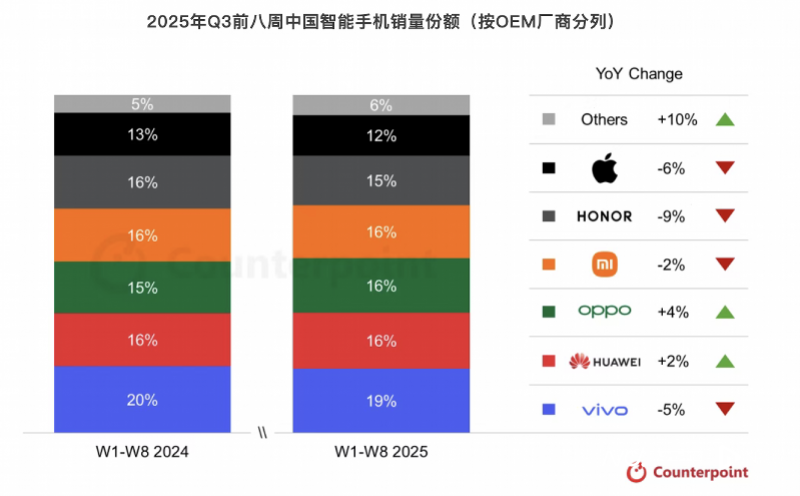
Core Insights - Vivo has achieved the top position in the Chinese smartphone market with a 19% market share, leading Huawei by 3 percentage points, while OPPO and Xiaomi follow closely with the same share [1][3] - The S30 and X200s series contributed over 60% of Vivo's sales in the first eight weeks of Q3 2025, indicating strong performance in the mid-to-high-end segment [3] - OPPO experienced the highest growth among manufacturers, with a 4% year-on-year increase in sales, driven by the popularity of the Reno 14 series [3] - Huawei maintained positive growth with a 2% year-on-year increase, supported by supply chain optimization and a strong product lineup, including the Nova 14 series [3] - Apple saw a 6% year-on-year decline in sales in the Chinese market, attributed to fierce competition from domestic brands [4] - Honor's sales dropped by 9% year-on-year, the largest decline among major manufacturers, due to ongoing adjustments in its channel strategy [4][5] - The overall smartphone market in China is expected to see a 3%-5% quarter-on-quarter decline in Q3 2025, influenced by weak consumer demand and a gap in new product releases [5] Company Performance - Vivo's strong performance is attributed to the S30 and X200s series, which are positioned in the mid-to-high-end market [3] - OPPO's growth is linked to its comprehensive product range, particularly the Reno 14 series, which has resonated well with consumers [3] - Huawei's growth is supported by its expanding product portfolio and successful launches, such as the Nova 14 series [3] - Apple's decline in market share is partially offset by the stable performance of the iPhone 16 Pro series [4] - Honor's significant sales drop highlights challenges in its channel strategy and market positioning [4][5] Market Trends - The shift in consumer preference towards mid-to-high-end products benefits brands like OPPO and Huawei [3] - The competitive landscape is intensifying, with domestic brands launching compelling models that meet consumer demands [4] - The overall smartphone market in China is facing a contraction, with expectations of a slight decline in Q3 2025 [5]