HarmonyOS

Search documents
华为销售收入超8800亿四连增 鸿蒙终端设备数突破4000万台
Chang Jiang Shang Bao· 2026-02-25 23:58
Core Insights - Huawei's overall business remains stable, with annual sales revenue exceeding 880 billion yuan, marking the second highest in history for 2025 [2][4] - The company has achieved continuous revenue growth for four consecutive years, with a projected revenue of 862.1 billion yuan for 2025 [3][4] - The HarmonyOS ecosystem is expanding, with over 40 million devices running HarmonyOS 5 and 6, and more than 75,000 native applications and cloud services available [4] Financial Performance - In the first half of 2025, Huawei reported revenue of 427.04 billion yuan, a year-on-year increase of 3.95%, while net profit decreased by 32% to 37.195 billion yuan [2] - Research and development investment for the first half of 2025 reached 96.95 billion yuan, accounting for 22.7% of total revenue, reflecting a year-on-year increase of 9.04% [2] Market Expansion - Huawei is accelerating its overseas market expansion, with successful deployments of innovative solutions in Nigeria and Peru aimed at enhancing connectivity in underserved areas [8][9] - The company is collaborating with various operators to implement advanced network solutions, such as the EcoMatrix in Peru and the Alpha antenna in Ghana, which significantly improve network efficiency and coverage [8][9] Strategic Focus - Huawei is committed to strengthening its core competitiveness and focusing on high-quality development, aiming to provide competitive products and services globally [2][4] - The company emphasizes the importance of building a robust digital infrastructure and fostering an open-source ecosystem to accelerate the release of AI's industrial value [5][6]


四大证券报精华摘要:2月25日
Xin Hua Cai Jing· 2026-02-25 02:32
Group 1: A-Share Market Overview - A-share market experienced a strong start post-Spring Festival, with major indices collectively rising and trading volume exceeding 2 trillion yuan, indicating a significant recovery in market risk appetite [4][3] - The market showed structural divergence, with resource sectors like oil, gas, and chemicals performing well, while sectors such as film and AI applications faced notable pullbacks [1][4] Group 2: Investment Opportunities - Multiple public fund institutions identified structural opportunities in sectors like artificial intelligence, semiconductors, and consumer goods, driven by moderate economic recovery and accelerated industrial upgrades [2] - AI sector is a focal point for many fund managers, with expectations of continued strong performance in the AI industry chain through 2026, supported by significant growth in annual recurring revenue from AI-native applications [2] - The semiconductor industry is also highlighted for its rapid changes driven by AI developments, with a focus on individual stock performance and industry trends [2] Group 3: Oil and Gas Sector Insights - The oil and gas sector saw a surge in stock prices due to rising international oil prices driven by geopolitical uncertainties, with some stocks receiving increased leverage from investors [3] - Analysts predict that international oil prices will experience increased volatility rather than a one-sided rise, suggesting a focus on upstream companies with oil and gas resources and offshore service engineering firms [3] Group 4: Storage Chip Market Trends - The global storage market is experiencing a price increase, with DRAM and NAND inventories only sufficient for about four weeks, driven by demand from AI and computing advancements [6] - Chinese storage companies are making significant technological and capacity breakthroughs, positioning themselves as key players in the global storage landscape [6] Group 5: Policy Changes in the Solar Industry - The cancellation of export tax rebates for solar products starting April 1 is expected to accelerate industry consolidation, with larger companies better positioned to withstand profit pressures compared to smaller firms reliant on price competition [7] - The policy aims to shift the competitive focus from price wars to technology and brand battles, potentially enhancing industry concentration [7] Group 6: ETF Market Dynamics - The ETF market is showing a "cold and hot" pattern, with significant inflows into Hong Kong-themed ETFs despite overall outflows from broad-based ETFs, indicating a shift in investor preferences [10] Group 7: Insurance Sector Outlook - Insurance institutions are optimistic about the A-share market for 2026, planning to slightly increase allocations to A-shares, while also showing interest in overseas investments such as Hong Kong stocks and gold [11][12] Group 8: Huawei's HarmonyOS Progress - Huawei reported that the number of devices running HarmonyOS has surpassed 40 million, with a growing ecosystem of applications and services, indicating a significant advancement in their technology strategy [13]
解码广东新春第一会:含“科”量拉满,两业协同“新”在何处
Nan Fang Du Shi Bao· 2026-02-24 13:47
Core Viewpoint - The Guangdong Provincial High-Quality Development Conference emphasizes the importance of "coordinated development of manufacturing and service industries" as a key strategy to embrace technological advancements and secure future growth [1][2]. Group 1: Technological Integration - The rapid evolution of artificial intelligence and other frontier technologies is breaking down traditional boundaries between manufacturing and service sectors, leading to a transformative "chemical reaction" driven by digital technologies [1][2]. - The conference highlighted the urgent need for new technologies to enhance the synergy between manufacturing and services, which is essential for maintaining a competitive edge in the global market [2]. - Examples of successful integration include Huawei's hardware and software solutions for smart vehicles and SHEIN's flexible supply chain model, showcasing the practical applications of this transformation [2]. Group 2: Policy and Ecosystem - Guangdong's approach to "coordinated development" reflects a strategic commitment to elevate the service sector to a position equal to manufacturing, indicating a deeper understanding of industrial development dynamics [1][3]. - The province is leveraging a robust talent ecosystem and innovative practices to foster rapid growth among leading enterprises in niche markets [3]. - The establishment of a supportive regulatory environment, such as "regulatory sandboxes," is crucial for breaking down institutional barriers and facilitating innovation [3]. Group 3: Corporate Performance and Investment - Major companies showcased their achievements at the conference, illustrating the robust technological ecosystem formed by foundational computing power, intelligent terminals, and flexible platforms [4][6]. - Huawei reported a sales revenue exceeding 880 billion yuan for 2025, with significant advancements in its AI ecosystem, including over 40 million devices running HarmonyOS and numerous applications and solutions [6]. - SHEIN plans to invest over 10 billion yuan in building a smart supply chain headquarters, aiming to enhance the benefits of cross-border e-commerce for small and medium-sized factories [6]. Group 4: Future Opportunities - The conference's white paper on "Coordinated Development of Manufacturing and Service Industries" indicates that new information technologies are deeply penetrating the entire industrial chain, leading to the emergence of smart factories and flexible supply chains [7][11]. - The integration of AI and big data with the real economy is expected to create new business models, enhancing efficiency and responsiveness [11]. - Coordinated development will enable precise supply-demand matching, allowing companies to better respond to consumer trends and create new demands, thereby facilitating domestic economic circulation [11].
史上第二高!华为2025年营收破8800亿
Ge Long Hui· 2026-02-24 08:18
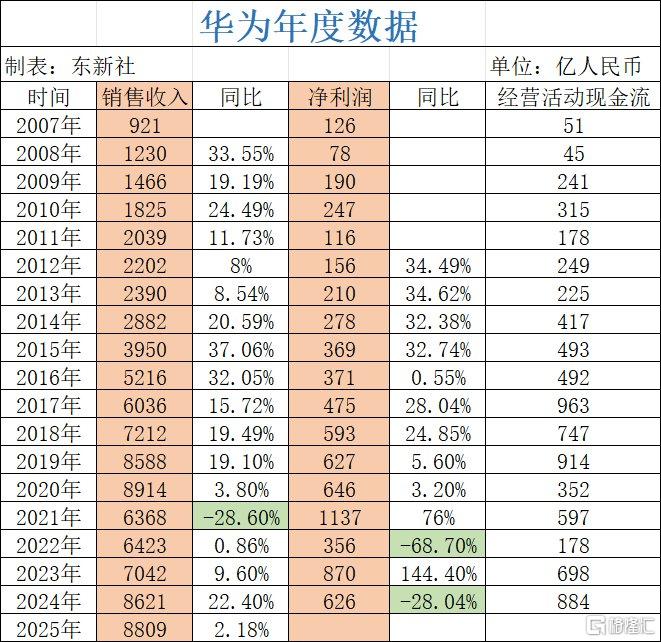
Core Viewpoint - Huawei's sales revenue for 2025 is projected to exceed 8800 billion RMB, marking a 2.18% year-on-year increase, and is the second highest in the company's history after 2020 [1][2]. Group 1: Financial Performance - Huawei's sales revenue for 2025 is specifically reported at 8809 billion RMB, showing a slight recovery compared to previous years [1]. - The peak revenue was recorded in 2020 at 8914 billion RMB, followed by a significant decline due to U.S. sanctions impacting its mobile business [1]. - The revenue for 2024 was 8621 billion RMB, reflecting a 22.4% year-on-year growth, while the growth for 2025 is considerably lower at 2.18% [2][3]. Group 2: Business Developments - The HarmonyOS ecosystem is evolving, with over 40 million devices running HarmonyOS 5 and 6, and more than 75,000 native applications and cloud services available [1]. - Huawei has 43 mainstream industry models based on Ascend pre-training and over 200 open-source models adapted to the Ascend ecosystem, facilitating the implementation of over 6000 solutions [1]. Group 3: Future Outlook - Analysts suggest that while Huawei's revenue is returning to historical highs, the company faces significant growth pressure moving forward [2]. - The ability to surpass the 9000 billion RMB revenue mark and exceed historical peaks will depend on the growth of new business areas such as AI computing and smart vehicles [2].
史上第二高,华为2025年销售收入超8800亿元
Feng Huang Wang· 2026-02-24 06:05
Core Insights - Huawei's sales revenue for 2025 is projected to exceed 880 billion RMB, marking a 2.2% year-on-year increase [3][4] - This revenue figure positions 2025 as the second highest in Huawei's history, following a peak in 2020 [4] - The company faces significant growth pressure moving forward, with a stark contrast between the 22.4% growth in 2024 and the modest 2.2% expected in 2025 [4] Revenue Trends - Huawei's revenue over the past six years has been as follows: 2019: 858.8 billion RMB; 2020: 891.4 billion RMB; 2021: 636.8 billion RMB; 2022: 642.3 billion RMB; 2023: 704.2 billion RMB; 2024: 862.1 billion RMB [3] - The historical peak revenue of 891.4 billion RMB in 2020 was followed by a significant decline due to U.S. sanctions impacting its mobile business [3][4] Future Growth Strategies - Huawei aims to enhance its R&D investments, focusing on products and solutions that meet the growing demand for computing power, particularly in AI and smart automotive sectors [4] - The company is committed to building an AI open ecosystem centered around its Ascend series and strengthening the HarmonyOS ecosystem to improve user experience [4] - Key initiatives include solidifying digital infrastructure, creating an open AI ecosystem, and co-developing the Harmony operating system to enhance usability [4] Ecosystem Development - The HarmonyOS ecosystem has seen over 40 million devices equipped with HarmonyOS 5 and 6, with more than 75,000 native applications and cloud services available [4] - There are currently 43 mainstream large models pre-trained on Ascend, with over 200 open-source models adapted to the Ascend ecosystem, facilitating the deployment of over 6,000 solutions [4]
受存储涨价压力,2026年全球手机产量恐下行
WitsView睿智显示· 2026-02-12 09:53
Core Viewpoint - The global smartphone production is expected to decline by 10% in 2026 due to rising memory prices, potentially dropping to 1.135 billion units, with a pessimistic scenario predicting a decline of 15% or more [2][3]. Group 1: Market Impact - The significant increase in memory prices, with contract prices for 8GB+256GB models expected to rise nearly 200% in Q1 2026 compared to the same period in 2025, has led to the BOM cost share of memory in smartphones increasing from 10-15% to 30-40% [5]. - Brands are likely to raise terminal prices to maintain operations and may need to adjust product configurations to cope with the ongoing surge in memory prices [5]. Group 2: Brand Performance - Samsung, as the leading smartphone brand and a major player in the memory industry, is expected to see a decline in production, but the drop will be less severe due to its vertical integration advantages [5]. - Apple, with a higher proportion of high-end models, is better positioned to absorb rising memory costs and has a consumer base more accepting of price adjustments, providing some support for its production performance [5]. - Xiaomi and Transsion, which focus on lower-end models, are more sensitive to cost fluctuations and are expected to experience significant production cuts in 2026 due to the ongoing rise in memory prices [5]. Group 3: Competitive Landscape - Vivo, Oppo, Xiaomi, and Honor will face not only memory cost pressures but also strong competition from Huawei, which is expected to have the smallest production adjustment among brands and may even see growth due to its flexible pricing strategy [6]. - The current decline in terminal demand is attributed to rising memory prices, but the overall functionality of electronic devices has reached a level that satisfies most consumer needs, leading to longer replacement cycles and reduced upgrade momentum [6].



华为鸿蒙存量设备 API 版本使用数更新,HarmonyOS 6.0.2 (22) 占比 68.66%
Xin Lang Cai Jing· 2026-02-06 01:25
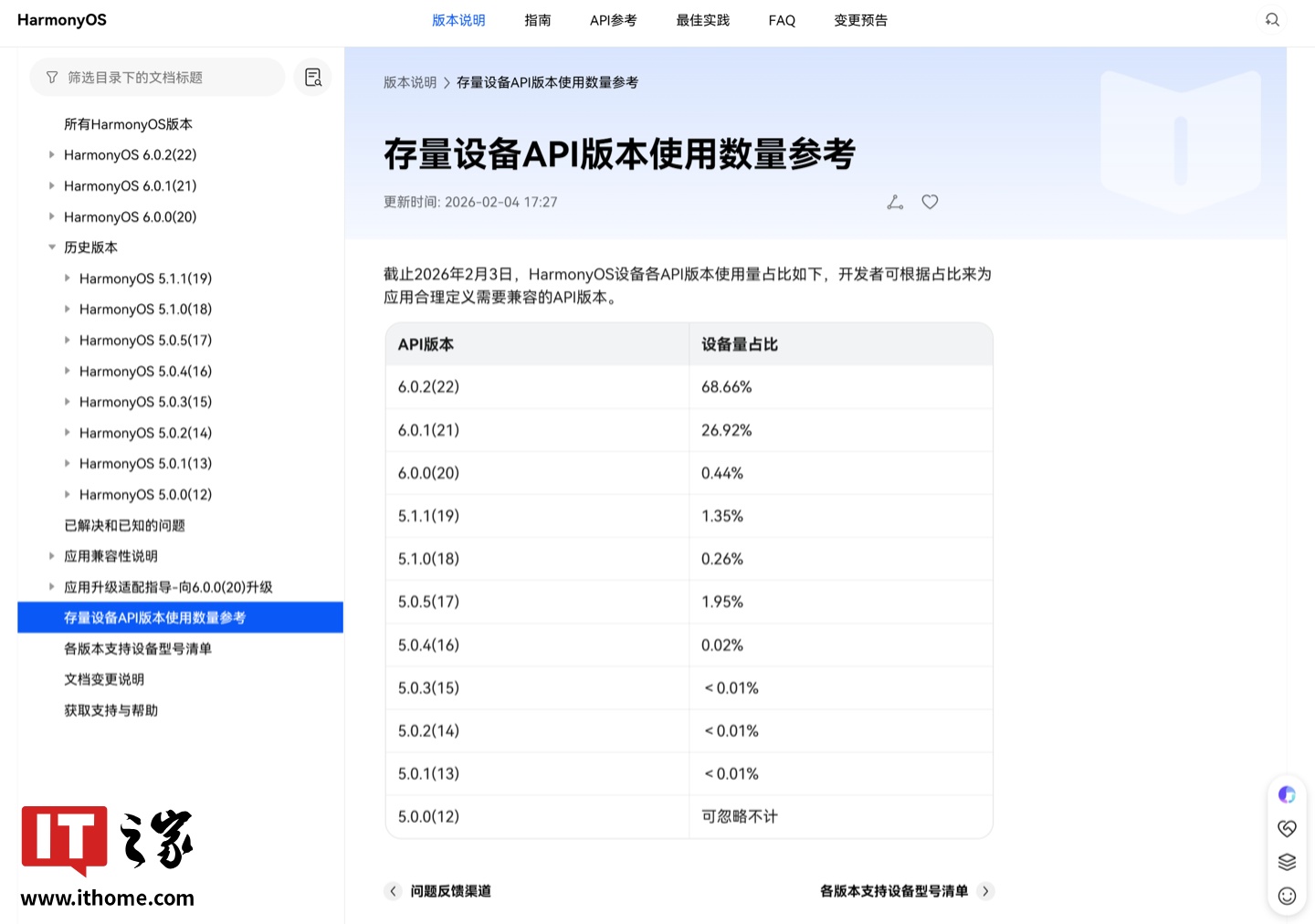
Core Insights - Huawei has updated the API version usage statistics for HarmonyOS devices as of February 3, 2026, indicating the distribution of various API versions among existing devices [1][5]. Group 1: HarmonyOS API Version Usage - HarmonyOS 6.0.2 (22) accounts for 68.66% of the API version usage among devices [1][5]. - HarmonyOS 6.0.1 (21) represents 26.92% of the usage [1][5]. - HarmonyOS 6.0.0 (20) has a minimal share of 0.44% [1][5]. - Older versions such as HarmonyOS 5.1.1 (19) and 5.1.0 (18) have usage shares of 1.35% and 0.26% respectively [1][5]. - The remaining versions (5.0.5 to 5.0.0) have negligible usage, with some being less than 0.01% [1][5]. Group 2: Recent Updates and Enhancements - HarmonyOS 6.0.2 (22) was released on January 22, enhancing development capabilities, including improved user interaction and web page experience through ArkWeb [1][5]. - The Connectivity Kit's Bluetooth module has been enhanced to better obtain socket link information [1][5]. - The HarmonyOS 6.0.0.130 SP15/SP17 update has optimized application launch speeds and improved gaming experience on Mate 80 series devices, which now support AI photo editing features [2][6].
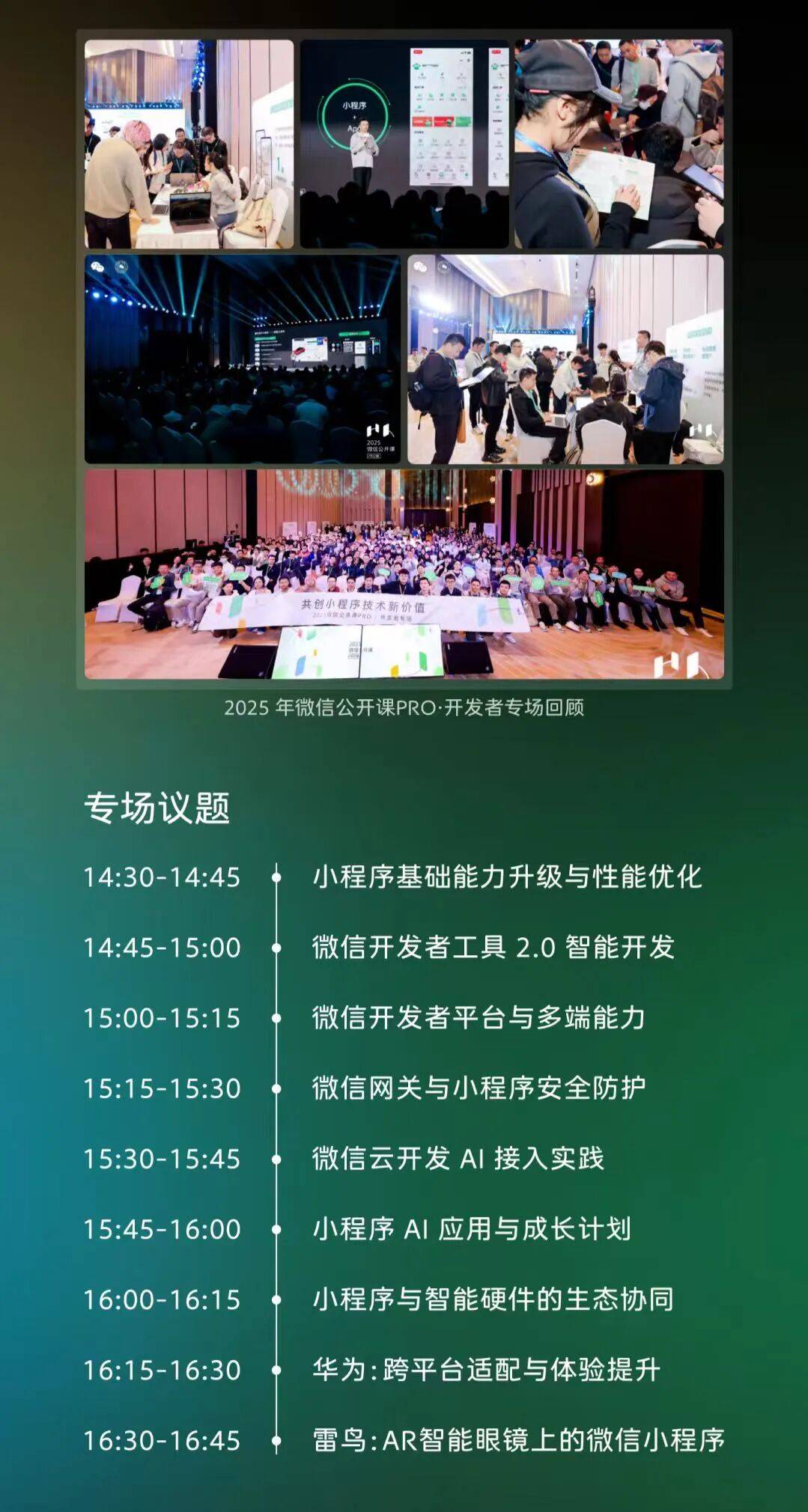
HarmonyOS首登微信公开课,分享跨平台适配与体验提升实践经验
Sou Hu Cai Jing· 2026-01-31 03:27
Group 1 - The core event was the 2026 WeChat Open Class PRO held in Guangzhou, where HarmonyOS development experts made their first official appearance as guest speakers, focusing on "cross-platform adaptation and experience enhancement" [1] - The collaboration between WeChat and HarmonyOS is highlighted as a practical example of their joint efforts in ecosystem development, showcasing active communication and cooperation in technology [1][4] - The event served as a crucial communication platform connecting developers, industry partners, and the platform, emphasizing the shared goal of enhancing user experience [4] Group 2 - Various topics were discussed during the event, including upgrades to mini-program capabilities, performance optimization, and the introduction of WeChat Developer Tools 2.0 [2][4] - Specific sessions included discussions on WeChat gateway security, AI integration in cloud development, and the collaboration between mini-programs and smart hardware [4] - HarmonyOS's participation as a key speaker reflects its commitment to sharing technical expertise in web kernels and cross-platform adaptation [4][6]
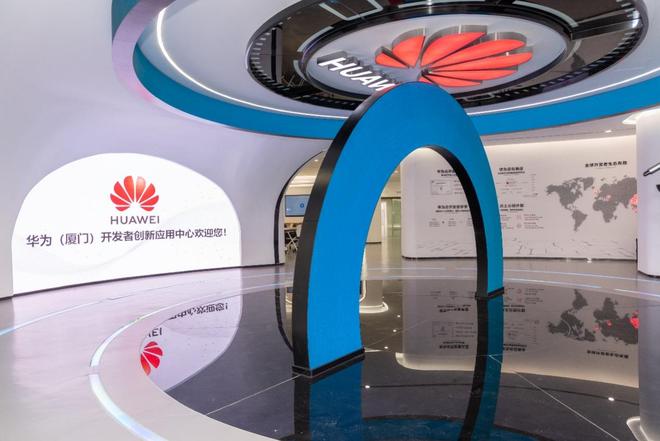
从开发者中心到产业高地:厦门书写鸿蒙生态城市实践新范本
Huan Qiu Wang Zi Xun· 2026-01-29 12:33
Core Viewpoint - The rapid development of the HarmonyOS ecosystem, driven by national strategies and technological advancements, positions it as a key player in the digital economy, with Xiamen emerging as a significant hub for its implementation and innovation [1][2][3]. Group 1: HarmonyOS Development - HarmonyOS has evolved from its debut in 2019 to commercial use in 2024, completing a decade's worth of development in just five years, showcasing remarkable speed in the industry [1]. - The ecosystem addresses traditional operating system challenges such as poor device compatibility and low development efficiency, facilitating a shift from functional hardware to scenario-based services [2]. - The strong policy support, including the "14th Five-Year Plan" and "15th Five-Year Plan," emphasizes the importance of foundational software and operating systems as key areas for breakthrough [2]. Group 2: Xiamen's Role in the Ecosystem - Xiamen has established the first HarmonyOS-themed developer innovation center in the country, which serves as a platform for enterprise empowerment, talent cultivation, and ecological aggregation [3][5]. - The center collaborates with nine local associations and has developed numerous local enterprises into Huawei's HarmonyOS ecosystem partners, fostering industry clustering [5]. - Xiamen's ecosystem includes applications in smart home, smart healthcare, smart shipping, and financial technology, demonstrating a diverse and growing application matrix [5]. Group 3: Achievements and Impact - Over three years, the center has empowered more than 110 enterprises and created over 20 benchmark cases in various industries, while also training over 1,300 certified HarmonyOS engineers [7][9]. - The center has played a crucial role in bridging the gap for traditional enterprises lacking the capability to adapt to new operating systems, facilitating their transition to HarmonyOS [8]. - Successful commercial cases, such as the significant sales growth of products upgraded to HarmonyOS, highlight the ecosystem's potential to drive new growth curves for businesses [11]. Group 4: Developer Opportunities - The expanding demand for HarmonyOS has created a wide range of opportunities for developers, from application adaptation to vertical industry solutions [13]. - The center provides systematic support for developers, including technical exchanges, training, and access to resources, enabling them to enhance their skills and participate in commercial projects [13]. - The success stories of local enterprises serve as a direct value guide for developers, indicating that engaging with HarmonyOS can lead to tangible business benefits [13]. Group 5: Future Prospects - The HarmonyOS ecosystem is expected to continue growing, with Xiamen positioned to leverage its existing strengths in areas like smart oceans and green buildings [14]. - The integration of cutting-edge technologies such as AIoT is anticipated to further expand the application space for HarmonyOS [14]. - Xiamen's experience demonstrates that with the right focus and execution, cities can become fertile grounds for innovation and digital transformation [14].
华为鸿蒙存量设备 API 版本使用数量情况公布,HarmonyOS 6.0.1 (21) 占比达 91.19%
Xin Lang Cai Jing· 2026-01-12 01:23
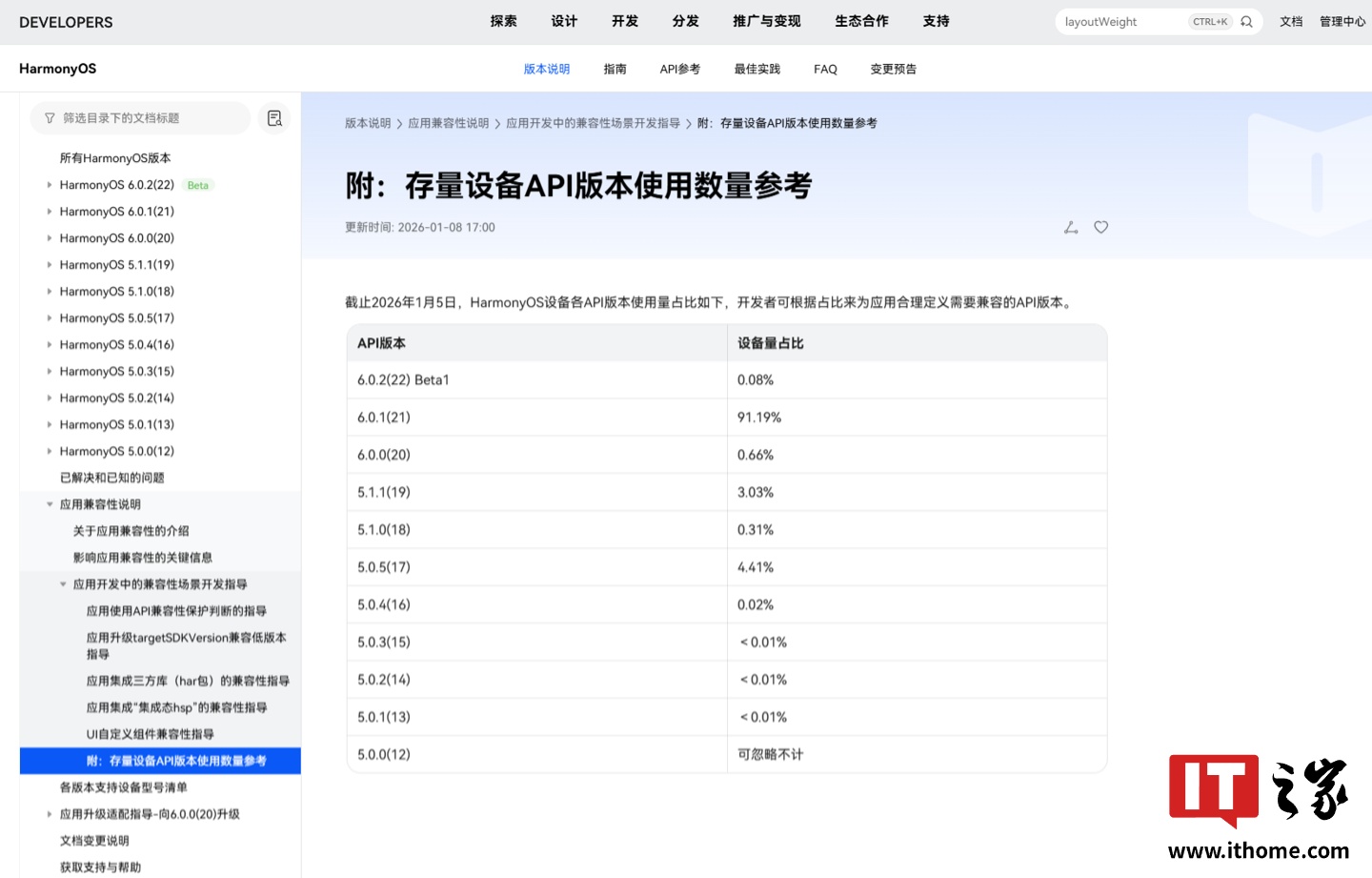
Core Insights - Huawei's HarmonyOS 6.0.2 (22) Beta1 version was released on January 6, 2026, enhancing development capabilities based on the previous version 6.0.1 (21) [2][8] API Version Usage - As of January 5, 2026, the distribution of API versions among HarmonyOS devices is as follows: - 6.0.1 (21): 91.19% - 5.0.5 (17): 4.41% - 5.1.1 (19): 3.03% - 6.0.0 (20): 0.66% - 5.1.0 (18): 0.31% - 6.0.2 (22) Beta1: 0.08% - Other versions (5.0.4 (16) and below): negligible [6][7] Enhancements in HarmonyOS 6.0.2 (22) Beta1 - ArkUI has improved scrolling component capabilities, allowing for more configurable and customizable properties [3][8] - Ability Kit has enhanced the management of UIAbility within applications [3][8] - ArkWeb has improved user interaction capabilities, enhancing the web page experience [3][8] - Connectivity Kit's Bluetooth module has enhanced the ability to obtain socket link information [3][8] - Test Kit's UITest module has improved the simulation of interactive operations [3][8] - A new FAST Kit has been introduced, providing high-performance algorithms and data structure acceleration services [3][8]