华夏信选A

Search documents
近一周28只基金限购:覆盖6大品类,原因、影响与投资注意点一文看
Sou Hu Cai Jing· 2025-11-26 10:47
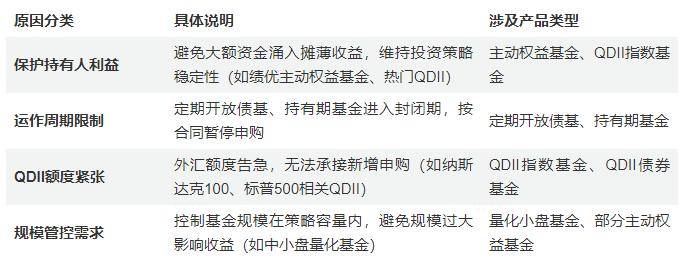
Core Viewpoint - The article discusses the recent trend of mutual funds implementing purchase restrictions to protect existing investors' interests and manage fund sizes as the year-end approaches [1][2] Group 1: Reasons for Purchase Restrictions - Protection of Investor Interests: Funds are limiting large inflows to prevent dilution of returns and maintain investment strategies, particularly in actively managed equity funds and popular QDII funds [1] - Operational Cycle Limitations: Certain funds, such as periodic open-end bond funds and holding period funds, are entering closed periods, necessitating the suspension of new subscriptions [1] - QDII Quota Constraints: Some QDII funds are unable to accept new subscriptions due to tight foreign exchange quotas, affecting funds linked to indices like the Nasdaq 100 and S&P 500 [1] - Scale Management Needs: Funds are controlling their sizes to remain within strategic capacity, particularly impacting small-cap quantitative funds and some actively managed equity funds [1] Group 2: Recent Purchase Restrictions - A total of 28 funds announced purchase restrictions in the week from November 20 to November 26, 2025, with various measures such as suspension of subscriptions or limits on large purchases [1] - Specific funds affected include: - 华夏信选A: Suspended subscriptions due to closed period operations [1] - 华安新兴动力A: Suspended subscriptions due to closed period operations [1] - 汇添富全球消费人民: Limited large purchases to 1,000 yuan to protect investor interests [1] - 鹏华香港美国互联网美元现汇: Limited large purchases to 20,000 yuan due to QDII quota restrictions [1] - 华夏标普500ETF发起式联接(QDII): Suspended subscriptions to protect investor interests and ensure stable fund operations [1] Group 3: Impacts on Investors - Subscription Restrictions: Some products have paused subscriptions or set very low limits, preventing investors from making new or large investments [1] - Liquidity Impact: With periodic open-end bond funds and closed-end funds suspending subscriptions, investors can only exit through redemptions or wait for the closure period to end [1] - Premium Risk: The limitation on QDII funds may lead to high premium rates for on-market ETFs, posing risks for investors who blindly buy into these shares [1] - Strategy Adjustment Limitations: Investment advisory products may struggle to allocate to restricted QDII funds, potentially affecting global asset allocation effectiveness [1]