博山炉

Search documents
流转古今之雅韵
Xin Lang Cai Jing· 2026-01-22 20:14
Group 1 - The origin of incense burning customs dates back to ancient sacrificial activities, where natural elements like the sun, moon, mountains, and rivers were worshipped for favorable weather [1] - During the late Shang and Zhou dynasties, frequent sacrificial activities further promoted the development of incense burning customs, which became popular among the aristocracy during the Warring States period [2] - The opening of the Silk Road during the Western Han dynasty facilitated the continuous influx of various incense materials from the Western regions, leading to a unique incense culture that combined local and foreign elements [2] Group 2 - The Boshan furnace, a typical incense burner from the Han dynasty, not only served practical purposes but also symbolized the ruling class's strong desire for immortality and spiritual transcendence [2] - The design of the Boshan furnace evolved from earlier bronze vessels, showcasing creative modifications that reflected the social status of its owners, often found in royal or noble tombs [2] - The evolution of the Boshan furnace illustrates the innovative development of Chinese incense culture and provides important insights into the interaction between material civilization and spiritual beliefs in ancient China [3]
“海昏侯遇见南越王”国庆探馆:从南越国到海昏侯国,管窥西汉盛世之形成
Xin Hua She· 2025-10-06 00:40
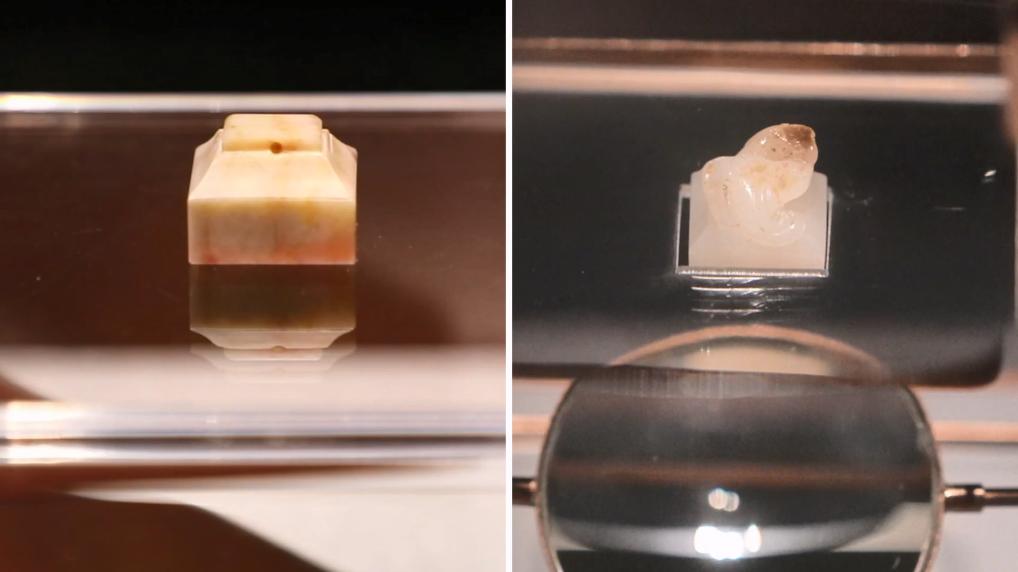
Core Viewpoint - The article highlights the cultural exchange and historical significance of the artifacts discovered from the Han Dynasty tombs of the South Yue Kingdom and the Haihunhou Kingdom, showcasing the prosperity and openness of the Western Han civilization through their burial practices and artifacts [2][16]. Group 1: Artifacts and Their Significance - The South Yue Kingdom and Haihunhou Kingdom artifacts reflect the integration of Central Plains and Baiyue cultures, emphasizing the open and inclusive nature of their civilizations [2]. - The jade seals found in the tombs of Zhao Mo and Liu He serve as private seals, with distinct designs indicating their status; Liu He's seal is made from higher quality jade and features more intricate craftsmanship [4]. - The jade burial suit from Zhao Mo's tomb, made of 2,291 pieces of jade, is the only complete example of its kind found in China, highlighting the high status of its owner [6]. Group 2: Trade and Cultural Exchange - The artifacts indicate that the South Yue Kingdom engaged in maritime trade, becoming a precursor to the Maritime Silk Road, which facilitated trade with Southeast Asia and South Asia [10]. - The discovery of imported frankincense in Zhao Mo's tomb suggests that foreign resin-based fragrances were already entering China during the early Western Han period, replacing traditional herbal scents [11]. - The unique design of the incense burners from both tombs illustrates the evolution of incense use and the aesthetic preferences of the time, reflecting a blend of practicality and beauty [13]. Group 3: Cultural Interactions - The artifacts from both tombs demonstrate the cultural exchanges between the Central Plains and the grassland cultures, as seen in the decorative motifs on the gold and silver items [14]. - The findings from these two significant archaeological sites provide a comprehensive view of the development of Western Han society, illustrating the grandeur of the Han civilization [16].