压接销

Search documents
压接销行业调查 | 全球前15强生产商排名及市场份额
QYResearch· 2026-03-17 01:07
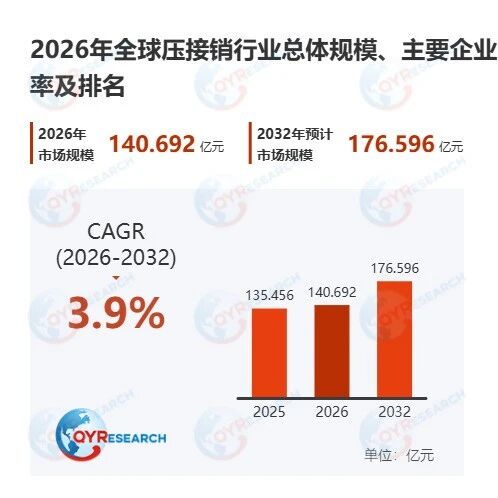
Core Insights - The global press-fit pin market is projected to reach $2.596 billion by 2032, with a compound annual growth rate (CAGR) of 3.86% from 2026 to 2032 [3]. Market Overview - The major manufacturers of press-fit pins globally include TE Connectivity, MinebeaMitsumi, ept GmbH, and others, with the top three companies holding approximately 22.36% of the market share [5][6]. - Hollow press-fit pins currently dominate the product type segment, accounting for about 69% of the market share [9]. - The automotive sector is the primary demand source, representing approximately 48% of the market [10]. Key Drivers - The transition to electric vehicles (EVs), hybrid electric vehicles (HEVs), and advanced driver-assistance systems (ADAS) is a significant driver for the demand for press-fit pins, as modern automotive electronics rely on numerous electronic control units (ECUs) [13]. - The exponential growth of cloud computing, artificial intelligence (AI), big data analytics, and 5G/6G network deployment is driving the demand for high-speed, high-density press-fit pins [14]. - Strict environmental regulations, such as EU RoHS and China RoHS 2.0, are phasing out lead solder, making press-fit pins a compliant and sustainable alternative [14]. Key Challenges - The ongoing trend of miniaturization and high-speed signal transmission imposes higher technical requirements on the production of press-fit pins, creating a significant barrier for small and medium-sized manufacturers [15]. - Fluctuations in raw material prices, particularly for copper alloys and precious metals, directly impact production costs and profit margins [15]. - The global supply chain for press-fit pins is highly concentrated, making it vulnerable to geopolitical conflicts and trade policies [15]. Industry Trends - There is a trend towards miniaturization and high-density integration in response to the demand for thinner consumer electronics and compact automotive ECUs [16]. - The automotive industry is shifting from solid to hollow/flexible press-fit pins, particularly in EVs and ADAS applications, to enhance reliability and reduce thermal stress [17]. - The growth of high-speed data transmission, driven by cloud computing and 5G infrastructure, is increasing the demand for press-fit pins optimized for high data rates [18]. - Regional manufacturing shifts are occurring to address rising labor costs and proximity to key growth markets, with production increasingly concentrated in Southeast Asia and China [18].