电动汽车转型

Search documents
压接销行业调查 | 全球前15强生产商排名及市场份额
QYResearch· 2026-03-17 01:07
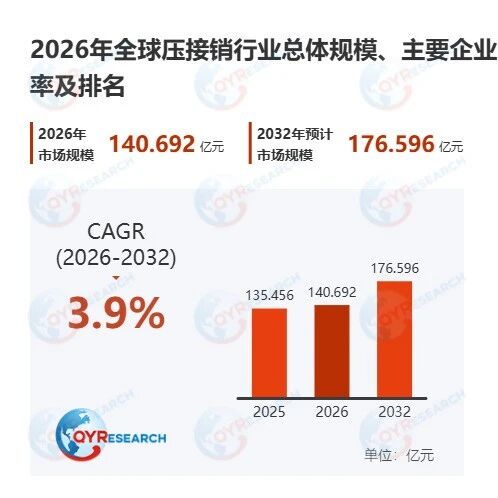
Core Insights - The global press-fit pin market is projected to reach $2.596 billion by 2032, with a compound annual growth rate (CAGR) of 3.86% from 2026 to 2032 [3]. Market Overview - The major manufacturers of press-fit pins globally include TE Connectivity, MinebeaMitsumi, ept GmbH, and others, with the top three companies holding approximately 22.36% of the market share [5][6]. - Hollow press-fit pins currently dominate the product type segment, accounting for about 69% of the market share [9]. - The automotive sector is the primary demand source, representing approximately 48% of the market [10]. Key Drivers - The transition to electric vehicles (EVs), hybrid electric vehicles (HEVs), and advanced driver-assistance systems (ADAS) is a significant driver for the demand for press-fit pins, as modern automotive electronics rely on numerous electronic control units (ECUs) [13]. - The exponential growth of cloud computing, artificial intelligence (AI), big data analytics, and 5G/6G network deployment is driving the demand for high-speed, high-density press-fit pins [14]. - Strict environmental regulations, such as EU RoHS and China RoHS 2.0, are phasing out lead solder, making press-fit pins a compliant and sustainable alternative [14]. Key Challenges - The ongoing trend of miniaturization and high-speed signal transmission imposes higher technical requirements on the production of press-fit pins, creating a significant barrier for small and medium-sized manufacturers [15]. - Fluctuations in raw material prices, particularly for copper alloys and precious metals, directly impact production costs and profit margins [15]. - The global supply chain for press-fit pins is highly concentrated, making it vulnerable to geopolitical conflicts and trade policies [15]. Industry Trends - There is a trend towards miniaturization and high-density integration in response to the demand for thinner consumer electronics and compact automotive ECUs [16]. - The automotive industry is shifting from solid to hollow/flexible press-fit pins, particularly in EVs and ADAS applications, to enhance reliability and reduce thermal stress [17]. - The growth of high-speed data transmission, driven by cloud computing and 5G infrastructure, is increasing the demand for press-fit pins optimized for high data rates [18]. - Regional manufacturing shifts are occurring to address rising labor costs and proximity to key growth markets, with production increasingly concentrated in Southeast Asia and China [18].

北美失血、电动转型受挫:Stellantis (STLA.US)创纪录减值后深陷亏损
Zhi Tong Cai Jing· 2026-02-26 09:17
Core Viewpoint - Stellantis has faced significant financial challenges, reporting an adjusted operating loss of €1.38 billion ($1.6 billion) in the second half of last year, primarily due to issues in the North American market [1] Group 1: Financial Performance - Stellantis reported a loss of €941 million in North America, contributing to the overall adjusted operating loss [1] - The company anticipates a revenue of €153.5 billion in 2025, a 2% decrease from 2024, attributed to unfavorable exchange rates and a decline in net pricing in the first half of 2025 [1] - The total impairment losses for the previous year surged to €25.4 billion, mainly occurring in the second half [1] - Stellantis expects a net loss of €22.3 billion for 2025, with €20.1 billion of that loss occurring in the second half [1] Group 2: Strategic Adjustments - Stellantis has revised its aggressive electric vehicle (EV) strategy due to disappointing demand in Europe and the cancellation of incentives in the U.S., leading to a renewed focus on fuel-efficient vehicles [1] - The company has reduced its battery production plans as part of this strategic shift [5] - Stellantis CEO Antonio Filosa indicated that there are "initial positive signals" from improved quality and new model launches [2] Group 3: Market Conditions - The automotive industry is facing intense competition, particularly from Chinese brands like BYD, which are gaining market share globally with competitive models [8] - Stellantis has confirmed it will not distribute dividends this year, with costs in the U.S. expected to reach €1.6 billion, up from €1.2 billion in 2025 due to tariffs [7] - The company aims to maintain its global corporate structure despite the challenges and will provide more details during the capital markets day on May 21 [8]

电动汽车转型放缓 采埃孚债务压力得到一定缓解
Xin Lang Cai Jing· 2026-02-23 08:44
Core Viewpoint - ZF Friedrichshafen AG is experiencing a reduction in debt pressure due to a slowdown in the electric vehicle transition, which has boosted demand for key components like transmissions [1][2]. Group 1: Company Strategy - The company has shifted its focus from prioritizing electric vehicles to supplying components for pure electric, hybrid, and internal combustion engine vehicles, which is expected to improve its financial situation [1][2]. - CFO Michael Frick stated that the company has established a new strategic direction in drive technology and believes that the rise in interest rates and credit spreads over the past two years is only a temporary phenomenon [1][2]. Group 2: Financial Obligations - According to ZF's latest financial report released in September, the company faces refinancing obligations exceeding €13 billion (approximately $15.3 billion) by the end of 2030, with rising interest rates putting pressure on its finances [1][2]. - The financial difficulties, combined with a decline in operating profit margins, have led the company to plan layoffs of approximately 14,000 employees, including those in the electric vehicle division [1][2]. Group 3: Industry Context - The slowdown in the electrification transition has caught many companies in the industry off guard, with Stellantis joining Ford and General Motors in announcing asset impairments and related expenses totaling €22.2 billion, primarily related to adjustments in electric vehicle strategies, including delays in launching several models [1][2].
一夜暴跌30%,全球第四大车企股价崩盘
Jing Ji Guan Cha Wang· 2026-02-08 03:13
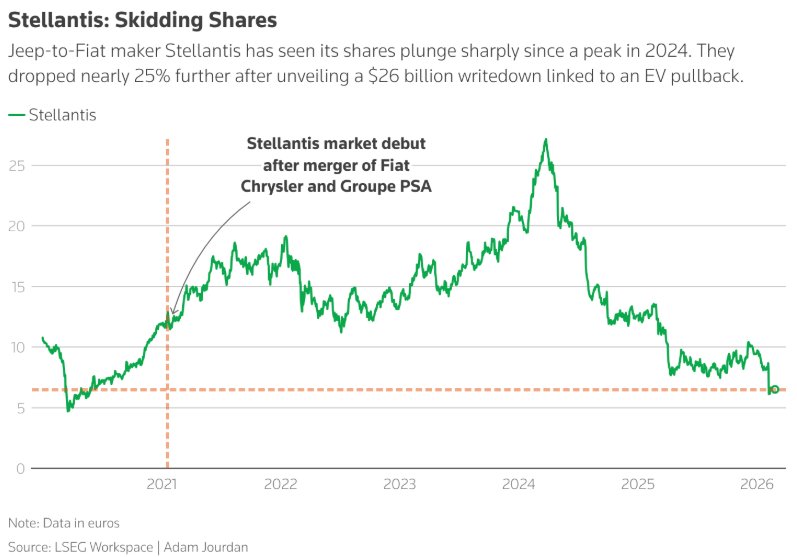
Core Viewpoint - Stellantis, the world's fourth-largest automaker, experienced a significant stock price drop due to an unexpected announcement regarding a comprehensive strategic contraction and restructuring of its electric vehicle (EV) business, leading to a projected non-cash loss of up to $26 billion (approximately €22.2 billion or ¥180.4 billion) [1][2]. Group 1: Financial Impact - The announced $26 billion loss far exceeded market expectations, with analysts initially predicting only a €2 billion loss, indicating a miscalculation in the company's financial outlook [1][2]. - Stellantis plans to incur approximately €6.5 billion in cash payments as part of the restructuring, which is expected to be completed over the next four years [2]. - The total projected costs of €22.2 billion are divided into three parts: €14.7 billion for product plan adjustments and compliance with new U.S. emissions regulations, €2.1 billion related to adjustments in the EV supply chain, and €5.4 billion for other operational changes [2]. Group 2: Strategic Changes - The company has already taken concrete actions, such as exiting its joint venture with LG Energy Solutions in Canada, where it sold its 49% stake [3]. - Stellantis has halted production of the RAM 1500 electric pickup in the U.S. and postponed the Alfa Romeo electric vehicle project in Europe, indicating a shift back to traditional combustion engines in some popular models [3]. - The new CEO, Antonio Filosa, acknowledged that the company had overestimated the speed of the energy transition, leading to a misalignment with consumer demand and preferences [2][3]. Group 3: Industry Context - Stellantis's situation reflects broader challenges faced by traditional automakers in the transition to electric vehicles, with significant losses reported by other major companies like Ford and General Motors, totaling nearly $50 billion due to similar adjustments in EV strategies [3]. - The European automotive industry is struggling with inertia from established supply chains and manufacturing systems, slow charging infrastructure development, and high battery costs, which hinder profitability in the EV market [4]. - Stellantis, formed from the merger of PSA Group and Fiat Chrysler, reported revenues of $204.9 billion in 2024 and ranks 28th on the Fortune Global 500 list [4].
福特否认与小米合作传闻:毫无事实根据
Huan Qiu Wang Zi Xun· 2026-02-01 02:56
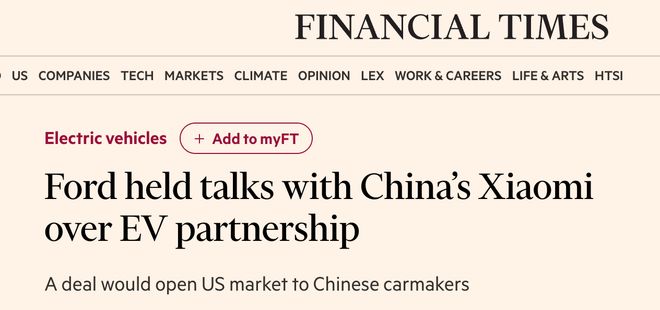
Core Viewpoint - Ford is in preliminary discussions with Xiaomi regarding a potential partnership to produce electric vehicles in the U.S., which could help Chinese automakers establish a foothold in the American market [1][3]. Group 1: Partnership Discussions - Ford is exploring the possibility of forming a joint venture with Xiaomi to manufacture electric vehicles in the U.S. [3]. - Previous discussions have also occurred between Ford and other Chinese automakers, such as BYD, regarding potential collaborations in the U.S. market [3]. Group 2: Company Response and Market Challenges - Ford has denied the reports of the partnership, stating that the claims are completely fabricated and without factual basis [3]. - The company faces significant risks in responding to the entry of low-cost Chinese electric vehicles into the U.S. market [3]. - Ford has discontinued key models in the mass market segment, such as the Ford Escape and Ford Edge, and does not plan to introduce a new low-cost electric vehicle platform until at least 2027 [3].


通用汽车去年第四季度计提70亿美元亏损
Guan Cha Zhe Wang· 2026-01-12 10:31
Core Viewpoint - General Motors reported a significant loss of up to $7 billion in Q4 due to challenges in electric vehicle (EV) transition and restructuring in the Chinese market, leading to a 1.9% drop in stock price after the announcement [1] Group 1: Financial Performance - The company expects to incur a loss of $6 billion related to the electric vehicle transition, alongside $1.1 billion in service fees tied to the restructuring in China [1] - In 2022, General Motors sold less than 170,000 electric vehicles in the U.S., falling short of its previous target of producing 1 million EVs by 2025 [1] - The company plans to report additional significant cash and non-cash expenses related to ongoing commercial negotiations with supply bases in 2026, which are expected to be lower than the 2025 EV-related expenses [1] Group 2: Market Dynamics - The demand for electric vehicles in North America is anticipated to slow down in 2025 due to the termination of consumer tax incentives and the relaxation of emission regulations [1] - In response to declining EV sales, General Motors is reducing its EV production capacity and has reintroduced the low-cost Chevrolet Bolt, despite high tariffs on Chinese imports [2] - The company faced a 43% decline in EV sales in the latter half of the previous year, following the Trump administration's cancellation of the $7,500 EV consumer tax credit [2] Group 3: Competitive Landscape - Ford Motor Company also announced a significant write-down of $19.5 billion and is shifting focus from large electric vehicles to more profitable hybrid and internal combustion engine models [3] - Ford sold 84,100 pure electric vehicles in the U.S. in 2025, which is less than half of General Motors' total sales [3]

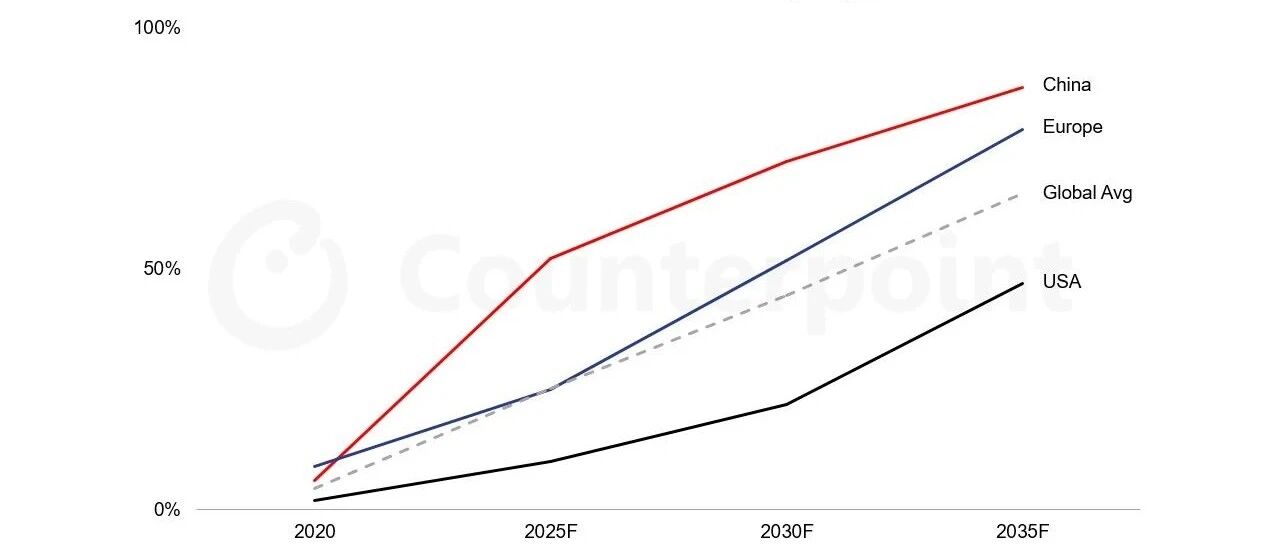
全球电动车转型走到十字路口:中国、欧盟与美国路径分化
Counterpoint Research· 2026-01-12 02:45
Core Viewpoint - The global electric vehicle (EV) market is entering a phase of significant differentiation, with China rapidly advancing while the EU and the US exhibit hesitance and policy adjustments that may slow their electric vehicle transitions [4][5][7]. Group 1: Electric Vehicle Market Dynamics - China's electric vehicle sales have surpassed 50% of total passenger car sales, indicating a shift from policy-driven to market-driven growth [4][7]. - The US electric vehicle market is experiencing a slowdown due to the potential rollback of federal EV purchase subsidies and weakened emissions regulations, leading manufacturers to refocus on hybrid and internal combustion engine (ICE) vehicles [5][11]. - The EU is recalibrating its electric vehicle strategy by relaxing the 2035 ban on ICE vehicles and introducing the M1E category for small electric cars, aiming to balance decarbonization goals with industry pressures [8][9][10]. Group 2: EU Policy Adjustments - The EU's new policy allows for a 90% reduction in CO2 emissions by 2035 instead of a complete ban, enabling the continued sale of hybrid and ICE vehicles under certain conditions [8][9]. - The introduction of the M1E category aims to promote affordable small electric vehicles, which could mirror the success seen in China's compact EV market [9][10]. - The EU's "super credit" system for M1E vehicles incentivizes local production and sales, potentially benefiting companies like BYD that are expanding in the EU market [10]. Group 3: Challenges for Global Automakers - The differentiation in regional policies forces automakers to adapt their strategies, impacting economies of scale and increasing overall costs [11]. - Companies like Ford and General Motors are facing significant financial challenges, with Ford reporting approximately $19.5 billion in EV-related losses and adjusting their strategies towards hybrids [11]. - The need for regional adaptability in strategy is becoming as crucial as global scale, influencing the competitive landscape of the electric vehicle market [11].
欧美市场滑坡严重!今年全球电动汽车销量增速预计创疫情来新低
Feng Huang Wang· 2026-01-04 02:42
Group 1: Global Electric Vehicle Market Outlook - The global electric vehicle (EV) sales growth is expected to reach its lowest level since the pandemic, with a projected increase of only 13% to 24 million units by 2026, down from a 22% growth forecast for 2025 [1] - Factors such as the cancellation of EV tax incentives by the Trump administration and the EU's relaxation of the fuel vehicle ban are impacting the industry's prospects this year [1] - The U.S. EV sales are predicted to decline by 29% to 1.1 million units in 2026 after reaching a record 1.5 million units in 2025, while European sales are expected to slow to a 14% growth rate, totaling 4.9 million units [1] Group 2: China's Electric Vehicle Market - In China, the largest EV market, sales are expected to reach 15.5 million units this year, up from 13.3 million units in 2025, although the growth rate will be lower than in the previous five years [2] - Chinese manufacturers like BYD have driven sales growth by introducing more affordable models, which have pressured traditional European and American automakers [2] - BYD is projected to become the largest global EV manufacturer by 2025, expanding its presence in Europe and other overseas markets [2] Group 3: Shift in Consumer Preferences - Industry executives anticipate a continued rise in sales of hybrid and plug-in hybrid vehicles due to insufficient charging infrastructure, making consumers hesitant about pure electric vehicles [3] - Ford's CEO indicated that the share of EVs in the U.S. new car market may drop from about 10% last year to around 5% recently [4] - In contrast, most automotive executives expect the Chinese EV market to maintain growth in 2026, supported by broader stimulus measures and local government investments in charging infrastructure [4] Group 4: Industry Adjustments and Future Outlook - The challenging outlook this year necessitates that automakers continuously adjust their product lineups during the transition from fuel vehicles to electric vehicles [5] - Executives emphasize the need for flexibility in product offerings during the transition, while maintaining a strong belief in the future of electric vehicles and the decarbonization of transportation [5]
英媒:全球需求降温,2026年电动汽车销量将创六年来最慢增速
Feng Huang Wang· 2026-01-03 23:30
Core Insights - The global electric vehicle (EV) market is expected to experience its slowest annual growth since the COVID-19 pandemic in 2020, with a projected increase of only 13% in 2026, reaching 24 million units, down from approximately 22% growth last year [1] - Factors such as the cancellation of EV tax incentives by the Trump administration, the EU's relaxation of the fuel vehicle ban set for 2035, and a slowdown in demand in China are expected to impact the industry's growth this year [1] Group 1: Market Performance - In the U.S., electric vehicle sales are projected to drop by 29% this year, falling to 1.1 million units after reaching a record of 1.5 million units in 2025 [2][3] - European EV sales are expected to grow by 14% this year, reaching 4.9 million units, building on a 33% increase in 2025 [2] Group 2: Regional Insights - In China, the largest EV market, sales are forecasted to increase from 13.3 million units in 2025 to 15.5 million units in 2026, representing a growth rate of 17%, although this is lower than the growth rates seen in the previous five years [3] - UBS predicts that China's EV sales will grow by 8% this year, including both pure electric and plug-in hybrid vehicles [4] Group 3: Competitive Landscape - BYD, a leading Chinese manufacturer, is set to surpass Tesla as the world's largest EV manufacturer by 2025, driven by the introduction of competitively priced models [3] - Ford has announced a significant asset write-down of $19.5 billion, indicating a shift in focus from electric models like the F-150 Lightning to more profitable hybrid and traditional fuel vehicles, with expectations that the share of EVs in the U.S. new car market may drop from about 10% last year to 5% [3]


刚刚,采埃孚把ADAS业务卖给三星了,到手124亿
3 6 Ke· 2025-12-24 11:17
Core Viewpoint - ZF Friedrichshafen AG has agreed to sell its Advanced Driver Assistance Systems (ADAS) business to Harman Group for €1.5 billion (approximately ¥12.4 billion), pending regulatory approval expected by the second half of 2026 [2][4]. Group 1: Transaction Details - The sale involves the packaging of several core business segments within the ADAS division, including computing solutions, smart cameras, radar technology, and ADAS software functions, while retaining chassis electronic components for commercial vehicle applications [5]. - The transaction will result in approximately 3,750 employees from ZF's ADAS division being transferred to Harman, which represents a significant portion of the division's workforce of about 6,465 employees globally [6][7]. Group 2: Financial Context - ZF is facing a substantial debt burden of approximately €10.6 billion (around ¥87.75 billion) as of mid-2025, with profits primarily allocated to debt repayment [4][11]. - In 2024, ZF's adjusted EBIT was only €210 million, while it needed to pay €810 million in interest, leading to a net loss of €1.02 billion and a total debt of €10.5 billion [11][15]. - The company's net debt has surged from €279 million in 2014 to €10.5 billion in 2024, with an average annual interest expense of €575 million [17]. Group 3: Strategic Implications - The sale is seen as a necessary step for ZF to alleviate financial pressure and is part of a broader strategy to divest non-core assets and reduce debt [11][20]. - Harman, a subsidiary of Samsung, aims to enhance its automotive offerings by acquiring ZF's ADAS technology, which fills a gap in its perception systems and positions it as a comprehensive supplier of L2+ hardware and software [10][11]. - The acquisition aligns with the industry's shift towards integrated computing architectures that combine safety, intelligence, and cabin experience [10].