可再生能源(风电

Search documents
欧盟加速能源基础设施建设以缓解电网瓶颈
Shang Wu Bu Wang Zhan· 2025-12-18 07:28
Core Viewpoint - The European Union plans to accelerate the construction of cross-border energy infrastructure to alleviate grid bottlenecks and promote the implementation of new transmission lines, addressing the high energy costs that currently affect its industrial competitiveness [1] Group 1: Current Energy Landscape - Despite significant deployment of low-cost renewable energy by EU member states, the expansion and modernization of the grid have lagged, leading to limitations in wind and solar power generation, increased electricity waste, and higher costs [1] - European energy prices are currently 2 to 3 times higher than those in China and the United States, severely impacting the competitiveness of its industries [1] Group 2: Proposed Actions and Investments - The European Commission intends to draft a plan for centralized planning to expedite the implementation of key cross-border electricity projects [1] - An investment of €5 billion in the grid is projected to save the energy system €8 billion in costs [1] - Without prompt action, grid limitations could force the EU to reduce the utilization of 310 terawatt-hours of renewable energy by 2040, equivalent to half of the EU's household electricity consumption in 2023 [1] Group 3: Regulatory Changes - To address long-standing approval delays and enhance project advancement efficiency, the European Commission plans to amend relevant regulations [1] - Proposed changes include exemptions from environmental assessments for certain energy infrastructure projects, allowing small renewable energy and storage projects to proceed without environmental permits, and reducing approval timelines for grid-related projects [1] - New electric vehicle charging facilities could receive automatic approval within a maximum of six months [1]
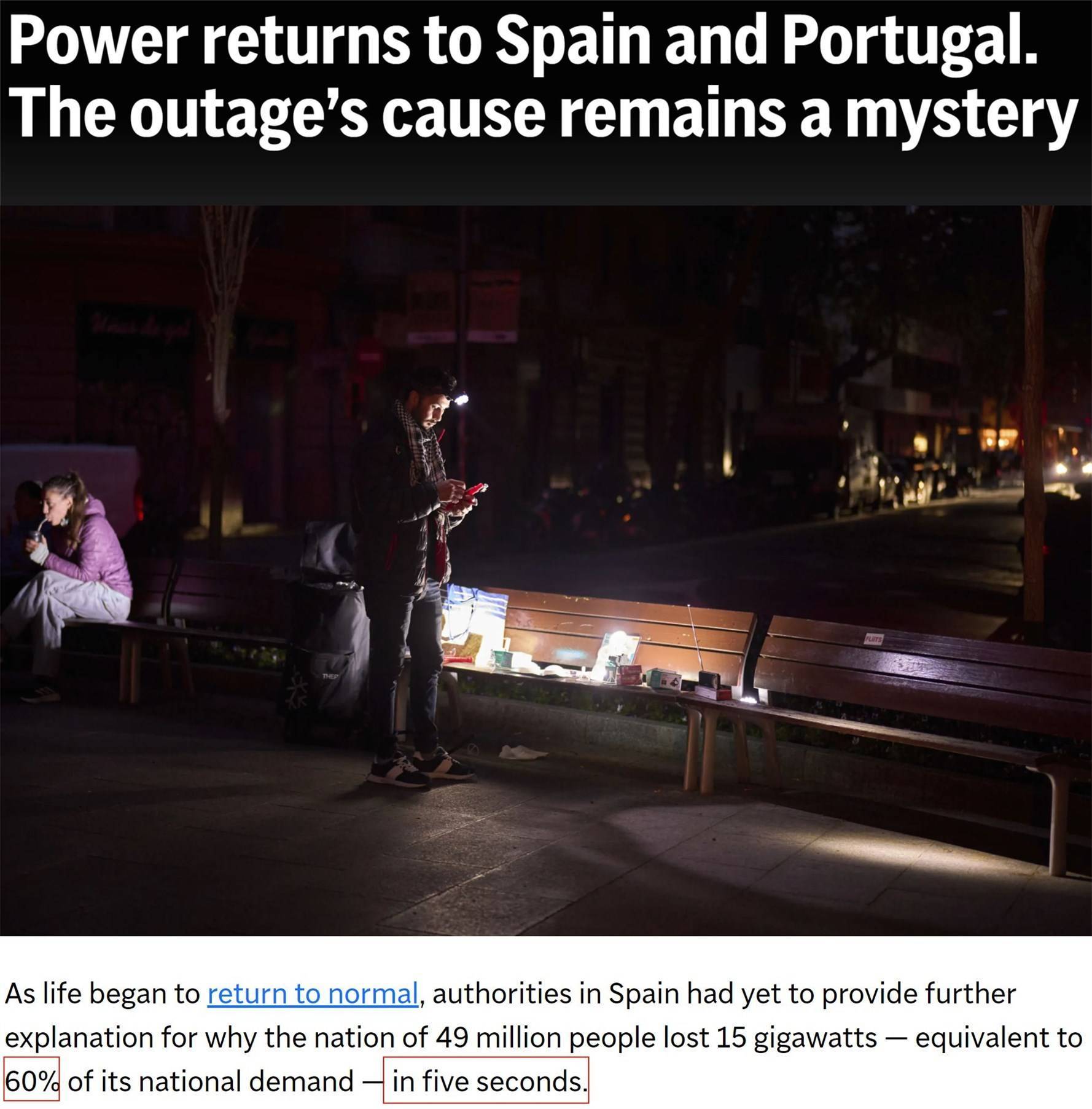
5秒失去全国60%电力供应的警示:如何安全使用可再生能源是全球挑战
Sou Hu Cai Jing· 2025-05-01 20:04
Core Viewpoint - The recent large-scale power outage in Spain and Portugal has highlighted significant vulnerabilities in the energy infrastructure, particularly the aging systems and the challenges associated with the transition to renewable energy sources [1][4][5]. Group 1: Incident Overview - On April 28, Spain and Portugal experienced a massive power outage, one of the most severe in recent European history, with Spain losing 60% of its power supply in just five seconds [1][4]. - The outage led to significant disruptions, including traffic congestion, communication failures, and public service interruptions, prompting the Spanish Interior Ministry to declare a national emergency [4]. Group 2: Recovery and Current Status - By April 29, power supply in both countries had largely been restored, although some areas continued to experience minor issues due to unstable circuits [1][4]. - The Spanish government has initiated an investigation into the causes of the outage and has committed to improving the energy system [4][5]. Group 3: Infrastructure Challenges - Approximately 70% of the electricity infrastructure in Spain and Portugal was built before the 1980s, which has been under increasing pressure due to rapid growth in electricity demand and consumption [5]. - Spain has made significant strides in developing renewable energy, particularly in wind and solar power, but has not sufficiently invested in the necessary supporting infrastructure and interconnectivity to manage the increased instability and volatility of renewable energy generation [5][8]. Group 4: Analysis and Implications - Experts suggest that the sudden drop in solar power generation may have contributed to the outage, emphasizing the need for countries to ensure the safe use of renewable energy [6][7]. - The incident serves as a warning to other nations about the importance of energy security, which encompasses not only supply but also infrastructure safety and interconnectivity [9][10].