声镊单细胞分选系统

Search documents
长三角议事厅·周报丨长三角软信产业需以标准互认促生态共融
Xin Lang Cai Jing· 2025-06-23 10:19
Core Insights - The article discusses the rapid restructuring of the software and information technology services industry in the Yangtze River Delta region, highlighting the competitive cluster development around industrial software [1][4] - Shanghai's government has approved measures to promote high-quality development in the software and information services sector, aiming to create a globally competitive innovation hub [1][4] - By 2024, the total revenue of the software and information services industry in the Yangtze River Delta is expected to reach 3.88 trillion yuan, accounting for nearly 30% of the national total [1][4] Group 1: Regional Development and Collaboration - Shanghai's software and information services industry revenue is projected to exceed 380 billion yuan in Q1 2025, with a year-on-year growth of 15.3%, contributing 13.6% to the city's GDP [2] - Jiangsu is focusing on the integration of software and manufacturing, with a software business revenue growth of 8.7% in 2024, and industrial software chain growth reaching 15.9% [2] - Zhejiang is building an industrial APP ecosystem with over 60,000 applications to support deep digital transformation in manufacturing [3] Group 2: Standardization and Ecosystem Integration - The Yangtze River Delta is promoting standard recognition and ecosystem integration as key strategies to break regional barriers, with a joint release of the "Yangtze River Delta Industrial Software Recommendation Directory" covering 35 quality software products [4][5] - The G60 Science and Technology Corridor is facilitating interconnectivity among 31 industrial internet platforms, reducing technical barriers for cross-regional collaboration [4] - Shanghai's "Gongfu Chain Master" platform has shared over 35,000 industrial knowledge models with Jiangsu, Zhejiang, and Anhui, fostering a collaborative model of "Shanghai R&D + Regional Application" [4] Group 3: Challenges and Future Directions - Despite progress, challenges remain in achieving ecosystem integration, including the lack of a unified regional standard system and insufficient collaborative applications in manufacturing scenarios [5][6] - The need for a standardized certification center and open-source platform is emphasized to enhance cross-regional collaboration and build a foundational trust mechanism [5][6] - The article suggests that the ability to establish an efficient and unified collaborative mechanism will directly impact the Yangtze River Delta's competitiveness in the global software and information services industry [6]
千行百业“智变”加速 上交会汇聚“AI+”跨行业解决方案
Shang Hai Zheng Quan Bao· 2025-06-12 18:27
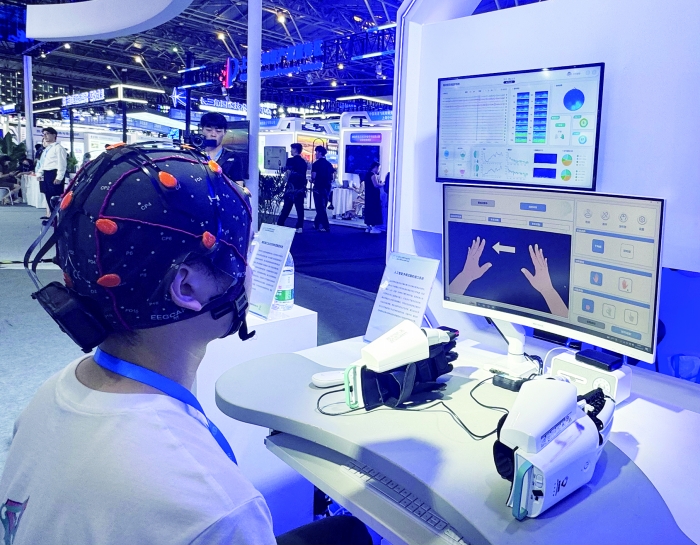
Group 1: AI Applications - The 11th China (Shanghai) International Technology Import and Export Fair showcased deep applications of artificial intelligence (AI) across various sectors, including "AI + consumption," "AI + healthcare," and "AI + commercial security" [6] - A company demonstrated XR glasses that allow users to receive navigation information while walking, integrating with wearable devices for a complete mixed-reality experience, with plans for mass production by the end of the year [6] - A smart retail system by Yunna Technology enables "frictionless payment" through 3D machine vision and AI behavior analysis, already implemented in over 1,000 stores across 30 countries [7] Group 2: Brain-Computer Interface (BCI) Market - Shanghai Shuli Intelligent Technology showcased a multi-modal BCI platform with a 95% accuracy in decoding brain signals, improving recovery outcomes for stroke patients by 30% to 50% compared to traditional methods [8] - McKinsey predicts the global BCI market in healthcare will reach $40 billion by 2030 and exceed $145 billion by 2040, indicating significant growth potential [8] - Hong Kong University displayed a non-invasive BCI technology for treating conditions like Parkinson's and insomnia, with clinical trials for insomnia treatment expected soon [8] Group 3: Medical Technology Innovations - Shanghai Jieti Medical introduced China's first high-throughput wireless invasive BCI system, designed for minimal surgical intervention, offering motor function alternatives for paralyzed patients [9] - A new blockchain vulnerability detection system based on the DeepSeek model was presented, achieving a 94% accuracy in identifying high-risk items, enhancing cybersecurity compliance [10] Group 4: Domestic Manufacturing and Innovation - A company demonstrated a single-cell sorting system that combines AI algorithms with acoustic tweezers, achieving a sorting efficiency 6 to 7 times higher than traditional methods, with a 30% cost reduction compared to foreign brands [11] - The introduction of the THT550 snow traction equipment marks a significant advancement in domestic high-end equipment, reducing reliance on imports and enhancing operational efficiency through AI and navigation systems [12]