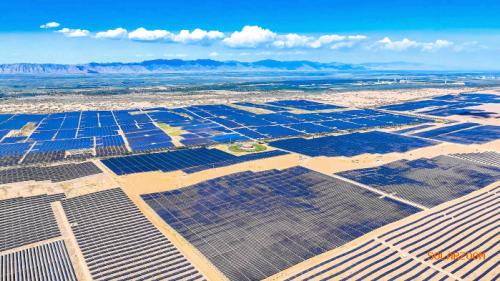
大跨度柔性支架智能光伏系统

Search documents
光伏治沙,鄂尔多斯还需克服哪些“坎”
Zhong Guo Xin Wen Wang· 2025-10-05 06:06
Core Insights - Ordos City, known as "China's coal capital," has been a leader in photovoltaic (PV) desertification control, benefiting from reduced sandstorms and increased solar power generation in recent years [1][2][4] Group 1: Photovoltaic Desertification Control - The 2 million kW PV desertification project in the Kubuqi Desert, initiated in June 2022, is expected to generate 4.1 billion kWh annually, saving 1.23 million tons of standard coal and reducing CO2 emissions by 3.198 million tons [2][3] - The project utilizes a dual function of PV panels for power generation and sand fixation, creating a "small greenhouse" effect that promotes plant growth [3][4] - Ordos has approved a total of 39.79 million kW of PV capacity, with 10.02 million kW already built, and plans to achieve over 3 million acres of PV desertification control upon full project completion [5] Group 2: Economic and Agricultural Benefits - Local farmers have benefited economically from planting vegetables like tomatoes under PV panels, with reported incomes of 50,000 yuan from 12 acres of cultivation [2][3] - The integration of solar water pumps and precision drip irrigation has effectively addressed irrigation challenges in desert areas, enhancing vegetation productivity and soil quality [6] Group 3: Future Development and Challenges - Experts highlight the need for standardized construction and recognition criteria for PV desertification projects to facilitate broader implementation [7][8] - Recommendations include promoting successful models of renewable energy and ecological restoration, and developing policies to encourage the integration of PV with other agricultural and ecological projects [7][8]

光伏治沙,中国鄂尔多斯还需克服哪些“坎”
Zhong Guo Xin Wen Wang· 2025-09-29 02:31
Core Viewpoint - Ordos, known as "China's coal capital," has been a leader in the field of photovoltaic (PV) desertification control, benefiting from reduced sandstorms and increased solar power generation, but still needs to address sustainable development challenges in the future [1][4]. Group 1: Photovoltaic Desertification Control - The 2 million kW PV desertification project in the Kubuqi Desert, initiated in June 2022 and expected to be completed by December 2023, will generate an average of 4.1 billion kWh annually, saving 1.23 million tons of standard coal and reducing CO2 emissions by 3.198 million tons [2][3]. - The project area has nearly 1,000 acres of medicinal herbs and organic fruits and vegetables using modern water-saving planting techniques, contributing to agricultural economic benefits [3]. - The integration of PV and desertification control is seen as a sustainable model, utilizing the natural complementarity of resources in China's vast desert areas [3][4]. Group 2: Policy and Development Challenges - Ordos has approved a total of 39.79 million kW of PV capacity, with 10.02 million kW already built and 29.77 million kW under construction, aiming to achieve over 3 million acres of PV desertification control [5][6]. - Experts highlight the need for standardized construction and recognition criteria for PV desertification projects to avoid potential ecological damage during implementation [7][8]. - Recommendations include promoting successful models of renewable energy and ecological restoration, and developing policies to encourage the integration of PV with desertification control [7][8].
光伏治沙,中国鄂尔多斯还需克服哪些"坎"
Zhong Guo Xin Wen Wang· 2025-09-28 06:05
Core Viewpoint - Ordos, known as "China's coal capital," has been a leader in photovoltaic (PV) desertification control, benefiting from reduced sandstorms and increased agricultural productivity through innovative PV projects [1][3][6] Group 1: Photovoltaic Projects and Economic Impact - The 2 million kW PV desertification project in the Kubuqi Desert began construction in June 2022 and is expected to generate 4.1 billion kWh annually, saving 1.23 million tons of standard coal and reducing CO2 emissions by 3.198 million tons [3][4] - Local farmers have reported significant income from crops grown under PV panels, with one farmer earning 50,000 yuan from 12 acres of tomatoes sold to major cities [3][4] Group 2: Environmental Benefits and Sustainability - The dual function of PV panels in desert areas helps stabilize sand, conserve water, and create microclimates for plant growth, contributing to sustainable desert management [4][5] - The integration of PV and desertification control is seen as a way to enhance ecological restoration and carbon sequestration, with the potential for improved vegetation and soil quality [7][9] Group 3: Future Development and Challenges - Ordos has approved a total of 39.79 million kW of PV capacity, with plans to achieve over 30 million acres of PV desertification control, creating a "PV Great Wall" to protect the Yellow River [6][7] - Experts highlight the need for standardized construction and recognition criteria for PV desertification projects to facilitate broader implementation and success [8][9]