
天弘中证500ETF

Search documents
两市ETF融券余额环比增加5095.31万元
Zheng Quan Shi Bao Wang· 2026-01-12 01:37
Core Insights - The total ETF margin balance in the two markets reached 119.44 billion yuan, an increase of 1.47% from the previous trading day, with a net increase of 1.733 billion yuan [1] - The financing balance for ETFs increased by 1.53% to 111.74 billion yuan, while the margin balance also saw a rise [1] Group 1: ETF Margin Balance Overview - The latest ETF margin balance in the Shenzhen market is 34.95 billion yuan, up by 6.89 billion yuan, with a financing balance of 34.01 billion yuan [1] - The Shanghai market's ETF margin balance stands at 84.49 billion yuan, increasing by 10.43 billion yuan, with a financing balance of 77.73 billion yuan [1] - The total margin balance for ETFs includes a financing balance of 111.74 billion yuan and a margin balance of 9.39 billion yuan, reflecting a slight increase in both categories [1] Group 2: Notable ETFs by Financing Balance - The ETF with the highest financing balance is Huaan Gold ETF at 7.269 billion yuan, followed by E Fund Gold ETF and Guotai CSI All-Share Securities Company ETF at 4.186 billion yuan and 3.897 billion yuan respectively [2] - Significant increases in financing balance were observed in E Fund MSCI China A-Share International ETF, Tianhong CSI 500 ETF, and GF CSI 300 ETF, with growth rates of 3835.01%, 449.99%, and 324.63% respectively [2] - Conversely, the largest decreases in financing balance were seen in the following ETFs: Fortune CSI AAA Technology Innovation Corporate Bond ETF (-96.87%), E Fund SSE 50 ETF (-69.67%), and Bosera SSE Sci-Tech Innovation Board Chip ETF (-61.40%) [2] Group 3: Financing Net Inflows and Outflows - The ETFs with the highest net inflows include Satellite ETF (297.13 million yuan), Southern CSI 500 ETF (97.36 million yuan), and Huatai-PB SSE 300 ETF (97.19 million yuan) [3] - The ETFs with the largest net outflows were Huatai-PB SSE Dividend ETF (-62.77 million yuan), E Fund CSI Overseas China Internet 50 (QDII-ETF) (-43.64 million yuan), and Fortune CSI Hong Kong Internet ETF (-41.00 million yuan) [3] Group 4: Margin Trading and Short Selling - The ETFs with the highest short selling balances are Southern CSI 1000 ETF (2.696 billion yuan), Southern CSI 500 ETF (2.005 billion yuan), and Huaxia CSI 1000 ETF (506 million yuan) [5] - The largest increases in short selling balances were recorded for Southern CSI 500 ETF (20.39 million yuan), Southern CSI 1000 ETF (16.64 million yuan), and Huaxia CSI 1000 ETF (13.09 million yuan) [5] - The ETFs with the most significant decreases in short selling balances include Huaxia CSI A500 ETF (-31.58 million yuan), Guotai CSI A500 ETF (-18.73 million yuan), and Tianhong CSI Photovoltaic Industry ETF (-0.93 million yuan) [5]
两市ETF融券余额环比增加1.42亿元
Zheng Quan Shi Bao Wang· 2025-12-18 01:55
Core Viewpoint - The total margin balance of ETFs in the two markets has increased to 125.413 billion yuan, reflecting a rise of 10.05 billion yuan from the previous trading day, indicating a growing interest in ETF investments [1] Group 1: ETF Margin Balance Overview - As of December 17, the total ETF margin balance reached 125.413 billion yuan, up 10.05 billion yuan or 0.81% from the previous day [1] - The financing balance for ETFs is 117.981 billion yuan, which is an increase of 8.63 billion yuan or 0.74% from the previous day [1] - The Shenzhen market's ETF margin balance is 36.306 billion yuan, increasing by 1.15 billion yuan, while the Shanghai market's ETF margin balance is 89.107 billion yuan, rising by 8.90 billion yuan [1] Group 2: Notable ETFs by Financing Balance - The ETF with the highest financing balance is Huaan Gold ETF at 7.291 billion yuan, followed by the Fuguo Zhongzhai 7-10 Year Policy Financial Bond ETF at 6.019 billion yuan and the E Fund Gold ETF at 5.546 billion yuan [2] - The top three ETFs with the highest percentage increase in financing balance are Tianhong Zhongzheng 500 ETF (394.14%), Guangfa Zhongzheng 500 ETF (371.65%), and Guangfa Zhongzheng 1000 ETF (270.68%) [2] Group 3: Financing Net Inflows and Outflows - The ETFs with the highest net inflows are Hai Futong Zhongzheng Short Bond ETF (0.493 billion yuan), E Fund Zhongzheng Hong Kong Securities Investment Theme ETF (0.201 billion yuan), and Bosera Convertible Bond ETF (0.128 billion yuan) [4] - The ETFs with the highest net outflows include Huaan Gold ETF (-0.151 billion yuan), Huaxia Hang Seng ETF (-0.069 billion yuan), and Huaxia Hang Seng Technology ETF (-0.068 billion yuan) [4] Group 4: Margin Trading and Short Selling - The latest short selling balance is highest for the Southern Zhongzheng 1000 ETF at 2.395 billion yuan, followed by Southern Zhongzheng 500 ETF at 2.164 billion yuan and Huaxia Zhongzheng 1000 ETF at 0.505 billion yuan [5] - The ETFs with the largest increase in short selling balance include Southern Zhongzheng 500 ETF (40.895 million yuan), Huatai Bairui Huasheng 300 ETF (27.044 million yuan), and Huaxia Shangzheng 50 ETF (23.359 million yuan) [5][7]
两市ETF融资余额增加65.98亿元
Zheng Quan Shi Bao Wang· 2025-12-17 04:04
Core Insights - The total margin balance of ETFs in the two markets reached 124.408 billion yuan, an increase of 6.429 billion yuan from the previous trading day, representing a 5.45% increase [1] - The financing balance of ETFs increased by 6.598 billion yuan, a 5.97% rise, while the margin balance decreased by 0.17 billion yuan [1] Group 1: ETF Financing Balances - The latest financing balance for ETFs in the Shenzhen market is 36.191 billion yuan, up by 0.889 billion yuan, a 2.52% increase [1] - The financing balance for ETFs in the Shanghai market is 88.217 billion yuan, increasing by 5.540 billion yuan, a 6.67% rise [1] - A total of 135 ETFs have a financing balance exceeding 100 million yuan, with the highest being Huaan Gold ETF at 7.442 billion yuan [2] Group 2: Significant Changes in Financing Balances - The top three ETFs with the highest increase in financing balance are: - Fuguo Zhongzheng AAA Technology Innovation Corporate Bond ETF with an increase of 135735.80% [3] - Bosera Zhongzheng 0-3 Year National Development Bank ETF with an increase of 606.96% [3] - Guotai Zhongzheng 5-Year Treasury Bond ETF with an increase of 391.10% [3] - The ETFs with the largest decrease in financing balance include: - Bosera Zhongzheng A500 ETF with a decrease of 68.00% [3] - Zhongzheng Shanghai State-Owned Enterprises ETF with a decrease of 59.99% [3] - E Fund Shanghai Stock Exchange Sci-Tech Innovation Board Growth ETF with a decrease of 42.77% [3] Group 3: Net Buying and Selling of ETFs - The top three ETFs with the highest net buying amounts are: - Fuguo Zhongzheng 7-10 Year Policy Financial Bond ETF with a net buying amount of 3.250 billion yuan [4] - Bosera Zhongzheng 0-3 Year National Development Bank ETF with a net buying amount of 0.783 billion yuan [4] - Guotai Zhongzheng 5-Year Treasury Bond ETF with a net buying amount of 0.383 billion yuan [4] - The ETFs with the highest net selling amounts include: - Huaan Gold ETF with a net selling amount of 0.113 billion yuan [4] - E Fund Gold ETF with a net selling amount of 0.065796 billion yuan [4] - E Fund CSI 300 Non-Bank ETF with a net selling amount of 0.03931 billion yuan [4] Group 4: Margin Trading and Short Selling - The latest margin balance for short selling is highest for: - Southern Zhongzheng 1000 ETF with a balance of 2.413 billion yuan [5] - Southern Zhongzheng 500 ETF with a balance of 2.123 billion yuan [5] - Huaxia Zhongzheng 1000 ETF with a balance of 0.499 billion yuan [5] - The ETFs with the largest increase in short selling balance include: - Tianhong Zhongzheng Photovoltaic Industry ETF with an increase of 1.4985 million yuan [7] - Huaxia Hengsheng Internet Technology ETF with an increase of 0.7194 million yuan [7] - Chemical ETF with an increase of 0.6488 million yuan [7] - The ETFs with the largest decrease in short selling balance include: - Southern Zhongzheng 1000 ETF with a decrease of 39.0104 million yuan [7] - Southern Zhongzheng 500 ETF with a decrease of 27.6819 million yuan [7] - Huaxia Zhongzheng 1000 ETF with a decrease of 20.4220 million yuan [7]
两市ETF融资余额增加6.14亿元
Zheng Quan Shi Bao Wang· 2025-12-16 02:44
Core Viewpoint - The latest ETF margin balance in the two markets reached 117.979 billion yuan, with a slight increase of 61.582 million yuan compared to the previous trading day, indicating a stable market trend in ETF financing and short selling activities [1]. Group 1: ETF Margin Balance Overview - As of December 15, the total ETF margin balance was 117.979 billion yuan, reflecting a 0.05% increase from the previous day [1]. - The ETF financing balance was 110.520 billion yuan, which increased by 614 million yuan, representing a 0.56% rise [1]. - The Shenzhen market's ETF margin balance was 35.302 billion yuan, up by 1.65 million yuan, while the Shanghai market's ETF margin balance was 82.677 billion yuan, down by 1.03 billion yuan [1]. Group 2: Specific ETF Financing Balances - The top three ETFs by financing balance are: - Huaan Gold ETF with 7.555 billion yuan - E Fund Gold ETF with 5.647 billion yuan - Huaxia Hang Seng ETF with 3.863 billion yuan [2]. - Significant increases in financing balance were observed in: - Penghua CSI 300 ETF with a 171.76% increase - Southern SSE STAR 50 ETF with a 114.77% increase - E Fund CSI Photovoltaic Industry ETF with an 83.82% increase [2][3]. - Notable decreases in financing balance included: - Tianhong CSI 500 ETF with a 90.92% decrease - GF CSI 500 ETF with a 75.18% decrease - Southern CSI Shanghai-Hong Kong Stock Connect Carbon Neutral ETF with a 49.32% decrease [2][3]. Group 3: Net Buying and Selling of ETFs - The top three ETFs by net buying amount were: - Fuguo 7-10 Year Policy Financial Bond ETF with 194 million yuan - E Fund ChiNext ETF with 126 million yuan - Harvest SSE STAR Chip ETF with 115 million yuan [4]. - The ETFs with the highest net selling amounts included: - Huatai-PB CSI 300 ETF with 140 million yuan - E Fund CSI Hong Kong Securities Investment Theme ETF with 90.895 million yuan - E Fund Gold ETF with 73.889 million yuan [4][5]. Group 4: Short Selling Balances - The top three ETFs by short selling balance were: - Southern CSI 1000 ETF with 2.452 billion yuan - Southern CSI 500 ETF with 2.151 billion yuan - Huaxia CSI 1000 ETF with 519 million yuan [5]. - The largest increases in short selling balance were seen in: - Bosera Convertible Bond ETF with an increase of 11.1843 million yuan - Huaxia SSE 50 ETF with an increase of 8.1568 million yuan - E Fund CSI 300 Non-Financial ETF with an increase of 2.4102 million yuan [5][6]. - The largest decreases in short selling balance included: - Southern CSI 500 ETF with a decrease of 432 million yuan - Southern CSI 1000 ETF with a decrease of 104 million yuan - Huatai-PB CSI 300 ETF with a decrease of 9.7124 million yuan [5][6].
中证小盘500指数ETF今日合计成交额50.66亿元,环比增加38.76%
Zheng Quan Shi Bao Wang· 2025-11-25 08:25
Core Viewpoint - The trading volume of the CSI Small Cap 500 Index ETF reached 5.066 billion yuan today, marking a significant increase of 1.415 billion yuan or 38.76% compared to the previous trading day [1] Trading Volume Summary - The Southern CSI 500 ETF (510500) had a trading volume of 4.270 billion yuan, up by 1.386 billion yuan, reflecting a 48.07% increase [1] - The Harvest CSI 500 ETF (159922) recorded a trading volume of 469 million yuan, an increase of 148 million yuan, with a growth rate of 46.07% [1] - The CSI 500 (159982) saw a trading volume of 9.3526 million yuan, up by 4.1096 million yuan, representing a 78.38% increase [1] - Notably, the Industrial Bank CSI 500 ETF (510570) and the Ping An CSI 500 ETF (510590) experienced remarkable increases in trading volume of 1537.83% and 233.32%, respectively [1] Market Performance Summary - As of market close, the CSI Small Cap 500 Index (000905) rose by 1.25%, while the average increase for related ETFs was 1.15% [1] - The top performers included the Guoshou Anbao CSI 500 ETF (510560) and the 500 Index Increase (561550), which rose by 2.00% and 1.64%, respectively [1] Detailed Trading Data - A detailed table of various ETFs shows their trading volumes, daily changes, and percentage increases, highlighting significant movements in the market [1][2] - For instance, the Industrial Bank CSI 500 ETF (510570) had a trading volume of 1.6179 million yuan, with a staggering increase of 151.91 million yuan, marking a 1537.83% rise [1] - Conversely, some ETFs like the Invesco CSI 500 Enhanced Strategy ETF (561550) and the Huatai-PB CSI 500 ETF (512500) reported declines in trading volume [2]
欣旺达股价跌5.23%,天弘基金旗下1只基金重仓,持有31.86万股浮亏损失56.39万元
Xin Lang Cai Jing· 2025-11-12 01:53
Group 1 - The core point of the news is that XINWANDA's stock price has been declining, with a drop of 5.23% on November 12, reaching 32.10 CNY per share, and a total market capitalization of 59.304 billion CNY [1] - XINWANDA has experienced a cumulative decline of 7.66% over the past three days [1] - The company specializes in the research, design, production, and sales of lithium-ion battery modules, with its main business revenue composition being 51.47% from consumer batteries, 28.18% from electric vehicle batteries, 16.63% from other sources, and 3.72% from energy storage systems [1] Group 2 - Tianhong Fund has one fund heavily invested in XINWANDA, specifically the Tianhong CSI 500 ETF, which held 318,600 shares as of the third quarter, accounting for 0.53% of the fund's net value [2] - The Tianhong CSI 500 ETF has incurred a floating loss of approximately 563,900 CNY today and a total floating loss of 895,300 CNY during the three-day decline [2] - The Tianhong CSI 500 ETF was established on August 7, 2020, with a current scale of 2.05 billion CNY and has achieved a year-to-date return of 29.35% [2]

两市ETF融资余额增加36.60亿元
Zheng Quan Shi Bao Wang· 2025-09-23 02:00
Core Insights - The total margin balance of ETFs in the two markets reached 114.726 billion yuan, an increase of 3.34% from the previous trading day, with a net increase of 3.705 billion yuan [1] - The financing balance of ETFs increased by 3.55% to 106.890 billion yuan, while the margin balance also saw a rise [1] Group 1: ETF Financing Balances - The latest financing balance for ETFs exceeding 1 billion yuan includes 122 funds, with the highest being Huaan Gold ETF at 7.250 billion yuan, followed by E Fund Gold ETF and FTSE China Government Bond ETF at 5.945 billion yuan and 4.334 billion yuan respectively [2] - Significant increases in financing balances were observed in the following ETFs: Sci-Tech Innovation Index ETF (463.27%), Tianhong CSI 500 ETF (418.02%), and Bosera China Government Bond ETF (319.48%) [2][3] - Conversely, the largest decreases were seen in FTSE China Carbon Neutral ETF (-62.24%), Southern CSI Carbon Neutral ETF (-60.97%), and CSI 50 ETF (-50.04%) [2][3] Group 2: Net Financing Inflows and Outflows - The top three ETFs by net financing inflow were FTSE China Government Bond ETF (1.575 billion yuan), Bosera China Government Bond ETF (404 million yuan), and Hang Seng Technology ETF (305 million yuan) [4] - The ETFs with the highest net financing outflows included GF National New Energy Vehicle Battery ETF (-140 million yuan), Southern CSI 500 ETF (-90.35 million yuan), and Harvest CSI Sci-Tech Chip ETF (-76.09 million yuan) [4][5] Group 3: Margin Trading Data - The latest margin balance for the top ETFs includes Southern CSI 1000 ETF (2.590 billion yuan), Southern CSI 500 ETF (2.454 billion yuan), and Huaxia CSI 1000 ETF (463 million yuan) [5] - The largest increases in margin balances were recorded for Southern CSI 500 ETF (44.6865 million yuan), Huaxia CSI 50 ETF (10.1103 million yuan), and Guolian An Semiconductor ETF (3.9654 million yuan) [5][7] - The ETFs with the most significant decreases in margin balances included Southern CSI 1000 ETF (-17.2857 million yuan), Invesco CSI A500 ETF (-8.9745 million yuan), and Photovoltaic ETF (-3.4577 million yuan) [5][7]
两市ETF两融余额较上一日增加4.86亿元
Zheng Quan Shi Bao Wang· 2025-09-08 02:03
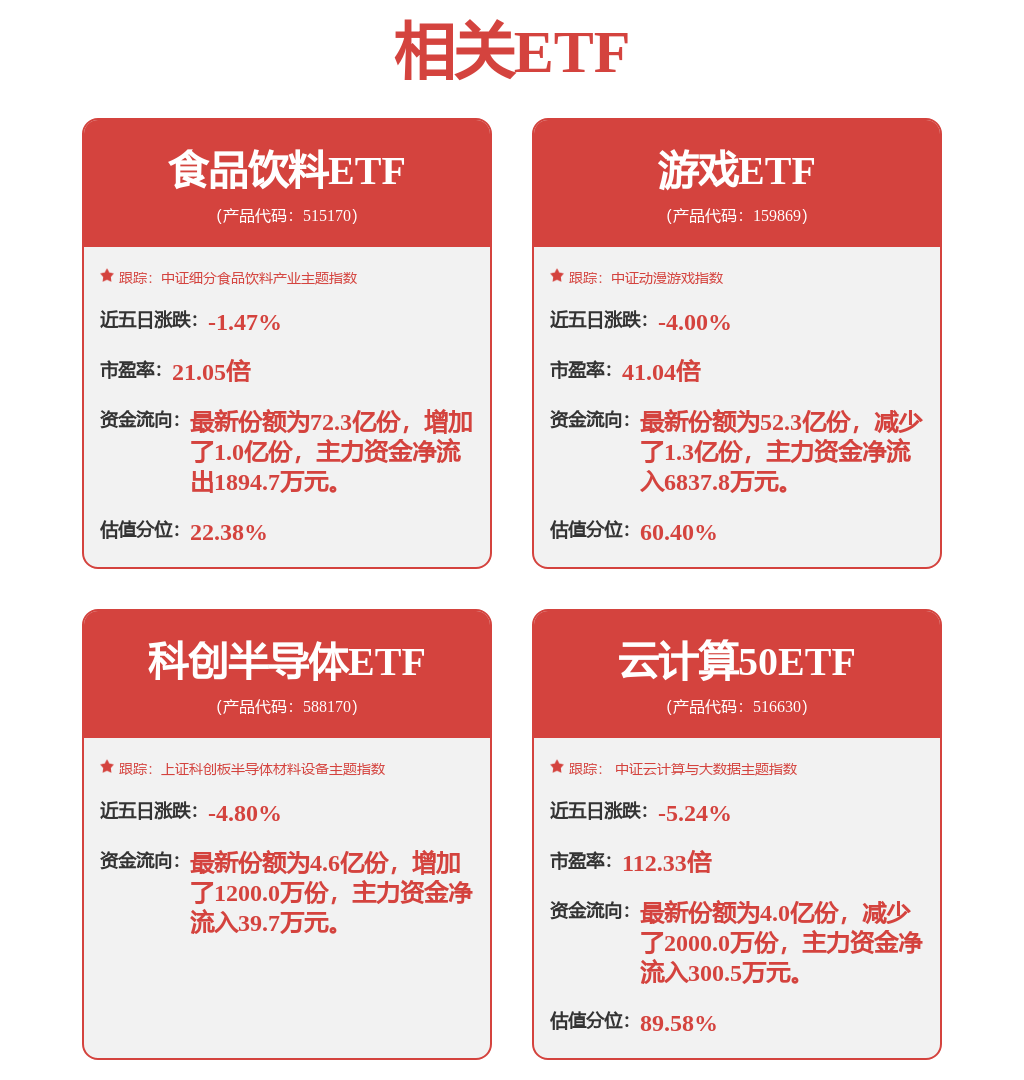
Core Viewpoint - The latest ETF margin balance in the two markets reached 110.197 billion yuan, reflecting a week-on-week increase of 4.86 billion yuan, indicating a positive trend in ETF financing and short selling activities [1] Group 1: ETF Margin Balance Overview - As of September 5, the total ETF margin balance was 110.197 billion yuan, up 4.86 billion yuan or 0.44% from the previous trading day [1] - The financing balance for ETFs was 103.025 billion yuan, increasing by 2.49 billion yuan or 0.24% [1] - The Shenzhen market's ETF margin balance was 34.492 billion yuan, up 6.29 billion yuan, while the Shanghai market's ETF margin balance was 75.704 billion yuan, down 1.43 billion yuan [1] Group 2: Notable ETFs by Financing Balance - The ETF with the highest financing balance was Huaan Gold ETF at 7.351 billion yuan, followed by E Fund Gold ETF at 6.184 billion yuan and Huaxia Hang Seng ETF at 4.164 billion yuan [2] - Significant increases in financing balance were observed in Bosera CSI A500 ETF, Tianhong CSI 500 ETF, and CSI 500 ETF Fund, with increases of 1772.73%, 985.22%, and 699.84% respectively [2] Group 3: Margin Trading and Short Selling Activities - The top three ETFs by net financing purchases were Huaan ChiNext 50 ETF, GF National Index New Energy Vehicle Battery ETF, and E Fund ChiNext ETF, with net purchases of 279 million yuan, 156 million yuan, and 110 million yuan respectively [3] - The highest increase in short selling balance was seen in the photovoltaic ETF, with a 94.28% increase in short selling volume [5] Group 4: Recent Performance of Specific ETFs - The Food and Beverage ETF (product code: 515170) saw a recent decline of 1.47% with a PE ratio of 21.05 times, while the Gaming ETF (product code: 159869) decreased by 4.00% with a PE ratio of 41.04 times [7] - The Cloud Computing 50 ETF (product code: 516630) experienced a decline of 5.24% with a high PE ratio of 112.33 times [8]

两市ETF两融余额较上一日减少1.09亿元
Zheng Quan Shi Bao Wang· 2025-06-09 01:51
Summary of Key Points Core Viewpoint - The latest balance of ETF margin trading in the two markets is 98.871 billion yuan, showing a slight decrease from the previous trading day, indicating a mixed sentiment in the market [1]. Group 1: ETF Margin Trading Data - As of June 6, the total ETF margin trading balance is 98.871 billion yuan, down by 1.09 million yuan or 0.11% from the previous day [1]. - The financing balance for ETFs is 93.314 billion yuan, which decreased by 1.87 million yuan or 0.20% [1]. - The Shenzhen market's ETF margin trading balance is 33.440 billion yuan, increasing by 27.2563 million yuan, while the financing balance is 32.707 billion yuan, up by 25.409 million yuan [1]. - The Shanghai market's ETF margin trading balance is 65.431 billion yuan, decreasing by 1.36 billion yuan, with a financing balance of 60.607 billion yuan, down by 2.13 billion yuan [1]. Group 2: Notable ETFs and Financing Changes - Among the ETFs, 105 have a financing balance exceeding 100 million yuan, with the highest being Huaan Gold ETF at 8.588 billion yuan [2]. - The ETFs with the largest increases in financing balance include招商沪深300ETF (19.37 million yuan, up 185.10%), 万家中证工业有色金属主题ETF (76.37 million yuan, up 104.74%), and 大数据ETF (485.12 million yuan, up 80.87%) [2][3]. - Conversely, the ETFs with the largest decreases in financing balance include 天弘中证500ETF (down 76.08%), 沪深300ETF基金 (down 65.24%), and 广发中证国新港股通央企红利ETF (down 47.75%) [2][3]. Group 3: Margin Trading and Short Selling Data - The latest short selling balance is led by 南方中证1000ETF, 南方中证500ETF, and 华夏中证1000ETF, with balances of 1.917 billion yuan, 1.834 billion yuan, and 402 million yuan respectively [5]. - The highest increase in short selling balance is seen in 南方中证500ETF (up 61.627 million yuan), 南方中证1000ETF (up 16.1287 million yuan), and 华泰柏瑞沪深300ETF (up 4.3753 million yuan) [6][7]. - The highest decrease in short selling balance is recorded for 国联安半导体ETF (down 2.2237 million yuan), 广发中证1000ETF (down 1.7536 million yuan), and 创新药 (down 1.2871 million yuan) [6][7].
5只中证小盘500指数ETF成交额环比增超100%
Zheng Quan Shi Bao Wang· 2025-05-23 12:31
Summary of Key Points Core Viewpoint - The trading volume of the CSI Small Cap 500 Index ETF increased significantly today, indicating heightened market activity and investor interest in this segment [1][2]. Trading Volume and Changes - The total trading volume of the CSI Small Cap 500 Index ETF reached 1.628 billion yuan, an increase of 418 million yuan from the previous trading day, representing a growth rate of 34.51% [1]. - Specific ETFs showed notable increases in trading volume: - Southern CSI 500 ETF (510500) had a trading volume of 1.088 billion yuan, up 291 million yuan, with a growth rate of 36.47% [2]. - Huaxia CSI 500 ETF (512500) saw a trading volume of 158 million yuan, an increase of 70.726 million yuan, with a growth rate of 81.05% [2]. - Jiashi CSI 500 ETF (159922) recorded a trading volume of 159 million yuan, up 21.474 million yuan, with a growth rate of 15.59% [2]. - Other ETFs with significant increases in trading volume included: - Industrial Bank CSI 500 ETF (510570) and Ping An CSI 500 ETF (510590), which saw increases of 3397.96% and 3095.99%, respectively [1]. Market Performance - As of market close, the CSI Small Cap 500 Index (000905) declined by 0.88%, while the average decline for related ETFs was 0.72% [2]. - The top-performing ETF was Ping An CSI 500 ETF (510590), which increased by 0.22% [2]. - The ETFs with the largest declines included Bank of China Securities CSI 500 ETF (515190) and E Fund CSI 500 ETF (510580), which fell by 1.02% and 1.01%, respectively [2].