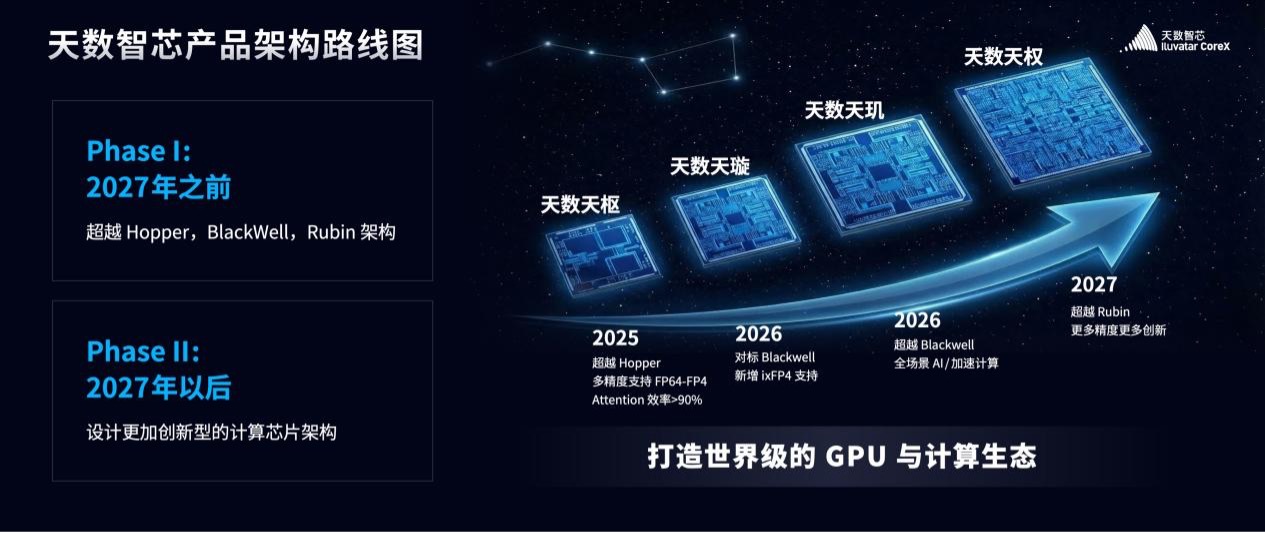
天数四代架构路线图

Search documents
港股上市后首个大动作:天数智芯发布四代芯片路线图,预期2027年超越英伟达Rubin
Xin Lang Cai Jing· 2026-01-26 11:45
Core Viewpoint - Tianzuo Zhixin aims to surpass NVIDIA with its fourth-generation architecture roadmap, expecting to achieve this by 2027, while also launching new products to enhance computing performance [1][4]. Company Overview - Tianzuo Zhixin, established in 2015, specializes in general-purpose GPU (GPGPU) products and AI computing solutions, officially listed on the Hong Kong Stock Exchange on January 8, 2023, with a 31.54% increase on its opening day [1][2]. Market Context - The Chinese AI chip market is experiencing rapid growth, with shipments expected to rise from 2.5 million units in 2024 to 11.4 million units by 2029, reflecting a CAGR of 32.1% [1]. - The GPGPU market in China is projected to reach a revenue of 154.6 billion RMB in 2024, with an anticipated growth to 715.3 billion RMB by 2029, indicating a CAGR of 29.5% from 2025 to 2029 [2]. Product Development - The fourth-generation architecture roadmap includes: - Tianzuo Tian Shu architecture surpassing Hopper by 2025 - Tianzuo Tian Xuan architecture matching Blackwell by 2026 - Tianzuo Tian Ji architecture exceeding Blackwell by 2026 - Tianzuo Tian Quan architecture surpassing Rubin by 2027, followed by a shift to breakthrough computing chip designs [2][4]. Technological Innovations - The Tianzuo Tian Shu architecture boasts over 90% effective utilization in AI calculations and a 60% efficiency improvement over the industry average, achieving approximately 20% better performance than the Hopper architecture in specific scenarios [4]. - The new product series "Tongyang" includes several modules with varying capabilities, such as the TY1000 and TY1200, designed for high-performance computing in various applications [5][7]. Application and Deployment - Tianzuo Zhixin's products have been deployed in over 300 clients and have completed more than 1,000 deployments across sectors like internet, finance, and robotics [8]. - The Tongyang series supports applications in embodied intelligence and data processing for retail, demonstrating strong compatibility with new AI models [8].