
天垓系列

Search documents
国产GPU,集体交卷
半导体行业观察· 2026-03-31 02:23
Core Viewpoint - The recent annual reports from local GPU companies, including TianShu ZhiXin, MoEr Thread, MuXi, and BiRan, indicate a significant increase in both revenue and market presence, reflecting the growing demand for AI computing power and GPU solutions in China [1]. Group 1: TianShu ZhiXin - TianShu ZhiXin, a leading provider of general-purpose GPU products and AI computing solutions in China, reported a revenue of RMB 1,033.6 million for 2025, a year-on-year increase of 91.6%, with a gross profit of RMB 558.0 million, up 110.5% [3][5]. - The company has focused on self-developed principles and a research and development rhythm of producing, designing, and pre-researching, which has strengthened its position in the domestic GPU and AI computing market [3][6]. - The general-purpose GPU products generated revenue of RMB 922.6 million, representing a 149.6% increase year-on-year, accounting for 89.3% of total revenue [6][7]. Group 2: MoEr Thread - MoEr Thread reported a revenue of RMB 150,552.51 million, a 243.37% increase year-on-year, with a net loss of RMB 102,431.13 million, narrowing by 36.70% compared to the previous year [11][13]. - The company launched the flagship MTTS5000 GPU, achieving market-leading performance and large-scale production, supporting trillion-parameter model training [11][13]. - MoEr Thread signed a significant product sales agreement worth RMB 660 million, indicating strong market demand and operational growth [14]. Group 3: MuXi - MuXi reported a net loss of RMB 78,944.63 million for the reporting period, with a focus on self-innovation and increasing R&D investment, which accounted for 62.49% of revenue [16][17]. - The company aims to achieve profitability by optimizing costs and stabilizing gross margins, with expectations for revenue growth to continue [17][18]. - MuXi is dedicated to developing high-performance GPU chips and computing platforms, targeting various industries including education, finance, and healthcare [18][19]. Group 4: BiRan Technology - BiRan Technology recorded a revenue of RMB 1,034.6 million, a 207.2% increase year-on-year, with a gross profit of RMB 557.0 million, up 210.8% [22][23]. - The company has made significant investments in R&D, amounting to RMB 1,476.1 million, reflecting its commitment to product innovation and market readiness [23][24]. - BiRan has successfully delivered large-scale computing clusters and established partnerships with leading AI model companies, enhancing its market presence and technological capabilities [25][26].


核心AI场景首超英伟达,一场国产算力的“破局叙事”|甲子光年
Xin Lang Cai Jing· 2026-01-29 12:12
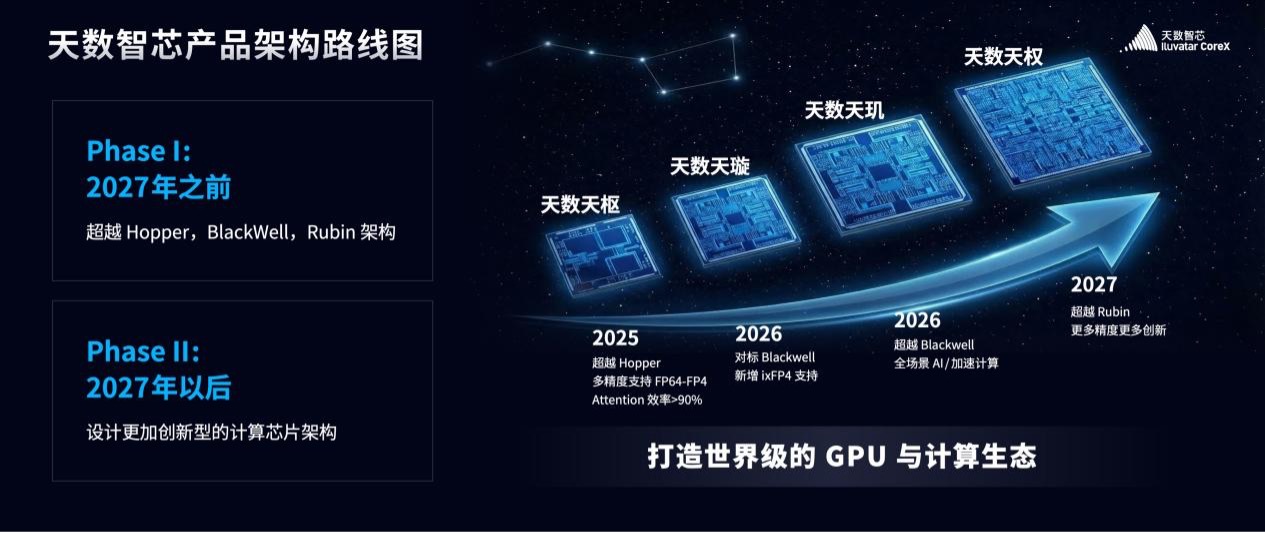
Core Insights - The article discusses the significant advancements made by the Chinese AI computing company, Tensu Zhixin, which has recently launched a roadmap to surpass international giants like Nvidia's Hopper, Blackwell, and Rubin by 2025 to 2027 [2][4][5] - Tensu Zhixin's new architecture, the Tensu Tian Shu, has already demonstrated a performance improvement of approximately 20% over Nvidia's Hopper in key model scenarios, marking a substantial leap for domestic solutions [4][5][32] - The company aims to redefine the narrative of domestic GPU industry by moving away from a "benchmarking" approach to a self-defined leadership in AI computing [4][33] Group 1: Evolution of Computing in China - The roadmap released by Tensu Zhixin outlines a clear timeline and quantifiable breakthroughs, marking a departure from the traditional "follow and catch up" strategy adopted by many domestic companies [5][35] - The architecture is set to achieve a practical utilization rate of over 90% in executing attention mechanisms by 2025, showcasing the company's commitment to high efficiency [5][35] - The upcoming architectures, Tian Xuan and Tian Ji, are expected to further enhance performance and address industry-specific computational needs by 2026 [7][37] Group 2: Technological Innovations - Three core technological innovations underpin the aggressive roadmap: TPC BroadCast, Instruction Co-Exec, and Dynamic Warp Scheduling, which collectively enhance computational efficiency and resource utilization [10][39] - The company has adopted a problem-oriented research and development approach, addressing common industry pain points such as FP8 accumulation precision and matrix transposition overhead [11][40] - This focus on practical solutions has resulted in significant performance improvements, such as a 50% reduction in memory usage for model inference [14][44] Group 3: Redefining Value in Computing - Tensu Zhixin proposes a new value coordinate system for the computing industry, emphasizing high efficiency, predictability, and sustainability as key competitive factors [12][41] - The company aims to optimize total cost of ownership (TCO) by enhancing effective computing output per unit of power, thus reducing unnecessary costs for enterprises [14][43] - The design philosophy ensures that hardware remains adaptable to future algorithmic advancements, extending its lifecycle and value [16][44] Group 4: Market Positioning and Product Launch - The launch of the "Tongyang" series of edge computing products fills a gap in the domestic high-end edge computing market and establishes a comprehensive "cloud + edge + end" computing layout [18][46] - The product matrix covers a range of performance metrics from 100T to 300T, with specific models tailored for various applications [19][47] - Tensu Zhixin's products have already been deployed in over 300 customer environments, demonstrating their effectiveness in real-world applications [22][49] Group 5: Long-term Strategy in the GPU Industry - The competition in the GPU industry is fundamentally about building an open and collaborative ecosystem, which is essential for long-term success [52][52] - Tensu Zhixin is focused on creating a closed-loop ecosystem for domestic AI computing through hardware foundation, software adaptation, and partner collaboration [53][52] - The company aims to ensure that its products maintain value over a decade, positioning itself as a long-term player in the industry rather than merely a competitor to Nvidia [53][55]


超越英伟达,天数智芯公布路线图
半导体行业观察· 2026-01-28 01:14
Core Viewpoint - The GPGPU industry is transitioning from merely providing computational power to ensuring that the power is efficient, reliable, and cost-effective for real-world applications, especially in the context of AI and large models [1][3]. Group 1: Industry Trends - The demand for performance in AI has surged, with model training parameters growing from billions to trillions, necessitating a shift from simply increasing GPU numbers to addressing system engineering challenges [3]. - Data centers are evolving from hardware-centric operations to focusing on efficiency, reliability, and sustainability, with key metrics including PUE, TCO, and stability becoming critical [3][4]. - The average utilization rates for inference and training scenarios are low, highlighting inefficiencies in the current growth model of computational power [3][4]. Group 2: Company Developments - Tian Shu Zhi Xin has unveiled its fourth-generation architecture roadmap, aiming to surpass NVIDIA's Hopper architecture by 20% in performance by 2025 [6]. - The company is focusing on high-efficiency, predictable, and sustainable computing power, which is essential for long-term value [4][6]. - The introduction of innovative technologies such as TPC Broadcast, Instruction Co-Exec, and Dynamic Warp Scheduling aims to enhance performance and efficiency in their new architectures [8]. Group 3: Product Launches - The company plans to release multiple chip models, including the "Tian Gai" and "Zhi Kai" series, over the next three years, with a goal of doubling processing capabilities with each generation [9]. - The newly launched "Tong Yang" series includes various models designed for edge computing, emphasizing high performance and low latency for diverse applications [10][12]. - The Tong Yang series products have demonstrated superior performance compared to NVIDIA's AGX Orin in practical tests, showcasing their competitive edge in the market [12]. Group 4: Market Positioning - Tian Shu Zhi Xin aims to establish itself as a leader in the domestic edge computing market, focusing on high-performance, cost-effective solutions that connect AI with the physical world [12][20]. - The company has achieved significant performance improvements across various sectors, including internet AI, finance, and healthcare, with notable metrics such as a 70% increase in report generation efficiency [18]. - The firm emphasizes a comprehensive ecosystem approach, integrating software and hardware solutions to enhance user experience and performance [21][23].
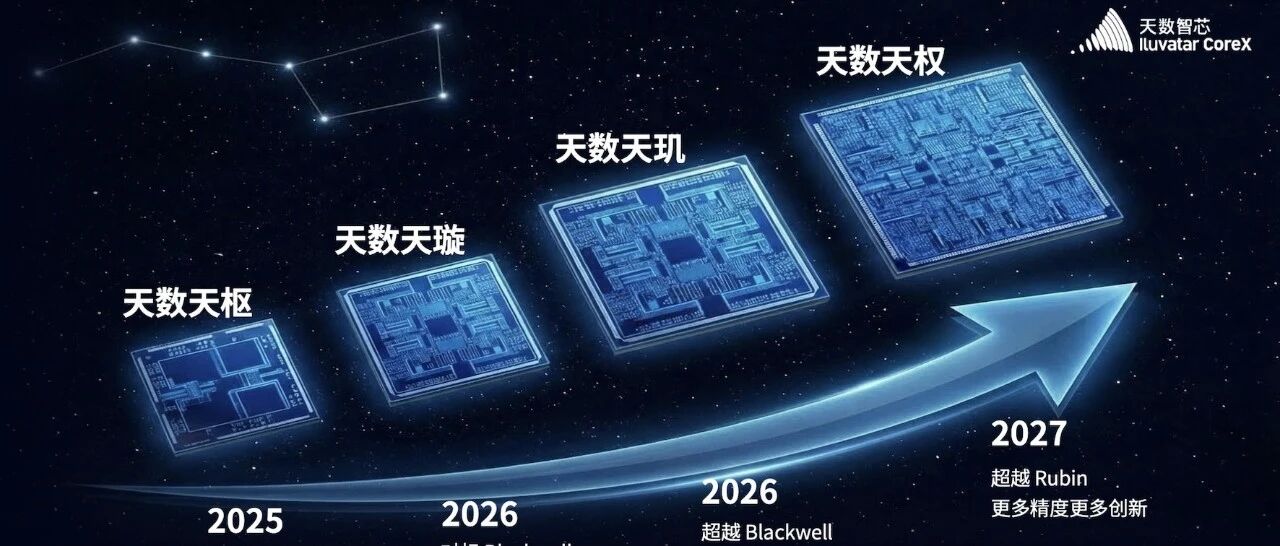
港股上市后首个大动作:天数智芯发布四代芯片路线图,预期2027年超越英伟达Rubin
Xin Lang Cai Jing· 2026-01-26 11:45
Core Viewpoint - Tianzuo Zhixin aims to surpass NVIDIA with its fourth-generation architecture roadmap, expecting to achieve this by 2027, while also launching new products to enhance computing performance [1][4]. Company Overview - Tianzuo Zhixin, established in 2015, specializes in general-purpose GPU (GPGPU) products and AI computing solutions, officially listed on the Hong Kong Stock Exchange on January 8, 2023, with a 31.54% increase on its opening day [1][2]. Market Context - The Chinese AI chip market is experiencing rapid growth, with shipments expected to rise from 2.5 million units in 2024 to 11.4 million units by 2029, reflecting a CAGR of 32.1% [1]. - The GPGPU market in China is projected to reach a revenue of 154.6 billion RMB in 2024, with an anticipated growth to 715.3 billion RMB by 2029, indicating a CAGR of 29.5% from 2025 to 2029 [2]. Product Development - The fourth-generation architecture roadmap includes: - Tianzuo Tian Shu architecture surpassing Hopper by 2025 - Tianzuo Tian Xuan architecture matching Blackwell by 2026 - Tianzuo Tian Ji architecture exceeding Blackwell by 2026 - Tianzuo Tian Quan architecture surpassing Rubin by 2027, followed by a shift to breakthrough computing chip designs [2][4]. Technological Innovations - The Tianzuo Tian Shu architecture boasts over 90% effective utilization in AI calculations and a 60% efficiency improvement over the industry average, achieving approximately 20% better performance than the Hopper architecture in specific scenarios [4]. - The new product series "Tongyang" includes several modules with varying capabilities, such as the TY1000 and TY1200, designed for high-performance computing in various applications [5][7]. Application and Deployment - Tianzuo Zhixin's products have been deployed in over 300 clients and have completed more than 1,000 deployments across sectors like internet, finance, and robotics [8]. - The Tongyang series supports applications in embodied intelligence and data processing for retail, demonstrating strong compatibility with new AI models [8].
训练芯片以价换量,又一国产GPU独角兽登陆港股
Guan Cha Zhe Wang· 2026-01-08 06:33
Core Viewpoint - TianShuZhiXin Semiconductor Co., Ltd. officially listed on the Hong Kong Stock Exchange, marking the gathering of the "Four Little Dragons" of domestic GPUs in the capital market [1][2] Group 1: Company Overview - TianShuZhiXin was founded in 2015 in Nanjing, initially focusing on computing acceleration hardware and software, later shifting to general-purpose GPU chips and AI computing solutions [2] - The company’s CEO, Gai Lujian, has 17 years of financial and investment experience and joined TianShuZhiXin in July 2020 [2] Group 2: Financial Performance - Revenue projections for TianShuZhiXin from 2022 to 2024 are 189 million, 289 million, and 540 million yuan, with a compound annual growth rate of 68.8% [2] - Net losses for the same period are projected at -553 million, -817 million, and -892 million yuan, with a net loss of -609 million yuan reported for the first half of 2025 [2][3] - R&D expenditures from 2022 to 2025 are approximately 456 million, 616 million, 773 million, and 451 million yuan for the first half of 2025, representing a significant percentage of total revenue [3] Group 3: Product Development - TianShuZhiXin has launched two product series: "TianZhai" for training and "ZhiKai" for AI inference optimization [3] - The average selling price of training GPUs decreased to 30,400 yuan, with a gross margin drop to 32%, both down over 20% year-on-year [3][4] - Upcoming products include TianZhai Gen 4 expected in Q2 2026 and TianZhai Gen 5 in Q1 2027, focusing on advanced training and high cost-performance deployment [5] Group 4: Market Position - The domestic general-purpose GPU market share increased from 8.3% in 2022 to 17.4% in 2024, with expectations to exceed 50% by 2029 [5]

计算机ETF(512720)盘中涨超1.3%,市场关注AI芯片架构创新与国产GPU进展
Mei Ri Jing Ji Xin Wen· 2026-01-08 06:26
Group 1 - The core viewpoint of the news highlights the rapid development of the AI computing power, large models, and GPU chip sectors within the computer and software development industry, with a focus on innovations in AI chip architecture and advancements in domestic GPUs [1] - Domestic GPU companies, such as Tianzu Zhixin and Birun Technology, are making progress with their products, which have begun small-scale shipments. The Tianpai series (training) is priced at approximately 30,000 to 40,000 yuan per unit, while the Zhi Kai series (inference) is around 10,000 yuan per unit [1] - Birun Technology is projected to have orders exceeding 1.2 billion yuan by 2025, with its next-generation BR20X chip expected to be commercialized in 2026, showcasing advanced GPGPU architecture, software platforms, and cluster technologies [1] Group 2 - In the large model sector, companies like Zhipu Huazhang (ToB) and MiniMax (ToC) are progressing through local deployment and overseas commercialization paths, having passed hearings at the Hong Kong Stock Exchange [1] - Zhipu Huazhang leverages Tsinghua University's research capabilities, with its GLM-4.7 model demonstrating strong performance in coding abilities, while MiniMax has achieved 73.1% of its revenue from overseas through efficient architecture and rapid iteration [1] - The industry is currently in a high R&D investment phase, with commercialization progress in sub-sectors such as AI servers and tax AI exceeding expectations [1]
天数智芯募资37亿港元,“国产GPU四小龙”齐聚资本市场
Guan Cha Zhe Wang· 2026-01-08 06:26
Core Viewpoint - TianShuZhiXin Semiconductor Co., Ltd. officially listed on the Hong Kong Stock Exchange, marking the gathering of the "Four Little Dragons" of domestic GPUs in the capital market [1][2] Group 1: Company Overview - TianShuZhiXin was founded in 2015 in Nanjing, initially focusing on computing acceleration hardware and software, later shifting to general-purpose GPU chips and AI computing solutions [2] - The company’s CEO, Gai Lujian, has 17 years of financial and investment experience and joined TianShuZhiXin in July 2020 [2] Group 2: Financial Performance - Revenue projections for TianShuZhiXin from 2022 to 2024 are 189 million, 289 million, and 540 million yuan, respectively, with a compound annual growth rate of 68.8% [2] - The company reported net losses of 553 million, 817 million, and 892 million yuan for the same period, with a projected net loss of 609 million yuan for the first half of 2025 [2][3] - R&D expenditures from 2022 to 2025 are approximately 456 million, 616 million, 773 million, and 451 million yuan for the first half of 2025, representing over 200% of total revenue in the initial years [3] Group 3: Product Development - TianShuZhiXin has launched two product lines: "TianVai" for training and "ZhiKai" for AI inference optimization [3] - The average selling price of training GPUs decreased to 30,400 yuan, with a gross margin drop to 32%, both down over 20% year-on-year [3][4] - Upcoming products include TianVai Gen 4 expected in Q2 2026 and TianVai Gen 5 in Q1 2027, focusing on advanced training and high cost-performance deployment [4] Group 4: Market Position - The company’s shipment volume increased from 7,800 units in 2022 to 16,800 units in 2024, with a market share of 0.7% in training chips and 0.2% in inference chips as of the first half of 2025 [5] - The domestic general-purpose GPU market share surged from 8.3% in 2022 to 17.4% in 2024, with expectations to exceed 50% by 2029 [5]
开盘暴涨31%!通用GPU大厂天数智芯上市,开启增长新周期
Sou Hu Cai Jing· 2026-01-08 03:11
Core Viewpoint - TianShu ZhiXin, a domestic general-purpose GPU manufacturer, officially listed on the Hong Kong Stock Exchange on January 8, 2025, raising approximately HKD 3.7 billion with an initial share price of HKD 144.6, which surged by 31.54% on the first trading day, reaching HKD 190.20 per share and a market capitalization exceeding HKD 47.55 billion [1][2]. Company Overview - TianShu ZhiXin is recognized as the first domestic general-purpose GPU company in China, achieving multiple industry milestones, including the first mass production of training and inference general-purpose GPU chips [8][12]. - The company has established a dual product line strategy, with "TianHua" targeting training and "ZhiKai" focusing on inference, aiming to connect the data center from training to deployment [12][15]. Financial Performance - Revenue for TianShu ZhiXin from 2022 to 2024 was approximately CNY 1.89 billion, CNY 2.89 billion, and CNY 5.39/5.40 billion, reflecting a compound annual growth rate of about 68.8% [17][19]. - The company reported a net loss of approximately CNY 5.54 billion, CNY 8.17 billion, CNY 8.92 billion, and CNY 6.09 billion in the first half of 2025, primarily due to high R&D expenditures [18][19]. Market Position and Competition - The general-purpose GPU market in China is characterized by an oligopolistic structure, with the top player holding a market share of approximately 91.9% [5][7]. - TianShu ZhiXin's market share is currently around 0.3%, indicating significant room for growth as the domestic GPU market is projected to grow at a compound annual growth rate of about 33% from 2025 to 2029 [5][6]. Investment and R&D Focus - Approximately 80% of the funds raised from the IPO will be allocated to R&D for general-purpose GPU chips and AI computing solutions, while 10% will be used for sales and marketing, and the remaining 10% for working capital [5][20]. - The company aims to enhance its software ecosystem and developer compatibility, particularly with CUDA, to lower migration costs for clients [21][22]. Future Outlook - The competitive landscape for general-purpose GPUs is expected to intensify, with domestic companies increasingly evaluated against specialized AI chips, emphasizing the need for efficient delivery and software toolchains [23][24]. - The ongoing "listing wave" in the domestic GPU sector is anticipated to create a more transparent competitive environment, where companies will be assessed based on their technological completeness and commercial viability [24][25].

【IPO追踪】国产GPU四小龙齐聚资本市场!天数智芯港股首秀市值超400亿
Sou Hu Cai Jing· 2026-01-08 02:54
Core Viewpoint - The strong market performance of domestic GPU companies, particularly Tensu Zhixin, reflects significant investor confidence in China's GPU industry and its potential for growth in AI computing solutions [2][4]. Group 1: Company Overview - Tensu Zhixin, known as one of the "Four Little Dragons" of domestic GPUs, officially listed on the Hong Kong Stock Exchange on January 8, with an opening price surge of over 30% [2]. - The company specializes in general-purpose GPU chips and AI computing solutions, offering products such as GPU chips, accelerator cards, and customized AI solutions for servers and clusters [4]. - Tensu Zhixin's products, including the Tianwei and Zhikai series, are designed for high performance, easy migration, and broad applicability, fully compatible with major AI ecosystems and deep learning frameworks [4]. Group 2: Financial Performance - The company has experienced rapid revenue growth, with revenues of 189 million RMB in 2022, projected to reach 540 million RMB in 2024 [5]. - Despite revenue growth, the company remains in a loss-making position, with losses of 524 million RMB in 2022 and projected losses of 892 million RMB in 2024 [5]. Group 3: IPO Details - Tensu Zhixin's IPO involved a global offering of 25.43 million shares, with a public offering in Hong Kong of 2.54 million shares at a price of 144.60 HKD per share, raising approximately 3.509 billion HKD after expenses [2]. - The IPO saw overwhelming demand, with a subscription rate of 414.24 times for the Hong Kong public offering and 10.68 times for the international offering, indicating strong investor interest [2][3].
超300倍认购,天数智芯暗盘大涨49%的背后逻辑
Zhi Tong Cai Jing· 2026-01-07 15:02
Core Viewpoint - The company TianShu ZhiXin (09903) has garnered significant investor interest, achieving a subscription multiple of nearly 300 times and raising over 1 billion HKD during its IPO, indicating strong market confidence in its growth potential and product offerings [1][5]. Group 1: Company Overview - TianShu ZhiXin is a leader in the domestic general-purpose GPU sector, with a projected revenue compound annual growth rate (CAGR) of 68.8% from 2022 to 2024, and a continued high growth rate of 64.2% in the first half of 2025 [2]. - The company has a robust research and development (R&D) capability, with R&D expenditures from 2022 to the first half of 2025 amounting to 457 million, 616 million, 772.8 million, and 334 million CNY respectively, representing significant percentages of revenue [2][3]. Group 2: Product Development - The company has developed two main product lines: the TianYai series, which is the first domestically produced general-purpose GPU for AI model training, and the ZhiKai series, designed for inference applications, enhancing integer computation and optimizing data pathways [2][3]. - The product delivery has shown a doubling trend, with shipments increasing from 7,800 units in 2022 to 16,800 units in 2024, and 15,700 units in the first half of 2025 [3]. Group 3: Market Position and Growth Potential - The company is positioned in a high-growth industry, with the AI chip market in China expected to grow at a CAGR of 80.3% from 2022 to 2024, and the domestic GPU market share projected to rise from 8.3% in 2022 to 17.4% in 2024, potentially exceeding 50% by 2029 [3]. - The company is expected to solidify its market leadership, with a projected revenue exceeding 10 billion CNY in the next five years, and a price-to-sales (PS) ratio significantly lower than industry leaders like NVIDIA [4]. Group 4: Investment Appeal - The company’s IPO raised a net amount of 3.479 billion HKD, with 80% allocated for R&D and product commercialization, indicating a strong commitment to innovation and market expansion [4]. - The current market valuation is considered low, presenting a potential opportunity for long-term investors, especially in light of the ongoing AI development wave and domestic substitution trends [5].